
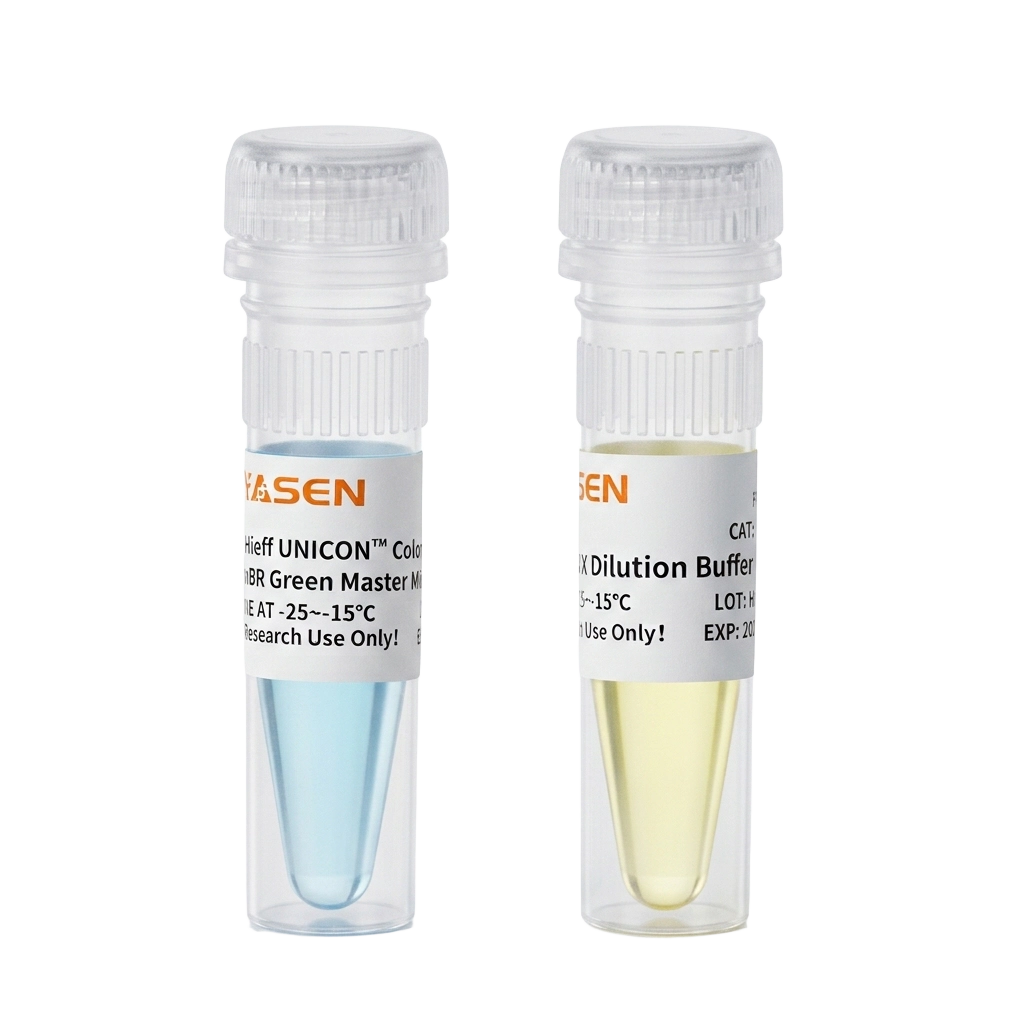


Le mélange maître Hieff UNICON™ ColorGPS qPCR (Low Rox) est une pré-solution pour l'amplification PCR quantitative en temps réel 2×, caractérisée par une intensité de fluorescence élevée, une sensibilité et une spécificité élevées et un rendement d'amplification élevé. Le composant principal, l'ADN polymérase Hieff UNICON™ Taq, est démarré à chaud par la méthode des anticorps, ce qui peut inhiber efficacement l'amplification non spécifique causée par le recuit de l'amorce pendant la préparation de l'échantillon. Dans le même temps, la formule ajoute des facteurs pour améliorer l'efficacité de l'amplification de la réaction PCR et des facilitateurs pour égaliser l'amplification des gènes avec différentes teneurs en GC (30 à 70 %), de sorte que la PCR quantitative puisse obtenir une bonne relation linéaire dans une large gamme de régions quantitatives. Le produit utilise la réaction de changement de couleur mixte de différents colorants pour surveiller l'opération de pipetage, ce qui réduit efficacement l'apparition d'erreurs de pipetage.
Caractéristiques
Suivi du pipetage : Réduisez le risque d'erreurs d'oubli/d'ajout
Excellente amplification : bonne linéarité sur une large plage linéaire
Haute précision : peut distinguer avec précision les modèles avec une différence de concentration de 2 fois
Bonne répétabilité : faible variabilité interpuits dans les puits répliqués, ce qui se traduit par une meilleure répétabilité
Stable et fiable : le système de réaction peut être stocké à température ambiante pendant 24 heures et le produit reste inchangé après 20 cycles de congélation-décongélation
Applications
Analyse des différences d'expression génétique
Analyse quantitative absolue
Caractéristiques
| Concentration | 2 ×(Mélange qPCR) |
| Méthode de détection | Méthode de teinture |
| Méthode PCR | PCR quantitative |
| Polymérase | ADN polymérase Taq |
| Type d'échantillon | ADN |
| Matériel d'application | Applied Biosystems 7500, 7500 Fast, ViiA7 ; Stratagene MX4000, MX3005P, MX3000P et autres instruments de PCR quantitative par fluorescence qui nécessitent l'ajout de faibles concentrations de colorant de référence ROX |
| Type de produit | Prémélange pour PCR quantitative par fluorescence en temps réel |
| Postuler à (candidature) | Expression génétique |
Composants
| Composants N° | Nom | 11189ES03 | 11189ES08 | 11189ES60 |
| 11189-UN | Hieff UNICON™ ColorGPS qPCR Mélange principal (Loum (Rox) | 1 ml | 5×1 mL | 100×1 mL |
| 11189-B | Tampon de dilution 10× | 1 ml | 1 ml | 20×1 mL |
Expédition et stockage
Ce produit doit être conservé entre -25 et -15 ℃ pendant 1 an.
Chiffres
 Figure 1. Des résultats fiables peuvent être obtenus dans la plage dynamique.
En utilisant 2 µL de modèles plasmidiques avec un gradient de 10^1-10^7, les gènes apparentés ont été amplifiés. Hieff UNICON™ Le mélange maître ColorGPS peut détecter efficacement une plage de quantités de modèles de 7 ordres de grandeur, obtenant une bonne linéarité dans une large plage linéaire.
 Chiffre2.Peut distinguer avec précision les différences de concentration de modèle de 2 fois.
En utilisant 2 µL de plasmide dilué dans un gradient de 2 fois comme matrice, les gènes apparentés ont été amplifiés. Hieff UNICON™ Le mélange maître ColorGPS peut résoudre avec précision les différences de concentration du modèle.
 Chiffre3Une faible variabilité inter-puits est observée, montrant une meilleure répétabilité.
En utilisant des dizaines de copies du plasmide comme modèle, l'amplification a été réalisée avec différents réactifs quantitatifs fluorescents selon les procédures spécifiées dans leurs manuels d'instructions respectifs. Les valeurs d'écart-type indiquent que, par rapport aux autres réactifs de transcription inverse, le nouveau produit présente des différences plus faibles entre les puits répliqués et une meilleure répétabilité.
 Chiffre4. Plus flexible, adapté aux procédures standards ou rapides.
Dans la procédure standard, le temps de dénaturation et le temps d'extension sont respectivement fixés à 10 secondes et 30 secondes, tandis que dans la procédure rapide, le temps de dénaturation et le temps d'extension sont respectivement fixés à 3 secondes et 10 secondes, pour détecter les valeurs Ct correspondant à 10 gènes cibles. Les résultats montrent que les valeurs Ct obtenues avec le nouveau produit dans les procédures standard et rapide présentent une forte corrélation, et que le nouveau produit peut obtenir de bons résultats en utilisant la procédure rapide.
 Chiffre5Une fois le système réactionnel préparé, il peut rester stable à température ambiante pendant 24 heures.
En utilisant différents gènes de souris, de cellules humaines 293 et d'Arabidopsis thaliana comme cibles, après avoir préparé le système de réaction, celui-ci a été placé dans l'obscurité à différentes températures pendant 24 heures avant la détection. Par rapport au traitement immédiat, la différence de détection pour différents gènes ne dépasse pas 0,5 Ct, ce qui indique que des résultats stables peuvent également être obtenus avec des opérations de longue durée.
Documents:
Manuels
Storage
FAQ
1. The instrument has not been calibrated for a long time or it is aging. Usually, the instrument needs to be calibrated once a year. It is necessary to have an instrument engineer perform the calibration or replace the aging components.
2. A 10 μL reaction system was used. The normal system is a 20 μL system. Using half of the normal system would result in an excessively low total concentration of Rox, increasing the probability of BadRox occurrence. It is recommended to conduct the experiment using the 20 μL system.
2.Is the length of the product too long? If the length of the product is set to 500bp or more, this situation may occur. It is recommended that during primer design, the length of the product be controlled within the range of 80-300bp.
3. Are the primers inappropriate? If the primers are not designed correctly, they need to be redesigned. If the primers are correctly designed but seem to be degraded, PAGE electrophoresis can be used to check the integrity of the primers.
4. Template degradation: Prepare the template anew and repeat the experiment.
2. What if CT is ≥ 30 but the repeatability is very poor? At this point, due to the low abundance of the effective template, the randomness of collisions between the template and the primers increases, thereby causing a greater difference between the replicons. It is recommended to try adding 2-3 replicons, and then eliminate the data with large differences for data analysis.
Citations
Documents
Applications
Vous pouvez aussi aimer
Enquête
FAQ
Le produit est destiné à des fins de recherche uniquement et n'est pas destiné à un usage thérapeutique ou diagnostique chez l'homme ou l'animal. Les produits et le contenu sont protégés par des brevets, des marques déposées et des droits d'auteur appartenant à Yeasen Biotechnology. Les symboles de marque indiquent le pays d'origine, pas nécessairement l'enregistrement dans toutes les régions.
Certaines applications peuvent nécessiter des droits de propriété intellectuelle tiers supplémentaires.
Yeasen se consacre à la science éthique, estimant que nos recherches doivent répondre à des questions cruciales tout en garantissant la sécurité et les normes éthiques.