
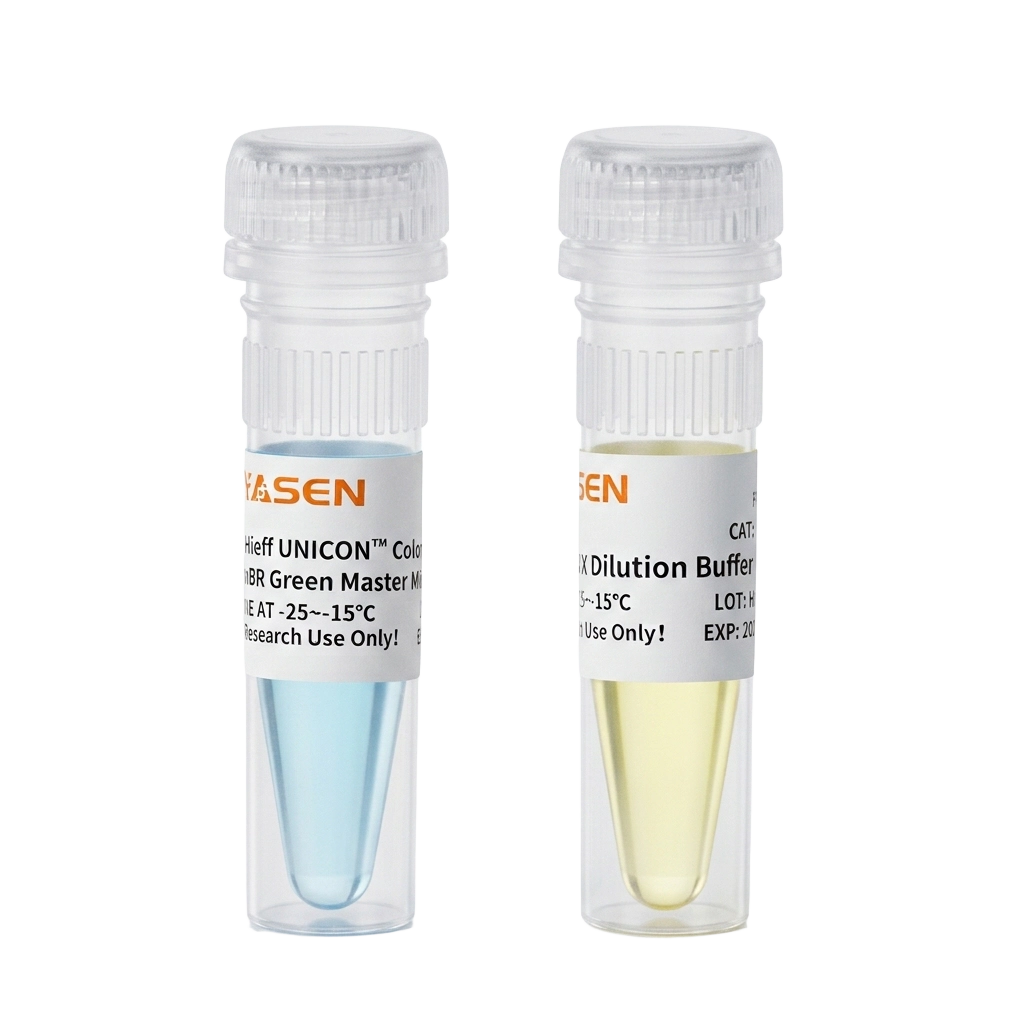


Hieff UNICON™ ColorGPS qPCR Master Mix (Low Rox) é uma pré-solução para amplificação quantitativa de PCR em tempo real 2×, apresentando alta intensidade de fluorescência, alta sensibilidade e especificidade e alto rendimento de amplificação. O componente principal, Hieff UNICON™ Taq DNA Polymerase, é iniciado a quente pelo método de anticorpo, que pode efetivamente inibir a amplificação não específica causada pelo recozimento do primer durante a preparação da amostra. Ao mesmo tempo, a fórmula adiciona fatores para aumentar a eficiência de amplificação da reação de PCR e facilitadores para equalizar a amplificação de genes com diferentes conteúdos de GC (30~70%), para que a PCR quantitativa possa obter uma boa relação linear em uma ampla gama de regiões quantitativas. O produto utiliza a reação de mudança de cor mista de diferentes corantes para monitorar a operação de pipetagem, o que reduz efetivamente a ocorrência de erros de pipetagem.
Características
Rastreamento de pipetagem: reduza o risco de erros de adição/perda
Excelente amplificação: boa linearidade em uma ampla faixa linear
Alta precisão: pode distinguir com precisão modelos com uma diferença de concentração de 2 vezes
Boa repetibilidade: pequena variabilidade entre poços em poços replicados, resultando em melhor repetibilidade
Estável e confiável: o sistema de reação pode ser armazenado em temperatura ambiente por 24 horas e o produto permanece inalterado após 20 ciclos de congelamento e descongelamento
Aplicações
Análise de Diferenças de Expressão Gênica
Análise quantitativa absoluta
Especificações
| Concentração | 2 ×(mistura qPCR) |
| Método de detecção | Método de tingimento |
| Método PCR | qPCR |
| Polimerase | Taq DNA Polimerase |
| Tipo de amostra | ADN |
| Equipamento de aplicação | Applied Biosystems 7500, 7500 Fast, ViiA7; Stratagene MX4000, MX3005P, MX3000P e outros instrumentos de PCR quantitativos de fluorescência que requerem a adição de baixas concentrações de corante de referência ROX |
| Tipo de produto | Pré-mistura para PCR quantitativa de fluorescência em tempo real |
| Aplicar para (aplicação) | Expressão genética |
Componentes
| Componentes No. | Nome | 11189ES03 | 11189ES08 | 11189ES60 |
| 11189-UM | Hieff UNICON™ ColorGPS qPCR Mixagem Master (euoc Roxo) | 1 mL | 5×1 mL | 100×1 mL |
| 11189-B | Tampão de diluição 10× | 1 mL | 1 mL | 20×1 mL |
Envio e armazenamento
Este produto deve ser armazenado a -25~-15℃ por 1 ano.
Figuras
 Figura 1. Resultados confiáveis podem ser obtidos dentro da faixa dinâmica.
Usando 2 µL de moldes de plasmídeo com um gradiente de 10^1-10^7, os genes relacionados foram amplificados. Hieff UNICON™ O master mix do ColorGPS pode detectar efetivamente uma faixa de quantidade de modelo de 7 ordens de magnitude, alcançando boa linearidade dentro de uma ampla faixa linear.
 Figura2. Pode distinguir com precisão diferenças de concentração de modelo de 2 vezes.
Usando 2 µL de plasmídeo diluído em um gradiente de 2 vezes como molde, os genes relacionados foram amplificados. Hieff UNICON™ O master mix do ColorGPS pode resolver com precisão as diferenças de concentração do modelo.
 Figura3. Pequena variabilidade entre poços é observada, mostrando melhor repetibilidade.
Usando dezenas de cópias do plasmídeo como molde, a amplificação foi realizada com diferentes reagentes quantitativos fluorescentes de acordo com os procedimentos especificados em seus respectivos manuais de instruções. Os valores de DP indicam que, comparado a outros reagentes de transcrição reversa, o novo produto tem diferenças menores entre poços replicados e melhor repetibilidade.
 Figura4. Mais flexível, adequado para procedimentos padrão ou rápidos.
No procedimento padrão, o tempo de desnaturação e o tempo de extensão são definidos para 10 segundos e 30 segundos, respectivamente, enquanto no procedimento rápido, o tempo de desnaturação e o tempo de extensão são definidos para 3 segundos e 10 segundos, respectivamente, para detectar os valores de Ct correspondentes a 10 genes alvo. Os resultados mostram que os valores de Ct obtidos com o novo produto em procedimentos padrão e rápido têm uma forte correlação, e o novo produto pode atingir bons resultados usando o procedimento rápido.
 Figura5. Após o sistema de reação ser preparado, ele pode permanecer estável em temperatura ambiente por 24 horas.
Usando diferentes genes de camundongo, células 293 humanas e Arabidopsis thaliana como alvos, após preparar o sistema de reação, ele foi colocado no escuro em diferentes temperaturas por 24 horas antes da detecção. Comparado ao processamento imediato, a diferença de detecção para diferentes genes não excede 0,5 Ct, indicando que resultados estáveis também podem ser obtidos com operações de longa duração.
Documentos:
Manuais
Storage
FAQ
1. The instrument has not been calibrated for a long time or it is aging. Usually, the instrument needs to be calibrated once a year. It is necessary to have an instrument engineer perform the calibration or replace the aging components.
2. A 10 μL reaction system was used. The normal system is a 20 μL system. Using half of the normal system would result in an excessively low total concentration of Rox, increasing the probability of BadRox occurrence. It is recommended to conduct the experiment using the 20 μL system.
2.Is the length of the product too long? If the length of the product is set to 500bp or more, this situation may occur. It is recommended that during primer design, the length of the product be controlled within the range of 80-300bp.
3. Are the primers inappropriate? If the primers are not designed correctly, they need to be redesigned. If the primers are correctly designed but seem to be degraded, PAGE electrophoresis can be used to check the integrity of the primers.
4. Template degradation: Prepare the template anew and repeat the experiment.
2. What if CT is ≥ 30 but the repeatability is very poor? At this point, due to the low abundance of the effective template, the randomness of collisions between the template and the primers increases, thereby causing a greater difference between the replicons. It is recommended to try adding 2-3 replicons, and then eliminate the data with large differences for data analysis.
Citations
Documents
Applications
Você também pode gostar
Investigação
Perguntas frequentes
O produto é apenas para fins de pesquisa e não se destina ao uso terapêutico ou diagnóstico em humanos ou animais. Os produtos e o conteúdo são protegidos por patentes, marcas registradas e direitos autorais de propriedade da
Certos aplicativos podem exigir direitos adicionais de propriedade intelectual de terceiros.