
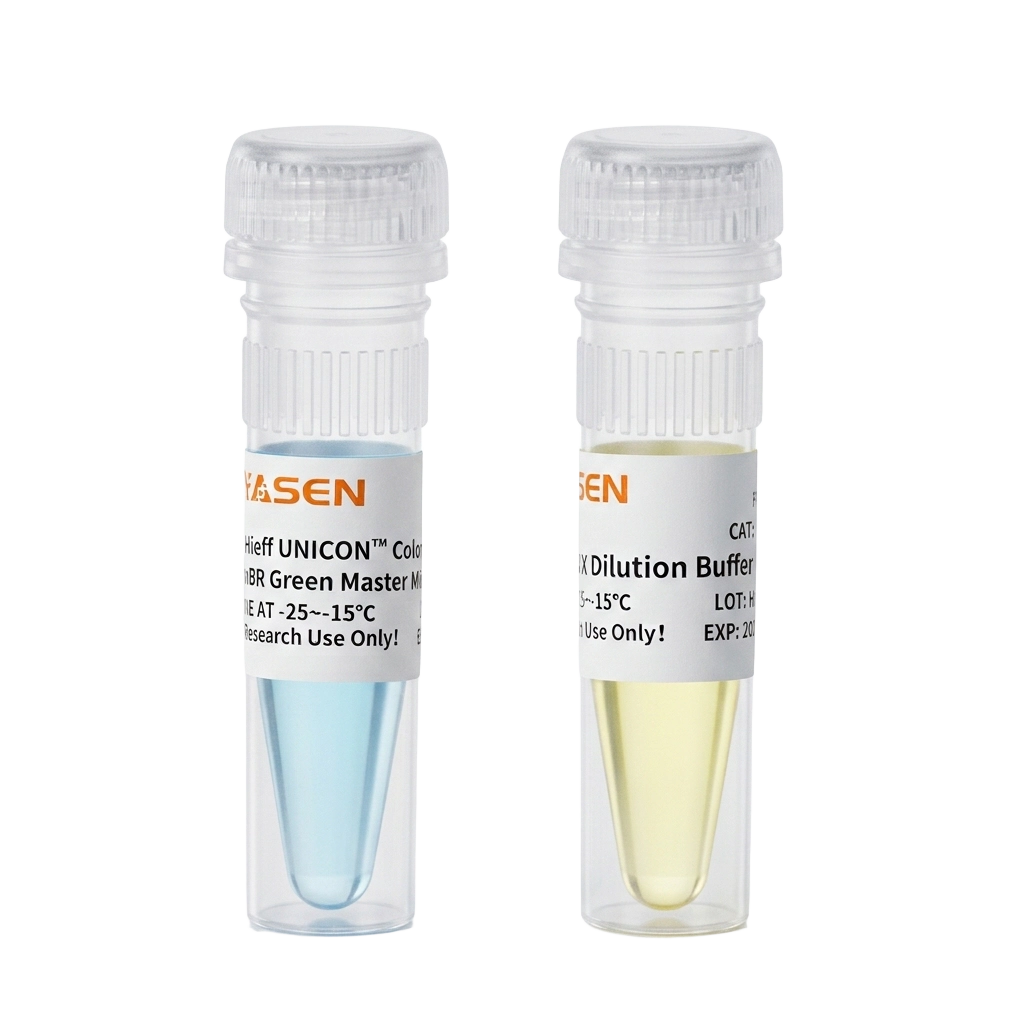


Hieff UNICON™ ColorGPS qPCR Master Mix (No Rox) er en præ-opløsning til 2x realtids kvantitativ PCR-amplifikation, med høj fluorescensintensitet, høj sensitivitet og specificitet og højt amplifikationsudbytte. Kernekomponenten, Hieff UNICON™ Taq DNA-polymerase, er varmstartet ved antistofmetode, som effektivt kan hæmme uspecifik amplifikation forårsaget af primer-annealing under prøveforberedelse. Samtidig tilføjer formlen faktorer til at forbedre amplifikationseffektiviteten af PCR-reaktionen og facilitatorer for at udligne amplifikationen af gener med forskellige GC-indhold (30~70%), så den kvantitative PCR kan opnå et godt lineært forhold i en bred vifte af kvantitative regioner. Produktet anvender den blandede farveændringsreaktion af forskellige farvestoffer til at overvåge pipetteringsprocessen, hvilket effektivt reducerer forekomsten af pipeteringsfejl.
Funktioner
Pipetteringssporing: Reducer risikoen for mistede/tilføjelsesfejl
Fremragende forstærkning: God linearitet over et bredt lineært område
Høj præcision: Kan præcist skelne skabeloner med en 2-fold koncentrationsforskel
God repeterbarhed: Lille variabilitet mellem brønde i replikatbrønde, hvilket resulterer i bedre repeterbarhed
Stabilt og pålideligt: Reaktionssystemet kan opbevares ved stuetemperatur i 24 timer, og produktet forbliver upåvirket efter 20 fryse-tø-cyklusser
Ansøgninger
Analyse af genekspressionsforskel
Absolut kvantitativ analyse
Specifikationer
| Koncentration | 2 ×(qPCR-mix) |
| Detektionsmetode | Farvemetode |
| PCR metode | qPCR |
| Polymerase | Taq DNA polymerase |
| Type prøve | DNA |
| Applikationsudstyr | Bio-Rad CFX96, CFX384, iCycler iQ, iQ5, MyiQ; MiniOpticon, Opticon, Opticon 2, Chromo4; Cepheid SmartCycler; Eppendorf Mastercycler ep realplex, realplex 2 s; Illumina Eco qPCR; Qiagen/Corbett Rotor-Gene Q, Rotor-Gene 3000, Rotor-Gene 6000;Roche Applied Science LightCycler 480; Thermo Scientific PikoReal Cycler og andre fluorescens kvantitative PCR-instrumenter, der ikke kræver tilsætning af ROX Reference Dye |
| Produkttype | Premix til real-time fluorescens kvantitativ PCR |
| Ansøg til (ansøgning) | Genekspression |
Komponenter
| Komponenter nr. | Navn | 11188ES03 | 11188ES08 | 11188ES60 |
| 11188-A | Hieff UNICON™ ColorGPS qPCR Master Mix (Ingen Rox) | 1 ml | 5×1 ml | 100×1 ml |
| 11188-B | 10×fortyndingsbuffer | 1 ml | 1 ml | 20×1 ml |
Forsendelse og opbevaring
Dette produkt bør opbevares ved -25~-15 ℃ i 1 år.
Figurer
 Figur 1. Pålidelige resultater kan opnås inden for det dynamiske område.
Ved at bruge 2 µL plasmidskabeloner med en gradient på 10^1-10^7 blev de relaterede gener amplificeret. Hieff UNICON™ ColorGPS master mix kan effektivt detektere et skabelonmængdeområde på 7 størrelsesordener, hvilket opnår god linearitet inden for et bredt lineært område.
 Figur2. Kan nøjagtigt skelne skabelonkoncentrationsforskelle på 2 gange.
Ved at anvende 2 µL plasmid fortyndet i en 2-fold gradient som skabelonen blev de relaterede gener amplificeret. Hieff UNICON™ ColorGPS-mastermix kan nøjagtigt løse skabelonkoncentrationsforskelle.
 Figur3. Lille variabilitet mellem brønde observeres, hvilket viser bedre repeterbarhed.
Ved at bruge snesevis af kopier af plasmid som skabelon blev amplifikation udført med forskellige fluorescerende kvantitative reagenser i overensstemmelse med procedurerne specificeret i deres respektive instruktionsmanualer. SD-værdierne indikerer, at sammenlignet med andre revers transkriptionsreagenser har det nye produkt mindre forskelle mellem replikatbrønde og bedre repeterbarhed.
 Figur4. Mere fleksibel, velegnet til standard eller hurtige procedurer.
I standardproceduren er denatureringstiden og forlængelsestiden sat til henholdsvis 10 sekunder og 30 sekunder, mens denatureringstiden og forlængelsestiden i den hurtige procedure er sat til henholdsvis 3 sekunder og 10 sekunder for at detektere Ct-værdierne svarende til 10 målgener.Resultaterne viser, at Ct-værdierne opnået med det nye produkt i både standard- og hurtige procedurer har en stærk sammenhæng, og det nye produkt kan opnå gode resultater ved brug af den hurtige procedure.
 Figur5. Efter at reaktionssystemet er fremstillet, kan det forblive stabilt ved stuetemperatur i 24 timer.
Ved at bruge forskellige gener fra mus, humane 293-celler og Arabidopsis thaliana som mål, blev det efter klargøring af reaktionssystemet anbragt i mørke ved forskellige temperaturer i 24 timer før påvisning. Sammenlignet med øjeblikkelig behandling overstiger detektionsforskellen for forskellige gener ikke 0,5 Ct, hvilket indikerer, at stabile resultater også kan opnås med langvarige operationer.
Documents:
Manualer
Storage
FAQ

1. The instrument has not been calibrated for a long time or it is aging. Usually, the instrument needs to be calibrated once a year. It is necessary to have an instrument engineer perform the calibration or replace the aging components.
2. A 10 μL reaction system was used. The normal system is a 20 μL system. Using half of the normal system would result in an excessively low total concentration of Rox, increasing the probability of BadRox occurrence. It is recommended to conduct the experiment using the 20 μL system.
2. Is the length of the product too long? If the length of the product is set to 500bp or more, this situation may occur. It is recommended that during primer design, the length of the product be controlled within the range of 80-300bp.
3. Are the primers inappropriate? If the primers are not designed correctly, they need to be redesigned. If the primers are correctly designed but seem to be degraded, PAGE electrophoresis can be used to check the integrity of the primers.
4.Template degradation: Prepare the template anew and repeat the experiment.
2. What if CT is ≥ 30 but the repeatability is very poor? At this point, due to the low abundance of the effective template, the randomness of collisions between the template and the primers increases, thereby causing a greater difference between the replicons. It is recommended to try adding 2-3 replicons, and then eliminate the data with large differences for data analysis.
Citations
Documents
| Brochure |
|---|
| Comprehensive_And_Professional_qPCR_Solution.pdf |
Applications
Du kan også lide
Forespørgsel
FAQ
Produktet er kun til forskningsformål og er ikke beregnet til terapeutisk eller diagnostisk brug hos mennesker eller dyr. Produkter og indhold er beskyttet af patenter, varemærker og ophavsrettigheder ejet af Yeasen Biotechnology. Varemærkesymboler angiver oprindelseslandet, ikke nødvendigvis registrering i alle regioner.
Visse applikationer kan kræve yderligere tredjeparts intellektuelle ejendomsrettigheder.
Yeasen er dedikeret til etisk videnskab og mener, at vores forskning bør adressere kritiske spørgsmål og samtidig sikre sikkerhed og etiske standarder.