
Clodronate Liposomes Kit (With Control Liposomes) _ 40339ES

YeasenSku: 40337ES05

Size: 2 x 2 mL
Preço:
Preço de venda$188.00
Estoque:
Em estoque

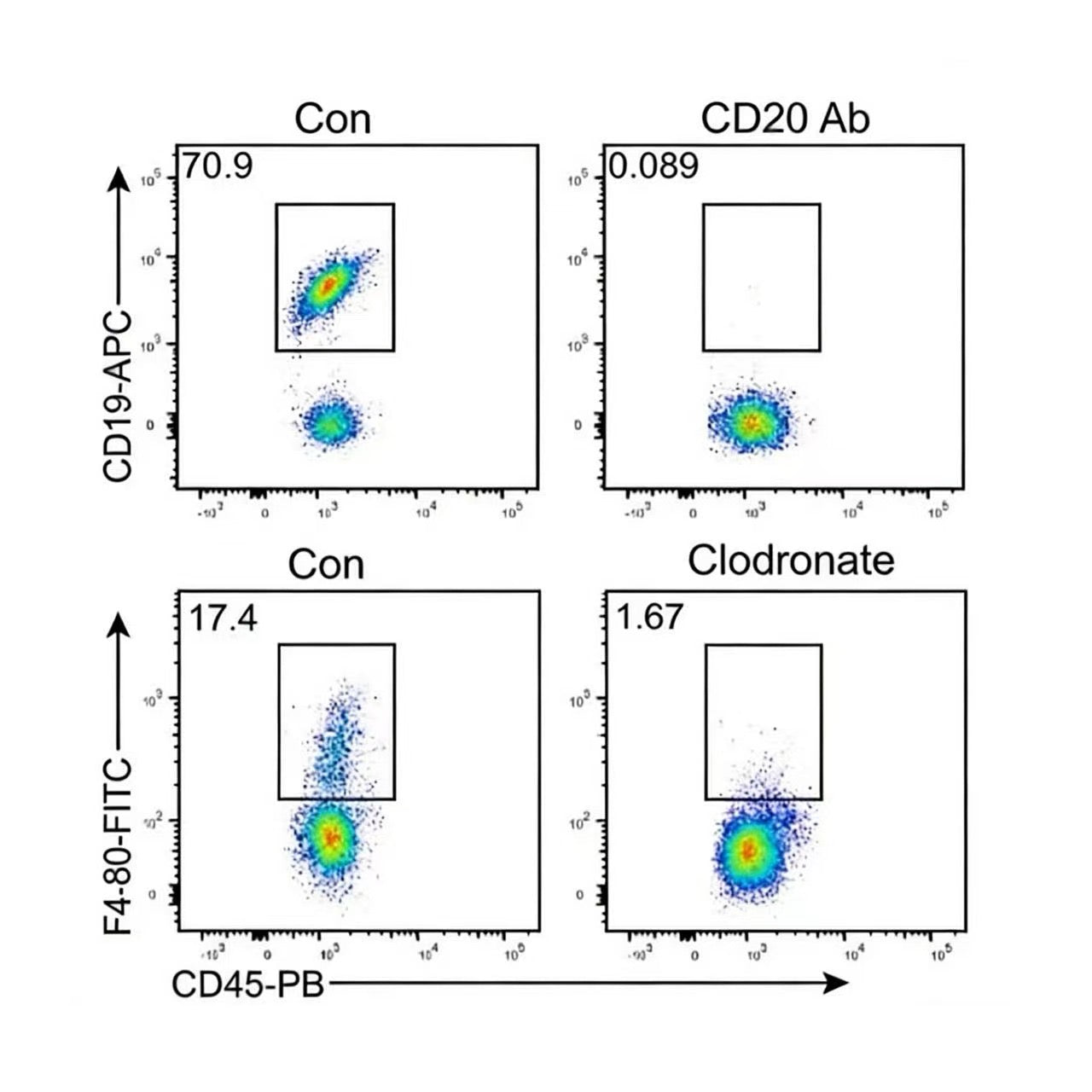
Clodronate Liposomes are currently the most mature, convenient, and cost-effective tool for macrophage depletion. They can effectively eliminate macrophages in various tissues and sites within animals, including the liver, spleen, lungs, and blood, and are currently the most widely used method for macrophage depletion.

After Clodronate Liposomes are injected into a living organism, they are phagocytosed by macrophages. Under the action of lysosomal phosphatases within the macrophages, the clodronate dissolved in the liposomes is gradually released and accumulates intracellularly. When a certain concentration is reached, the macrophages will suffer irreversible damage, inducing apoptosis.

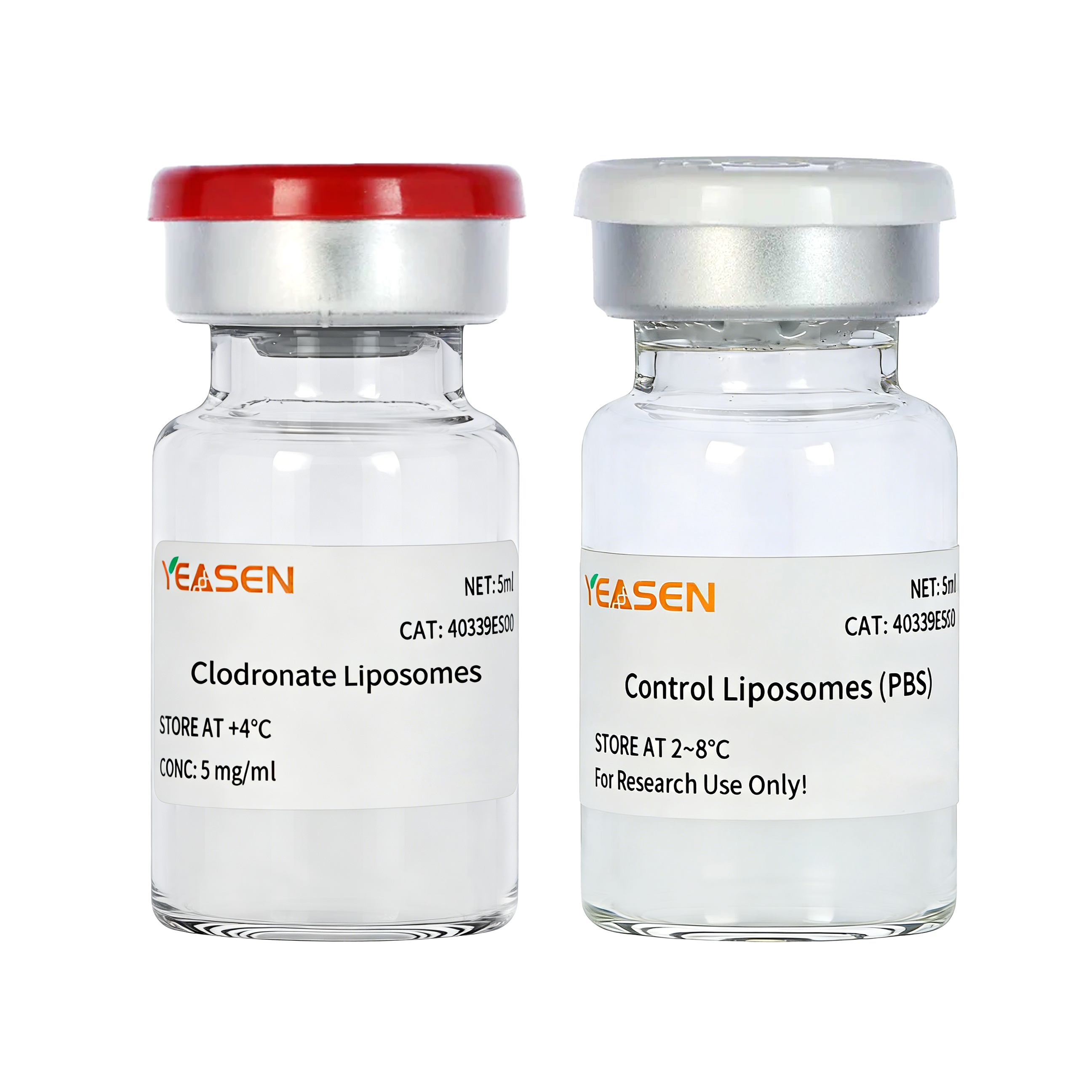
This product is a combination pack, containing an In Vivo Macrophage Depletion Reagent and an Empty Liposome Control.

Features

Efficient Macrophage Depletion: Efficient macrophage depletion through clodronate-encapsulated liposomes.

High specificity: Selectively targeting phagocytic macrophages and monocytes.

Validated in Multiple Models: Validated in multiple animal models for immunology, inflammation, and tumor microenvironment studies.

Ready-to-Use Format: Ready-to-use formulation for convenient and reproducible experiments.

Components

Components No.

Name

Cat.No.

Storage

40339ES05

40339ES08

40339ES10

40337ES

Clodronate Liposomes

2 mL

5 mL

10 mL

2~8℃

40338ES

Control Liposomes(PBS)

2 mL

5 mL

10 mL

2~8℃

Figure

1. Case Study: Efficient Depletion of Perivascular Macrophages in the Mouse Brain

Figure 1. Efficient depletion of perivascular macrophages in the brain following intracisternal administration of Yeasen Macrophage Depletion Reagent (Cat. No. 40337ES).

Figure 1. Efficient depletion of perivascular macrophages in the brain following intracisternal administration of Yeasen Macrophage Depletion Reagent (Cat. No. 40339ES).

Mice received a single injection of 4 µL clodronate liposomes (CLO) into the cisterna magna; control animals received an equal volume of PBS. Brain tissues were collected 7 days post-injection and sectioned for immunofluorescence staining using anti-CD163 antibody (Cell Signaling Technology, #24595) to label perivascular macrophages. Quantification of macrophages per unit vessel length showed a significant reduction in the CLO group (33.10 ± X.XX) compared to PBS controls (96.59 ± X.XX), corresponding to a ~66% decrease (or approximately 34% of control levels). Note: If CD26 was intended instead of CD163, please confirm—CD163 is a canonical marker for perivascular macrophages in the CNS; CD26 is atypical for this population.

Related Blogs:

Clodronate Liposomes for Macrophage Depletion: Precise Clodronate Content, Controlled Particle Size —Ensuring Safe and Reliable in vivo Experiments

Storage

This product should be stored at 2~8°C. Valid for 6 months. Do not freeze!

FAQ

Without perfusion, flow cytometry data is meaningless—macrophages won’t be properly isolated, making it impossible to assess differences. For flow cytometry, we recommend staining for F4/80 and CD11b. For immunohistochemistry, tail vein injection is recommended; harvest liver at 24 h post-injection. Note: Perfusion is not required for IHC.
Multilamellar.
5 mg/mL.
150 nm – 3 μm.
If not used immediately, store at 4°C. Do not freeze! Use as supplied—do not dilute. Liposomes may sediment over time; gently mix before use. Do not inject directly from 4°C—allow the suspension to equilibrate to room temperature before administration.
Yes, they can be used in vitro, but this application is better suited for in vivo experiments. In vitro, clodronate released from dead cells or leaked from liposomes accumulates in the culture medium. Although free clodronate cannot cross intact cell membranes, prolonged exposure in culture may eventually lead to cellular uptake and non-specific toxicity. In contrast, in vivo, free clodronate is rapidly cleared by the kidneys and has a short half-life.
Two likely causes:
Injection of a non-homogeneous suspension—liposomes sediment over time. Always gently mix before and during use, especially when injecting multiple animals sequentially.
IInjection of cold liposomes directly from 4°C—always warm to room temperature before administration.
This depends on the specific experimental design. We recommend that users develop their own protocol based on published literature relevant to their research goals. We can provide reference papers upon request.
This may be due to opportunistic infections. Macrophage depletion compromises innate immunity, increasing susceptibility to bacteria, viruses, or fungi—especially if aseptic techniques were not strictly followed.
In rats, mature macrophages are ED1+/ED2+, while some immature or less phagocytic precursors are ED1+/ED2–. Clodronate liposomes efficiently deplete ED2+ (mature, phagocytic) macrophages, but ED1+ precursors lacking phagocytic activity are not cleared. Thus, residual ED1+ cells reflect this precursor population.
All batches are rigorously tested for clodronate concentration and contaminants before release. However, liposomes are sensitive to temperature extremes. Store and transport at 4–8°C. Do not freeze or expose to >30°C. Use within 3 months of receipt to ensure optimal performance.
For IV injection, volume should not exceed 0.1 mL per 10 g body weight. Larger volumes may be used for intraperitoneal (IP) injection. For subcutaneous (SC) injection, volume depends on the capacity of the injection site.
No. Do not use if frozen.
Yes, they are anionic.
Yes, it refers to the clodronate concentration.

Citations

Documents

Applications

Você também pode gostar

Investigação

Perguntas frequentes

O produto é apenas para fins de pesquisa e não se destina ao uso terapêutico ou diagnóstico em humanos ou animais. Os produtos e o conteúdo são protegidos por patentes, marcas registradas e direitos autorais de propriedade da Yeasen Biotechnology. Os símbolos de marca registrada indicam o país de origem, não necessariamente o registro em todas as regiões.

Certos aplicativos podem exigir direitos adicionais de propriedade intelectual de terceiros.

Yeasen se dedica à ciência ética, acreditando que nossa pesquisa deve abordar questões críticas, garantindo ao mesmo tempo padrões éticos e de segurança.