
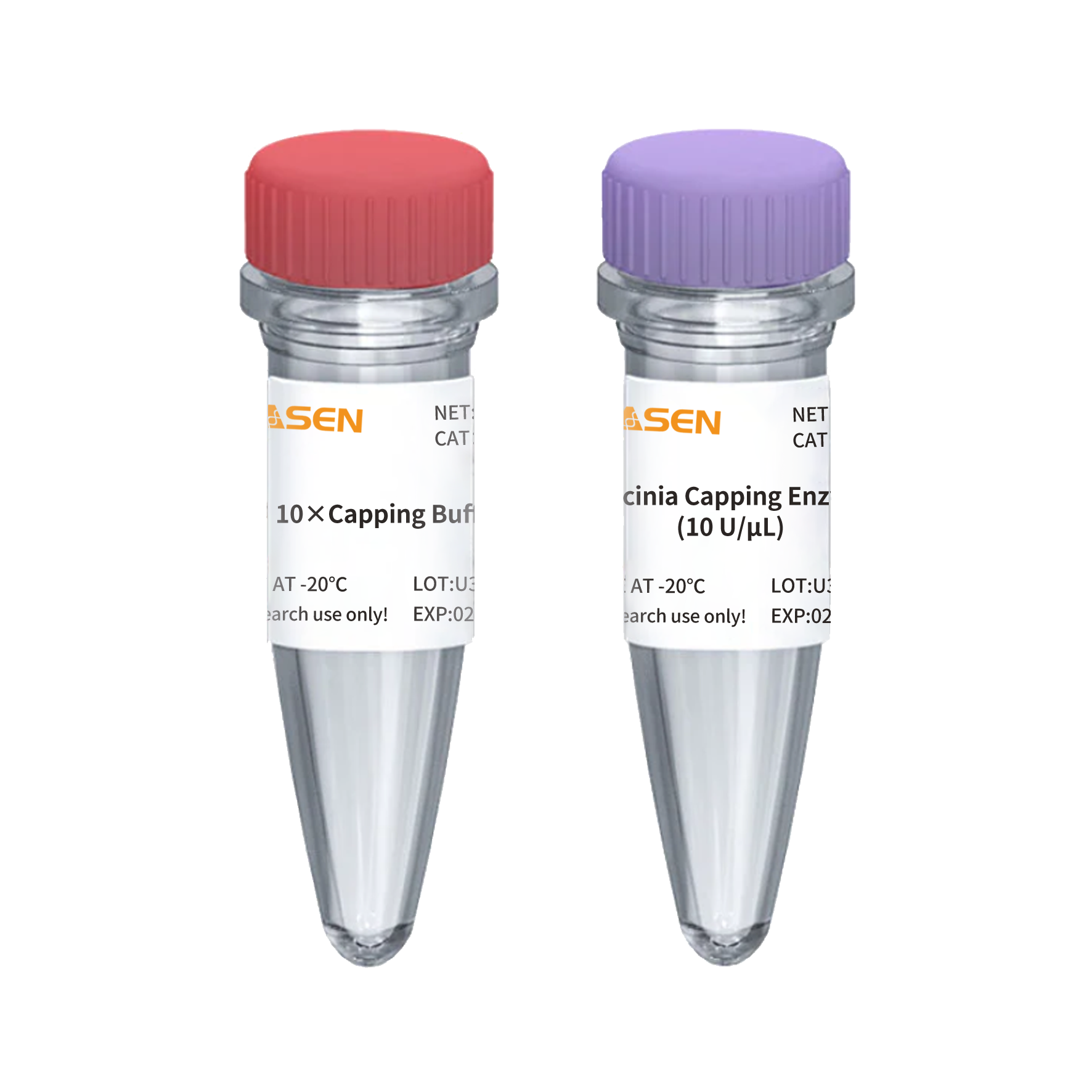
enzima de limpeza de mRNA Vaccinia (10 U/μl) _ 10615es

YeasenSku: 10615ES84

Tamanho: 2 Ku
Preço:
Preço de venda$365.00
Estoque:
Em estoque

O mRNA dos eucariotos forma uma estrutura especial na extremidade 5' após a transcrição, que é a estrutura cap. A estrutura cap desempenha um papel importante na estabilidade, transporte e tradução do mRNA. A enzima capping do vírus vaccinia é uma enzima eficaz que pode catalisar a formação da estrutura cap. É composta por duas subunidades D1 e D12. Também tem atividade de RNA trifosfatase, atividade de guanilato aciltransferase e atividade de guanina metiltransferase que podem conectar a estrutura cap 7-metilguanina (m7Gppp) à extremidade 5' do RNA (m7Gppp5'N). A enzima capping do vírus vaccinia pode capear o RNA na direção correta dentro de uma hora quando presente em uma concentração adequada de tampão de capping, trifosfato de guanosina (GTP), S-adenosilmetionina (SAM), etc.

Recurso

  • Isolado de uma fonte recombinante
  • Testado para ausência de endonucleases, exonucleases, RNases

Aplicativo

  • Capping de mRNA antes de ensaios de tradução/tradução in vitro
  • Marcação da extremidade 5´ do mRNA

Especificação

Fonte Recombinante E. coli com gene da enzima de encapsulamento do vírus vaccinia
Temperatura Ótima 37℃
Buffer de armazenamento 20 mM Tris-HCl pH 8,0, 100 mM NaCl, 1 mM DTT, 0,1 mM EDTA, 0,1% Triton X-100, 50% glicerina
Definição de unidade 1 unidade: A quantidade de enzima necessária para incorporar 10 pmol de GTP (α- 32P) em uma transcrição com 80 nucleotídeos (80 nt) a 37℃ em 1 hora.

Componentes

Componentes No. Nome 10615ES84 (2.000 U) 10615ES92 (10.000 U) 10615ES96 (100.000 U) 10615ES99 (5 UM)
10615 Enzima de encapsulamento de vacínia mRNA (10 U/μL) 200 μL 1 mL 10 mL 500 mL


Envio e armazenamento

Os produtos de grau GMP da enzima de encapsulamento de vacínia mRNA são enviados com gelo seco e podem ser armazenados a -15℃ ~ -25℃ por um ano.

Figuras
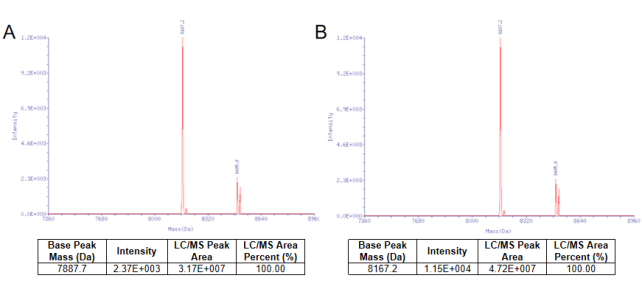
Figura 1. A eficiência de encapsulamento quase atingiu 100% pelo sistema de encapsulamento de vaccinia da YEASEN. A espectrometria de massa de ácido nucleico antes da reação de encapsulamento foi mostrada na Figura 1A. A espectrometria de massa de ácido nucleico após a reação de encapsulamento foi mostrada na Figura 1B.

Documentos:


Storage

mRNA Vaccinia Capping Enzyme GMP-grade products are shipped with dry ice and can be stored at -15℃ ~ -25℃ for one year.

FAQ

The purpose of preheating is to unfold the secondary structure of RNA and bring it to a single-stranded state. If this step is not carried out, it will affect the efficiency of capping. This part is indeed a current technical challenge in production. Some companies now directly predict the secondary structure of RNA when determining the template sequence. The capping enzyme only recognizes the first few nucleotides of mRNA. If it is determined that this structure will not result in the secondary structure of RNA, then heating can be omitted.
In industry, the most commonly used method for enzymatic cap addition is to treat IVT products with vaccinia virus cap-adding enzyme, which can modify them into Cap 0 mRNA. The Cap 0 structure can be further modified into Cap 1 (m7GpppmN) under the action of 2'O-methyltransferase. With enzymatic cap addition, the cap addition efficiency can reach over 95%. The co-transcription cap addition method is simple to operate, but because GTP competes with the cap dimer, the cap addition rate of this method is a little lower; both methods have their own advantages and disadvantages.
By increasing the amount of VCE, for example, adding 10 ul of 100 U of enzyme activity to a 100 ul system, the main purpose is to enhance the methyltransferase activity of VCE. It can also be achieved by increasing SAM (0.5 mmol) to enhance the guanine transfer activity and increase the cap formation rate. For instance, our new single-strand cap enzyme has a significantly improved cap formation rate. This is because its guanine transfer activity is better than that of traditional VCE. For traditional VCE, the small subunit D12 is prone to precipitation and polymer formation, which makes purification difficult and leads to loss, thus resulting in higher costs and inability to control batches.
Currently, the industry has not specifically targeted this aspect. In the industry, the main focus is on the efficiency of the cap application. The current best cap application rate is above 80%. Of course, the higher the better. There is still no absolute standard for this. For the synthesized mRNA, purification methods can be employed, such as the one-step membrane encapsulation method by Kang*. This significantly reduces the purification process. The traditional method uses Oligo d(T) columns for purification, with good results achieving a recovery rate of 70-80%; poor results have a recovery rate of 40-50%. An additional step of a hydrophobic column can also be added after the Oligo d(T) column.
The co-transcription requirement stipulates that the starting position of the template must begin with AGG*. The two-step method does not have any specific requirements for the position. However, our current products have the highest yield for the AGGG starting position, mainly due to the preference of the T7 enzyme.

Citations

Documents

Applications

Você também pode gostar

Investigação

Perguntas frequentes

O produto é apenas para fins de pesquisa e não se destina ao uso terapêutico ou diagnóstico em humanos ou animais. Os produtos e o conteúdo são protegidos por patentes, marcas registradas e direitos autorais de propriedade da Yeasen Biotechnology. Os símbolos de marca registrada indicam o país de origem, não necessariamente o registro em todas as regiões.

Certos aplicativos podem exigir direitos adicionais de propriedade intelectual de terceiros.

Yeasen se dedica à ciência ética, acreditando que nossa pesquisa deve abordar questões críticas, garantindo ao mesmo tempo padrões éticos e de segurança.