
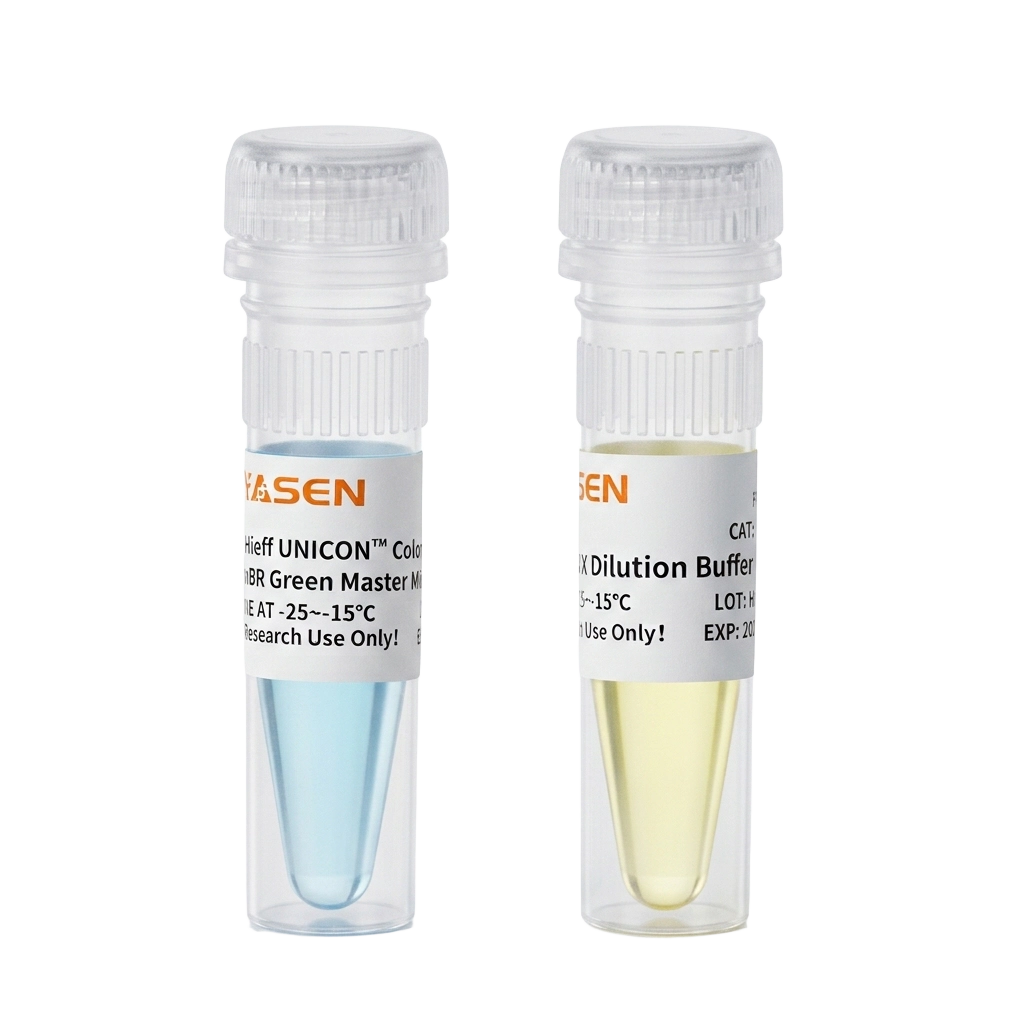


Hieff UNICON™ ColorGPS qPCR Master Mix (Low Rox) è una pre-soluzione per l'amplificazione PCR quantitativa in tempo reale 2×, caratterizzata da elevata intensità di fluorescenza, elevata sensibilità e specificità e alta resa di amplificazione. Il componente principale, Hieff UNICON™ Taq DNA Polymerase, è avviato a caldo con metodo anticorpale, che può inibire efficacemente l'amplificazione non specifica causata dal primer annealing durante la preparazione del campione. Allo stesso tempo, la formula aggiunge fattori per migliorare l'efficienza di amplificazione della reazione PCR e facilitatori per equalizzare l'amplificazione dei geni con diversi contenuti di GC (30~70%), in modo che la PCR quantitativa possa ottenere una buona relazione lineare in un'ampia gamma di regioni quantitative. Il prodotto utilizza la reazione di cambio colore misto di diversi coloranti per monitorare l'operazione di pipettaggio, il che riduce efficacemente il verificarsi di errori di pipettaggio.
Caratteristiche
Monitoraggio del pipettaggio: riduzione del rischio di errori di aggiunta/mancati
Amplificazione eccellente: buona linearità su un'ampia gamma lineare
Alta precisione: può distinguere accuratamente i modelli con una differenza di concentrazione doppia
Buona ripetibilità: piccola variabilità tra pozzetti nei pozzetti replicati, con conseguente migliore ripetibilità
Stabile e affidabile: il sistema di reazione può essere conservato a temperatura ambiente per 24 ore e il prodotto rimane inalterato dopo 20 cicli di congelamento-scongelamento
Applicazioni
Analisi della differenza di espressione genica
Analisi quantitativa assoluta
Specifiche
| Concentrazione | 2 ×(miscela qPCR) |
| Metodo di rilevamento | Metodo di tintura |
| Metodo PCR | PCR-q |
| Polimerasi | Taq DNA polimerasi |
| Tipo di campione | Il DNA |
| Attrezzatura per l'applicazione | Applied Biosystems 7500, 7500 Fast, ViiA7; Stratagene MX4000, MX3005P, MX3000P e altri strumenti PCR quantitativi a fluorescenza che richiedono l'aggiunta di basse concentrazioni di colorante di riferimento ROX |
| Tipo di prodotto | Premiscela per PCR quantitativa a fluorescenza in tempo reale |
| Applicare a (applicazione) | Espressione genica |
Componenti
| Componenti n. | Nome | 11189ES03 | 11189ES08 | 11189ES60 |
| 11189-UN | Hieff UNICON™ qPCR GPS a colori Mixaggio principale (Lloio (Rox) | 1 ml | 5×1 ml | 100×1 mL |
| 11189-B | Tampone di diluizione 10× | 1 ml | 1 ml | 20×1 ml |
Spedizione e stoccaggio
Questo prodotto deve essere conservato a una temperatura compresa tra -25 e -15 °C per 1 anno.
Cifre
 Figura 1. È possibile ottenere risultati affidabili all'interno dell'intervallo dinamico.
Utilizzando 2 µL di template plasmidici con un gradiente di 10^1-10^7, i geni correlati sono stati amplificati. Hieff UNICON™ Il master mix ColorGPS è in grado di rilevare efficacemente un intervallo di quantità di template di 7 ordini di grandezza, ottenendo una buona linearità entro un ampio intervallo lineare.
 Figura2Può distinguere con precisione differenze di concentrazione del modello pari a 2 volte.
Utilizzando 2 µL di plasmide diluito in un gradiente 2 volte come stampo, i geni correlati sono stati amplificati. Hieff UNICON™ Il master mix ColorGPS è in grado di risolvere con precisione le differenze di concentrazione del modello.
 Figura3Si osserva una piccola variabilità tra pozzetti, che mostra una migliore ripetibilità.
Utilizzando decine di copie di plasmide come stampo, l'amplificazione è stata eseguita con diversi reagenti quantitativi fluorescenti secondo le procedure specificate nei rispettivi manuali di istruzioni. I valori SD indicano che, rispetto ad altri reagenti di trascrizione inversa, il nuovo prodotto presenta differenze minori tra i pozzetti replicati e una migliore ripetibilità.
 Figura4. Più flessibile, adatto a procedure standard o rapide.
Nella procedura standard, il tempo di denaturazione e il tempo di estensione sono impostati rispettivamente a 10 secondi e 30 secondi, mentre nella procedura rapida, il tempo di denaturazione e il tempo di estensione sono impostati rispettivamente a 3 secondi e 10 secondi, per rilevare i valori Ct corrispondenti a 10 geni target. I risultati mostrano che i valori Ct ottenuti con il nuovo prodotto sia nelle procedure standard che rapide hanno una forte correlazione e il nuovo prodotto può ottenere buoni risultati utilizzando la procedura rapida.
 Figura5Dopo che il sistema di reazione è stato preparato, può rimanere stabile a temperatura ambiente per 24 ore.
Utilizzando diversi geni di topo, cellule umane 293 e Arabidopsis thaliana come target, dopo aver preparato il sistema di reazione, è stato posto al buio a diverse temperature per 24 ore prima del rilevamento. Rispetto all'elaborazione immediata, la differenza di rilevamento per diversi geni non supera 0,5 Ct, il che indica che è possibile ottenere risultati stabili anche con operazioni di lunga durata.
Documenti:
Manuali
Storage
FAQ
1. The instrument has not been calibrated for a long time or it is aging. Usually, the instrument needs to be calibrated once a year. It is necessary to have an instrument engineer perform the calibration or replace the aging components.
2. A 10 μL reaction system was used. The normal system is a 20 μL system. Using half of the normal system would result in an excessively low total concentration of Rox, increasing the probability of BadRox occurrence. It is recommended to conduct the experiment using the 20 μL system.
2.Is the length of the product too long? If the length of the product is set to 500bp or more, this situation may occur. It is recommended that during primer design, the length of the product be controlled within the range of 80-300bp.
3. Are the primers inappropriate? If the primers are not designed correctly, they need to be redesigned. If the primers are correctly designed but seem to be degraded, PAGE electrophoresis can be used to check the integrity of the primers.
4. Template degradation: Prepare the template anew and repeat the experiment.
2. What if CT is ≥ 30 but the repeatability is very poor? At this point, due to the low abundance of the effective template, the randomness of collisions between the template and the primers increases, thereby causing a greater difference between the replicons. It is recommended to try adding 2-3 replicons, and then eliminate the data with large differences for data analysis.
Citations
Documents
Applications
Potrebbe piacerti anche
Indagine
FAQ
Il prodotto è solo per scopi di ricerca e non è destinato all'uso terapeutico o diagnostico su esseri umani o animali. Prodotti e contenuti sono protetti da brevetti, marchi e copyright di proprietà di Yeasen Biotechnology. I simboli dei marchi indicano il paese di origine, non necessariamente la registrazione in tutte le regioni.
Alcune applicazioni potrebbero richiedere ulteriori diritti di proprietà intellettuale di terze parti.
Yeasen è un sostenitore della scienza etica, convinto che la nostra ricerca debba affrontare questioni critiche garantendo al contempo sicurezza e standard etici.