
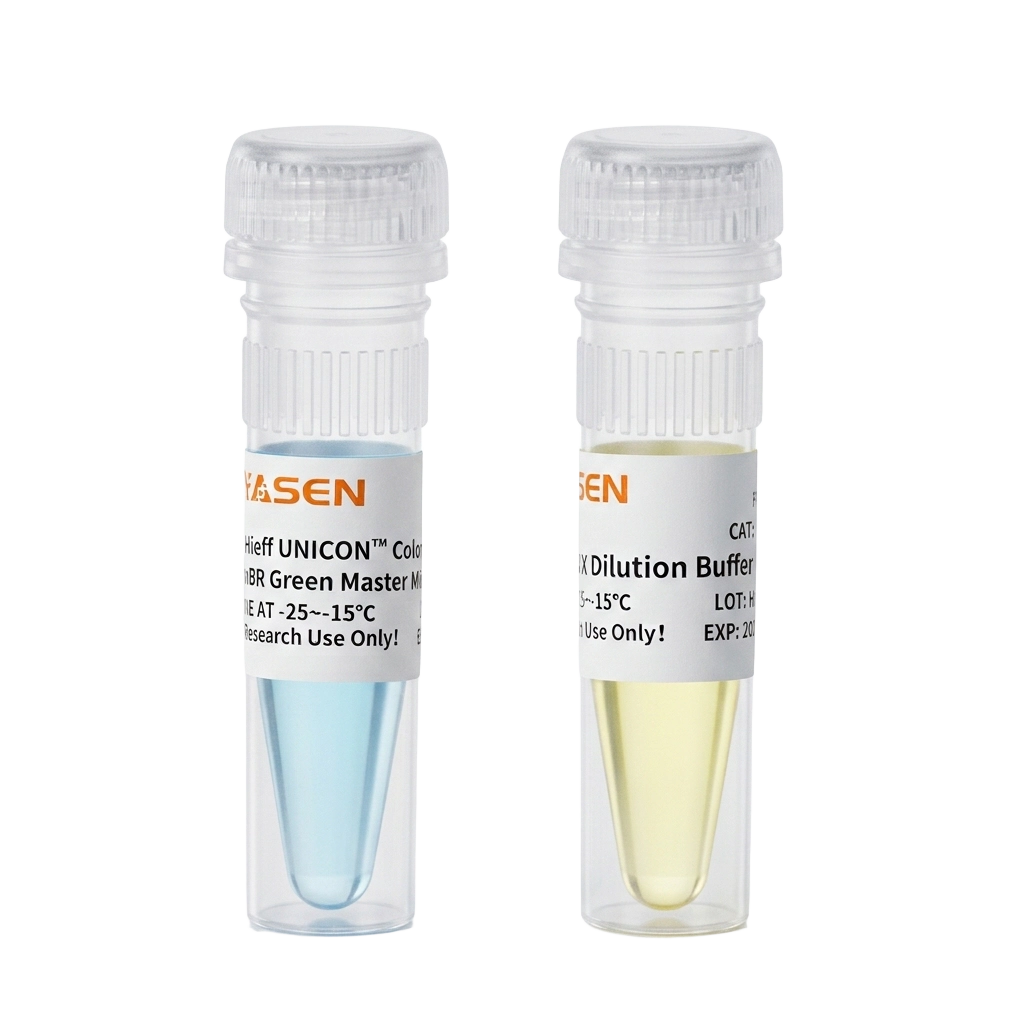


Hieff UNICON™ ColorGPS qPCR Master Mix (No Rox) es una presolución para la amplificación cuantitativa por PCR en tiempo real 2×, que presenta una alta intensidad de fluorescencia, alta sensibilidad y especificidad, y un alto rendimiento de amplificación. El componente principal, Hieff UNICON™ Taq DNA Polymerase, se inicia en caliente mediante el método de anticuerpos, lo que puede inhibir eficazmente la amplificación no específica causada por la hibridación de cebadores durante la preparación de la muestra. Al mismo tiempo, la fórmula agrega factores para mejorar la eficiencia de amplificación de la reacción de PCR y facilitadores para igualar la amplificación de genes con diferentes contenidos de GC (30~70%), de modo que la PCR cuantitativa pueda obtener una buena relación lineal en una amplia gama de regiones cuantitativas. El producto utiliza la reacción de cambio de color mixto de diferentes colorantes para monitorear la operación de pipeteo, lo que reduce eficazmente la aparición de errores de pipeteo.
Características
Seguimiento del pipeteo: reduzca el riesgo de errores de adición o de omisión
Excelente amplificación: Buena linealidad en un amplio rango lineal
Alta precisión: puede distinguir con precisión plantillas con una diferencia de concentración de 2 veces
Buena repetibilidad: pequeña variabilidad entre pocillos en pocillos replicados, lo que resulta en una mejor repetibilidad
Estable y confiable: el sistema de reacción se puede almacenar a temperatura ambiente durante 24 horas y el producto permanece inalterado después de 20 ciclos de congelación y descongelación.
Aplicaciones
Análisis de las diferencias en la expresión genética
Análisis cuantitativo absoluto
Presupuesto
| Concentración | 2 ×(Mezcla de qPCR) |
| Método de detección | Método de teñido |
| Método de PCR | PCR cuantitativa |
| Polimerasa | Taq ADN polimerasa |
| Tipo de muestra | ADN |
| Equipo de aplicación | Bio-Rad CFX96, CFX384, iCycler iQ, iQ5, MyiQ; MiniOpticon, Opticon, Opticon 2, Chromo4; Cepheid SmartCycler; Eppendorf Mastercycler ep realplex, realplex 2 s; Illumina Eco qPCR; Qiagen/Corbett Rotor-Gene Q, Rotor-Gene 3000, Rotor-Gene 6000; Roche Applied Science LightCycler 480; Thermo Scientific PikoReal Cycler y otros instrumentos de PCR cuantitativa de fluorescencia que no requieren la adición del colorante de referencia ROX |
| Tipo de producto | Premezcla para PCR cuantitativa de fluorescencia en tiempo real |
| Aplicar a (solicitud) | Expresión genética |
Componentes
| Componentes No. | Nombre | 11188ES03 | 11188ES08 | 11188ES60 |
| 11188-A | Alto UNICON™ PCR cuantitativa con GPS a color Mezcla maestra (Sin Rox) | 1 ml | 5 x 1 ml | 100×1 ml |
| 11188-B | Tampón de dilución 10× | 1 ml | 1 ml | 20 x 1 ml |
Envío y almacenamiento
Este producto debe almacenarse entre -25 y -15 ℃ durante 1 año.
Cifras
 Figura 1. Se pueden obtener resultados confiables dentro del rango dinámico.
Utilizando 2 µL de plantillas de plásmidos con un gradiente de 10^1-10^7, se amplificaron los genes relacionados. Hieff UNICON™ La mezcla maestra ColorGPS puede detectar eficazmente un rango de cantidad de plantilla de 7 órdenes de magnitud, logrando una buena linealidad dentro de un amplio rango lineal.
 Cifra2. Puede distinguir con precisión diferencias de concentración de plantilla de 2 veces.
Utilizando 2 µL de plásmido diluido en un gradiente doble como plantilla, se amplificaron los genes relacionados. Hieff UNICON™ La mezcla maestra ColorGPS puede resolver con precisión las diferencias de concentración de plantillas.
 Cifra3Se observa una pequeña variabilidad entre pocillos, lo que muestra una mejor repetibilidad.
Utilizando decenas de copias del plásmido como plantilla, se realizó la amplificación con diferentes reactivos cuantitativos fluorescentes según los procedimientos especificados en sus respectivos manuales de instrucciones. Los valores de desviación estándar indican que, en comparación con otros reactivos de transcripción inversa, el nuevo producto presenta menores diferencias entre pocillos replicados y mejor repetibilidad.
 Cifra4. Más flexible, adecuado para procedimientos estándar o rápidos.
En el procedimiento estándar, el tiempo de desnaturalización y el tiempo de extensión se establecen en 10 segundos y 30 segundos, respectivamente, mientras que en el procedimiento rápido, el tiempo de desnaturalización y el tiempo de extensión se establecen en 3 segundos y 10 segundos, respectivamente, para detectar los valores de Ct correspondientes a 10 genes objetivo.Los resultados muestran que los valores de Ct obtenidos con el nuevo producto tanto en los procedimientos estándar como en los rápidos tienen una fuerte correlación y el nuevo producto puede lograr buenos resultados utilizando el procedimiento rápido.
 Cifra5Una vez preparado el sistema de reacción, puede permanecer estable a temperatura ambiente durante 24 horas.
Utilizando diferentes genes de ratón, células 293 humanas y Arabidopsis thaliana como objetivos, después de preparar el sistema de reacción, se colocó en la oscuridad a diferentes temperaturas durante 24 horas antes de la detección. En comparación con el procesamiento inmediato, la diferencia de detección para diferentes genes no supera los 0,5 Ct, lo que indica que también se pueden obtener resultados estables con operaciones de larga duración.
Ddocumentos:
Manuales
Storage
FAQ

1. The instrument has not been calibrated for a long time or it is aging. Usually, the instrument needs to be calibrated once a year. It is necessary to have an instrument engineer perform the calibration or replace the aging components.
2. A 10 μL reaction system was used. The normal system is a 20 μL system. Using half of the normal system would result in an excessively low total concentration of Rox, increasing the probability of BadRox occurrence. It is recommended to conduct the experiment using the 20 μL system.
2. Is the length of the product too long? If the length of the product is set to 500bp or more, this situation may occur. It is recommended that during primer design, the length of the product be controlled within the range of 80-300bp.
3. Are the primers inappropriate? If the primers are not designed correctly, they need to be redesigned. If the primers are correctly designed but seem to be degraded, PAGE electrophoresis can be used to check the integrity of the primers.
4.Template degradation: Prepare the template anew and repeat the experiment.
2. What if CT is ≥ 30 but the repeatability is very poor? At this point, due to the low abundance of the effective template, the randomness of collisions between the template and the primers increases, thereby causing a greater difference between the replicons. It is recommended to try adding 2-3 replicons, and then eliminate the data with large differences for data analysis.
Citations
Documents
| Brochure |
|---|
| Comprehensive_And_Professional_qPCR_Solution.pdf |
Applications
También te puede gustar
Consulta
Preguntas frecuentes
El producto es solo para fines de investigación y no está destinado a uso terapéutico o diagnóstico en humanos o animales. Los productos y el contenido están protegidos por patentes, marcas comerciales y derechos de autor propiedad de Yeasen Biotechnology. Los símbolos de marca comercial indican el país de origen, no necesariamente el registro en todas las regiones.
Algunas aplicaciones pueden requerir derechos de propiedad intelectual adicionales de terceros.
Yeasen se dedica a la ciencia ética y cree que nuestra investigación debe abordar cuestiones críticas al tiempo que garantiza la seguridad y los estándares éticos.