


Frequently Bought Together
T7 High Yield RNA Synthesis Kit optimerer transkriptionsreaktionssystemet. Sættet kan syntetisere det enkeltstrengede RNA effektivt ved at bruge T7 RNA-polymerase, det lineære dobbeltstrengede DNA med T7-promotorsekvensen som template, NTP'er som substrat til at kontrollere DNA-sekvensen nedstrøms for promotoren. Under transkription kan modificerede nukleotider tilføjes til substratet for at fremstille biotin eller farvestof-mærket RNA.
Dette kit kan syntetisere lange transkripter og korte transkripter, RNA kan produceres 100-200 μg med 1 μg DNA skabelon input. RNA'et syntetiseret ved transkription kan bruges til forskellige downstream-applikationer, såsom RNA-struktur- og funktionsforskning, RNase-beskyttelse, probehybridisering, RNAi, mikroinjektion og in vitro oversættelse.
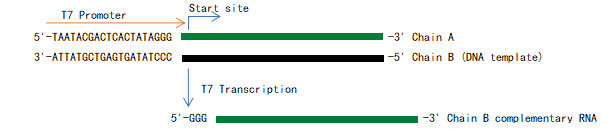
Figur 1: In vitro RNA-transkriptionsproces
Feature
- Op til 180 μg RNA pr. reaktion fra 1 μg af kontrolskabelonen
- Optimeret reaktionssystem til IVT-processen
- Reducer dsRNA-produktionen
- Højere RNA-integritet og renhed
Anvendelse
- In vitro RNA syntese
Komponenter
| Komponenter nr. | Navn | 10623ES50 (50 T) | 10623ES60 (100 T) | 10623ES70 (500 T) |
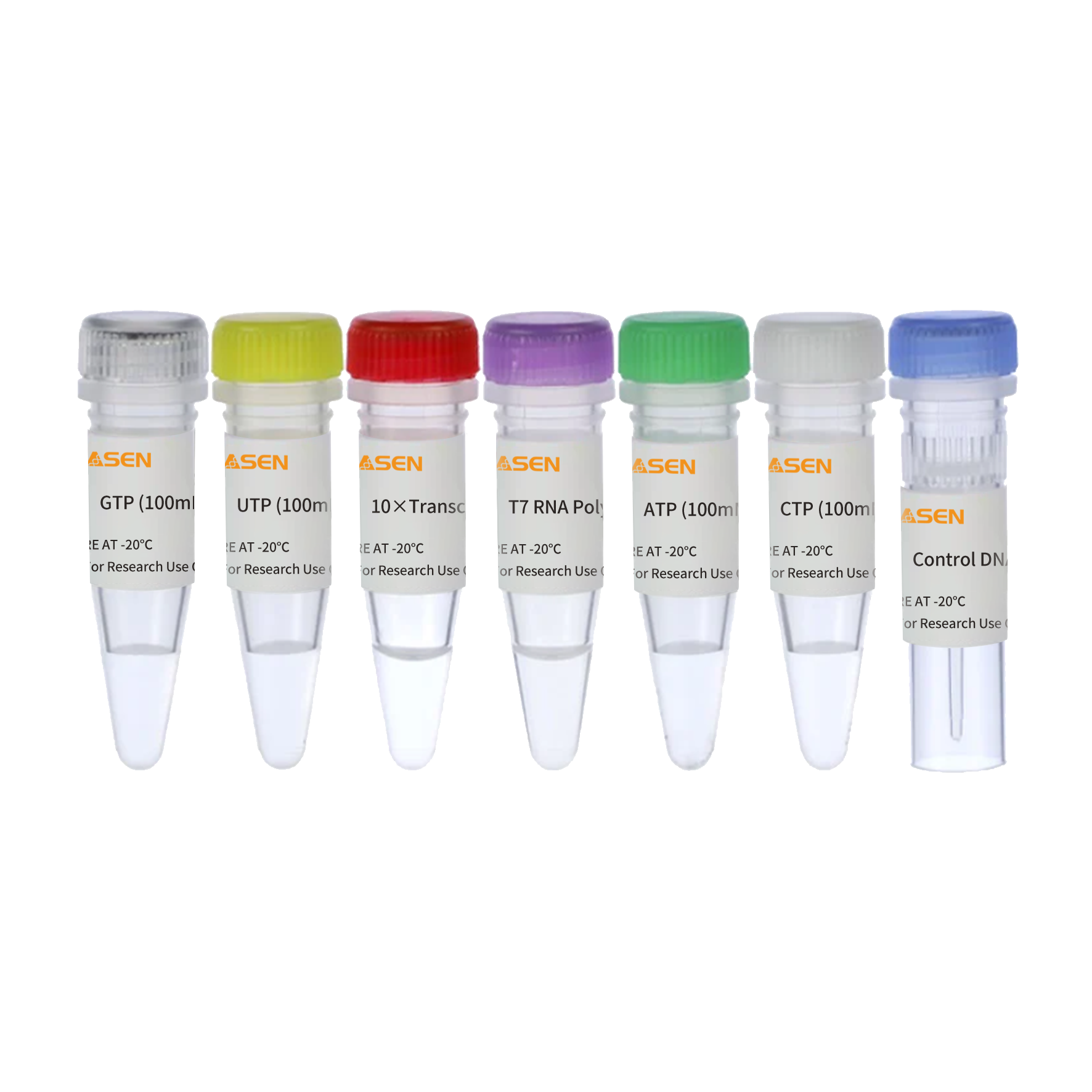
| 10623-A | T7 RNA polymerase blanding | 100 μL | 200 μL | 1 ml |
| 10623-B | 10×transskriptionsbuffer | 100 μL | 200 μL | 1 ml |
| 10623-C | ATP (100mM) | 100 μL | 200 μL | 1 ml |
| 10623-D | CTP (100 mm) | 100 μL | 200 μL | 1 ml |
| 10623-E | GTP (100 mm) | 100 μL | 200 μL | 1 ml |
| 10623-F | UTP (100 mm) | 100 μL | 200 μL | 1 ml |
| 10623-G | Kontrol DNA skabelon (500ng/μL) | 10 μL | 20 μL | 100 μL |
Forsendelse og opbevaring
Tøris transport. Opbevares ved -15℃ ~ -25℃, gyldig i to år.
Figurer
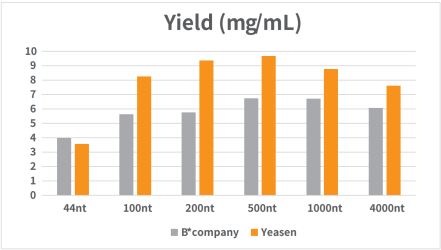
Figur 1. Standard-RNA blev syntetiseret in vitro under anvendelse af T7 RNA-syntesesæt.
Reaktionen blev inkuberet i et PCR-instrument ved 37°C i 2 timer og derefter oprenset med magnetiske perler (kat #12602). Udbytteresultatet blev analyseret med NanoDrop spektrofotometer som vist i figur 1.
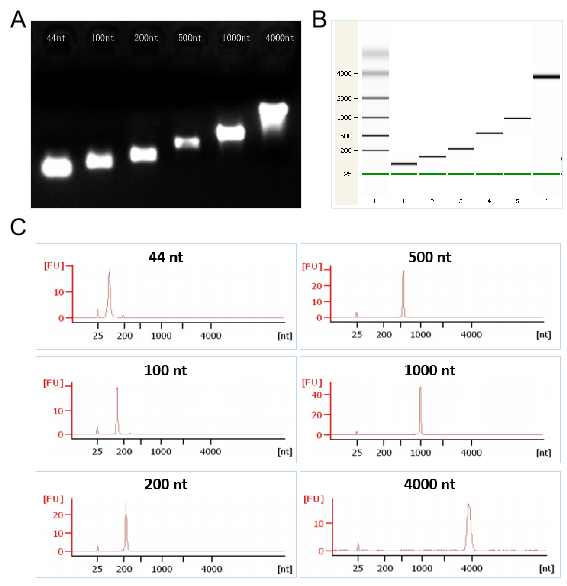
Figurer 2. Transskriptionsdemonstrationen af forskellige længder af RNA ved hjælp af T7-kit i henholdsvis elektroforetogrammet (figur 2A), kapillærelektroforesediagrammet (figur 2B) og kromatogrammet (figur 2C)
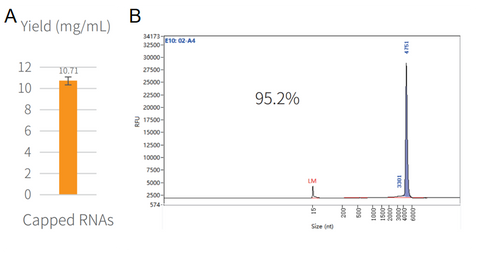
Figur 3. Syntese af capped RNA in vitro.
Reaktionen blev inkuberet i PCR-instrument ved 37 ℃ i 2 timer og derefter oprenset med magnetiske perler (kat #12602). Udbytteresultatet blev analyseret med NanoDrop spektrofotometer som vist i figur 3A. Integritetsresultatet blev analyseret ved kapillarelektroforese som vist i figur 3B.
1. Lavt afskriftsudbytte
Kvaliteten af skabelonen er tæt forbundet med udbyttet. Hvis udbyttet af forsøgsgruppen er væsentligt lavere end kontrolgruppen, er de mulige årsager:
① den eksperimentelle skabelon indeholder hæmmende komponenter;
② Skabelonen har noget galt.
Forslag:
① Rens skabelonen igen;
② Bestem skabelonkvantificeringen og dens integritet;
③ Forlæng reaktionstiden;
④ Øg mængden af skabeloninput;
⑤ Prøv andre promotorer og RNA-polymeraser.
2. Lavt udbytte af korte afskrifter
Et kort transkriptionsinitieringsfragment vil hæmme reaktionen. Når transkriptionsproduktet er mindre end 100 nt, vil forlængelse af reaktionstiden til 4-8 timer eller øge mængden af skabelon til 2 μg øge RNA-udbyttet.
3. RNA-transkriptionslængden er større end forventet
Hvis elektroforesen viser, at produktbåndet er større end den forventede størrelse, er de mulige årsager:
① Plasmidskabelonen er muligvis ikke fuldstændig lineariseret;
②3'-enden af sense-strengen har en fremtrædende struktur;
③ RNA'et har en sekundær struktur, der ikke er fuldstændig denatureret.
Forslag:
①Tjek om skabelonen er fuldstændig lineariseret, og udfør om nødvendigt yderligere linearisering;
②Vælg et passende restriktionsenzym for at undgå 3'-overhæng, eller brug Klenow Fragment/T4 DNA-polymerase til at fuldføre transkriptionen, før du fortsætter;
③Brug denatureret gel til at detektere RNA-produkter.
4. RNA-transkriptionslængden er mindre end forventet
Hvis elektroforesen viser, at produktbåndet er mindre end den forventede størrelse, er de mulige årsager:
①Skabelonen indeholder en termineringssekvens svarende til T7 RNA-polymerase;
②GC-indholdet i skabelonen er højt.
Forslag:
①Sænk reaktionstemperaturen (for eksempel 30°C). Nogle gange kan en sænkning af temperaturen øge transskriptionslængden, men det vil reducere udbyttet. Eller prøv forskellige RNA-polymeraser til transkription;
②Hvis skabelonens GC-indhold er højt, skal du bruge 42℃ til transskription, eller tilføj SSB for at øge udbyttet og transskriptionslængden.
5. Elektroforese-tailing af transkriptionsprodukter
Der er et halefænomen under elektroforese.
Mulige årsager:
① Kontamineret med RNase under eksperimentel drift;
② Kontamineret DNA skabelon af RNase.
Forslag:
①Brug RNase-fri pipettespidser og EP-rør, brug latex-engangshandsker og -masker, og alle reagenser er forberedt med RNase-fri H2O.
②Genrens skabelon-DNA'et.
[1] Dong Z, Zheng N, Hu C, et al.Nosema bombycis mikroRNA-lignende RNA 8 (Nb-milR8) øger svampepatogenicitet ved at modulere BmPEX16-genekspression i dens vært, Bombyx mori. Microbiol Spectr. 2021;9(2):e0104821. doi:10.1128/Spectrum.01048-21(IF:7.171)
[2] Wang X, Tang S, Ye S, et al. Ultrafølsom kvantificering af cirkulerende miR-195-5p med triple-streng displacement amplification kaskade. Talanta. 2022;242:123300. doi:10.1016/j.talanta.2022.123300(IF:6.057)
Storage
FAQ
The optimization of the IVT system can be achieved by adjusting the template, the amount of T7 enzyme used, and if it is co-transcription with cap addition, the ratio between the cap and NTP can be considered; for enzymatic cap addition, the conditions can be optimized in terms of the dosage of the cap-adding enzyme, 2-O-methyltransferase, and SAM. Regarding the template, apart from the requirement of complete linearization, there is another point, which is sequence design. For example, in the 5'UTR region, pay attention to uAUG and Kozak sequence; for CDS, consider the codon preference, GC3 content, and dinucleotide preference, etc.; 3'UTR: RBP and miRNA binding sites: and another point is the secondary structure of RNA. The stable secondary structure of the 5'UTR pre-sequence will reduce the expression of mRNA; the stable secondary structure of 3'UTR will increase the stability of mRNA and promote the expression of the encoded protein. For the recommended IVT system and more detailed tips, please refer to the mRNA in vitro synthesis experiment manual of Vivian Biotechnology.
The average yield is between 120-220 ug/ul (the yield is highly dependent on the sequence design). In the co-transcription method, the mRNA yield is 8 g/L. With process optimization, the yield will increase. Currently, the quality parameters of the available processes include observing the fluorescence value of GFP and measuring the cap addition rate using LC-MS.
The T7 pol enzyme will use the product RNA as a template and continue to extend the RNA at its 3' end. The extended sequence will form complementary pairing with the 3' end sequence of the original RNA molecule, thereby creating a hairpin structure.
The T7 pol enzyme can use RNA as a template to replicate RNA molecules, and synthesize the complementary strand.
(At present, there is no effective method for removing dsRNA. However, there is a patent report suggesting that a fiber column (sigma) could be tried.)
1. Reduce the concentration of magnesium ions; however, reducing the concentration of magnesium ions will also lead to a decrease in the production of RNA, and a balance point needs to be reached.
2. Increase the reaction temperature of IVT to 50-56℃. This temperature can effectively reduce the content of dsRNA in the product; however, the requirements for equipment for high-temperature reactions will vary, and it may also increase the cost.
3. In the IVT reaction system, certain dispersants such as urea and formamide are added; our process research team has also conducted some experiments on this route, which can achieve the effect of inhibiting dsRNA. However, whether it is suitable for process scaling-up still needs further research.
This kind of precipitation occurs by chance and is also closely related to the sequence design.
Solution: (1) Reduce the concentration of magnesium ions, but this will result in a decrease in yield. The amount of T7 enzyme needs to be increased and the reaction time (from 2 hours to 3-4 hours) needs to be extended; (2) The form of NTP (the presence of magnesium ions at a high concentration, such as 46 mM, does not select NTP, but when the magnesium ion concentration decreases, the yield of NTP (Tris salt form) does not change much, and the yield of the triNa form of NTP decreases significantly.
Citations
Documents
Applications

Du kan også lide
Forespørgsel
FAQ
Produktet er kun til forskningsformål og er ikke beregnet til terapeutisk eller diagnostisk brug hos mennesker eller dyr. Produkter og indhold er beskyttet af patenter, varemærker og ophavsrettigheder ejet af Yeasen Biotechnology. Varemærkesymboler angiver oprindelseslandet, ikke nødvendigvis registrering i alle regioner.
Visse applikationer kan kræve yderligere tredjeparts intellektuelle ejendomsrettigheder.
Yeasen er dedikeret til etisk videnskab og mener, at vores forskning bør adressere kritiske spørgsmål og samtidig sikre sikkerhed og etiske standarder.