
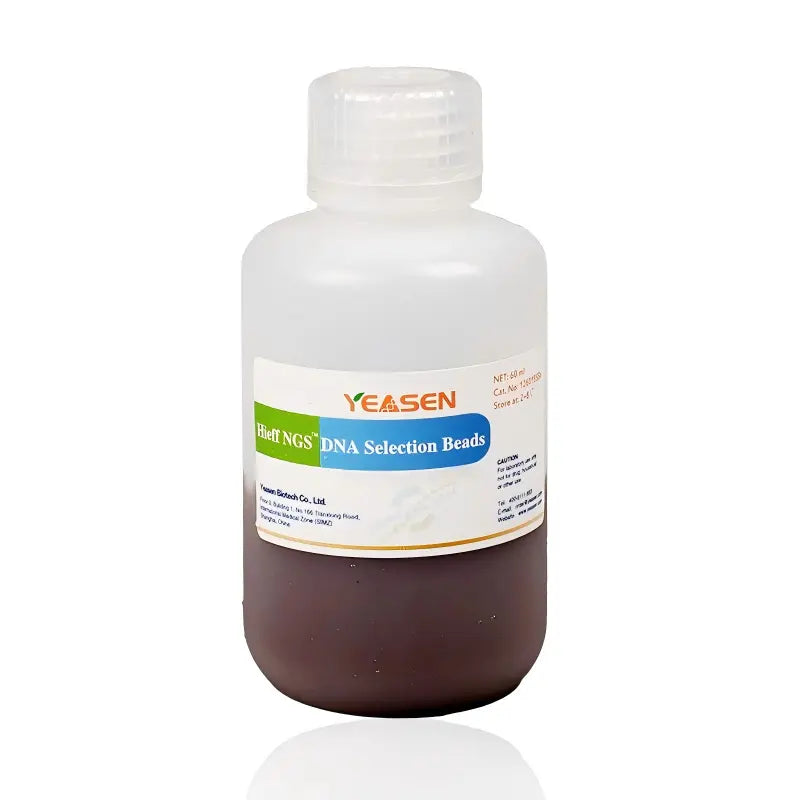



Hieff NGS™ DNA Seçim Boncukları, SPRI (Katı Faz Ters İmmobilizasyon) prensibine göre hazırlanır ve yeni nesil dizileme (NGS) kütüphanelerinin hazırlanması sırasında DNA saflaştırma ve boyut seçimi için uygulanabilir. Hieff NGS™ DNA Seçim Boncukları çeşitli DNA ve RNA kütüphane hazırlama kitleriyle uyumludur ve iyi bir alternatiftir. AMPür boncuklar.
Bileşenler
| Bileşenler No. | İsim | 12601ES08 | 12601ES56 | 12601ES75 |
| 12601 | Hieff NGS™ DNA Seçim Boncukları | 5 ml | 60 ml | 450 ml |
Özellikler
| Ürün Grubu | DNA temizleme ve seçme Boncukları |
| Başlangıç Malzemesi | DNA |
| Uyumluluk | DNA |
| Yalıtım Teknolojisi | Manyetik Boncuk |
| Son Ürün Türü | DNA |
| (Uygulama) ile Kullanım İçin | DNA temizleme, DNA boyut seçimi |
Nakliye ve Depolama
Boncuklar buz torbalarıyla gönderiliyor ve 2°C-8°C'de bir yıl saklanabiliyor.
Talimatlar
- 1. Hazırlık
Seçme boncuklarını kullanmadan önce en az 30 dakika oda sıcaklığında dengeleyin.
- 2. DNA Boyut seçimi
Boyut seçiminin işlem akışı Şekil 1’de gösterilmiş olup protokol aşağıdaki gibidir.
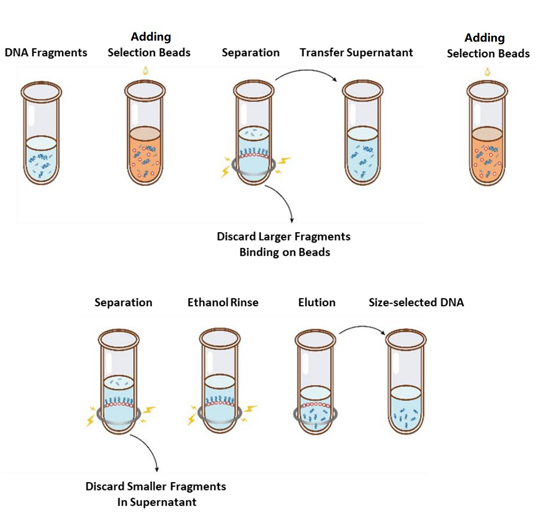
Şekil 1. DNA Boyut Seçiminin Akış Şeması
2.1 Her kullanımdan önce boncukları vorteksleyerek veya pipetleme yoluyla yukarı aşağı hareket ettirerek iyice karıştırın.
2.2 Numuneye ilk tur seçme boncuklarını ekleyin (Tablo 1'e bakın). En az 10 kez vorteksleyerek veya pipetleme yaparak iyice karıştırın.
2.3 Oda sıcaklığında 5 dakika inkübe edin.
2.4 Tüpü kısa bir süre döndürün ve manyetik standa yerleştirin. Çözelti berraklaştığında (yaklaşık 5 dakika), üstteki sıvıyı yeni bir PCR tüpüne aktarın.
2.5 Tablo 1'e göre 2.4. adımdaki numuneye ikinci tur seçme boncuklarını ekleyin. En az 10 kez vorteksleyerek veya pipetleme yaparak iyice karıştırın.
2.6 Oda sıcaklığında 5 dakika inkübe edin.
2.7 Tüpü kısa bir süre döndürün ve manyetik standa yerleştirin. Çözelti berraklaştığında (yaklaşık 5 dakika), üstteki sıvıyı aspire edin ve atın.
2.8 Tüpü manyetik standa koyun ve boncukları bozmadan 200 μL taze hazırlanmış %80'lik etanol ekleyin, oda sıcaklığında 30 saniye inkübe edin. Etanolü aspire edin ve atın.
2.9 Toplam iki yıkama için 2.8 adımını bir kez tekrarlayın.
2.10 Kalan etanolü 10 µL pipet uçlarıyla çıkarın. Tüpü manyetik standda tutun, çatlaklar görünene kadar seçme boncuklarını kapağı açık şekilde havada kurutun (yaklaşık 5 dk).
Not: Seçim boncuklarını aşırı kurutmayın. Bu, daha düşük kurtarma DNA hedefine yol açabilir.
2.11 Tüpü manyetik standdan çıkarın. Uygun miktarda ddH2O (≥20 µL) ekleyin ve en az 10 kez vorteksleyerek veya pipetleyerek iyice karıştırın.
2.12 Oda sıcaklığında 5 dakika inkübe edin.
Tüpü kısa bir süre döndürün ve manyetik standa yerleştirin. Çözelti berraklaştığında (yaklaşık 5 dakika), 20 μL üst sıvıyı yeni bir tüpe aktarın.
- 3.DNA Boyutu Seçimi İçin Önerilen Koşullar
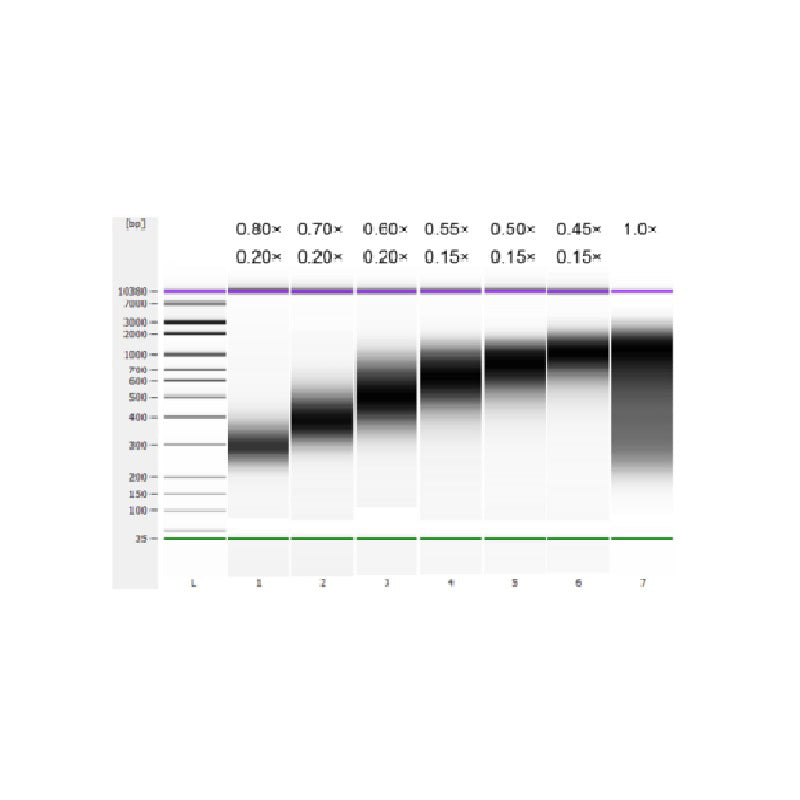
Buzağı timüs DNA'sı sonikasyonla parçalanarak 100-1000 bp'lik bir parça hazırlandı ve Tablo 1'e göre iki tur boyut seçimi yapıldı. Sonuçlar Agilent 2100 Bioanalyzer kullanılarak analiz edildi (Şekil 2).
Tablo 1. DNA boyutu seçimi için önerilen koşullar
| DNA parçasının uzunluğu | 250-350 baz puan | 320-420 baz puan | 450-550 bp | 550-700 baz puan | 700-900 baz puan | 800-1.000 bp |
| Boncuk Oranı: 1. Tur için DNA | 0,80× | 0,70× | 0,60× | 0,55× | 0,50× | 0,45× |
| Boncuk Oranı: 2. için DNA Yuvarlak | 0,20× | 0,20× | 0,20× | 0,15× | 0,15× | 0,15× |
Not: Tablodaki "×" örnek DNA'nın hacmini belirtir. Örneğin, kütüphanenin insert uzunluğu 250 bp ve örnek DNA hacmi 100 μL ise, ilk sıralama turunda kullanılan manyetik boncukların hacmi 0,80×100 μL=80 μL'dir; ikinci sıralama turunda kullanılan manyetik boncukların hacmi 0,20×100 μL=20 μL'dir.
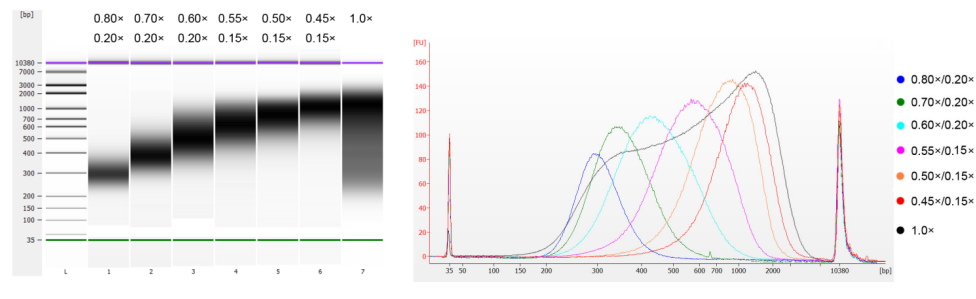
Şekil 2. Agilent 2100 yüksek hassasiyetli DNA çip elektroferogramı
Notlar:
1. Kendi güvenliğiniz ve sağlığınız için lütfen operasyon sırasında laboratuvar önlüğü ve tek kullanımlık eldiven giyin.
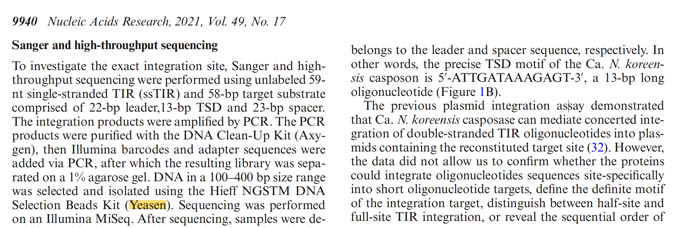
"Candidatus Nitrosopumilus koreensis'ten aile 1 kaspozazı tarafından diziye özgü entegrasyon"dan alıntılanmıştır AR1. Nükleik Asitler Res. 2021;49(17):9938-9952. doi:10.1093/nar/gkab725"
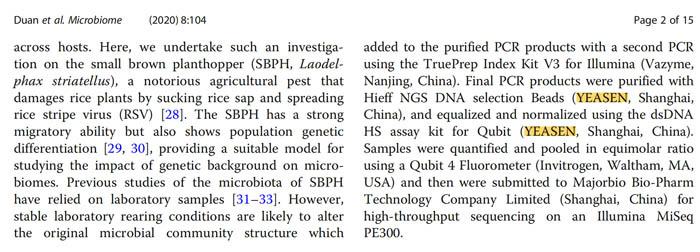
"Wolbachia'nın son enfeksiyonu vahşi Laodelphax striatellus popülasyonlarındaki mikrobiyal toplulukları değiştiriyor. Mikrobiyom. 2020;8(1):104. 2 Temmuz 2020'de yayınlandı. doi:10.1186/s40168-020-00878-x"
[1] Wang X, Yuan Q, Zhang W, ve diğerleri. Candidatus Nitrosopumilus koreensis'ten aile 1 kaspozazı tarafından diziye özgü entegrasyon AR1. Nükleik Asitler Res. 2021;49(17):9938-9952. doi:10.1093/nar/gkab725(IF:16.971)
[2] Duan XZ, Sun JT, Wang LT, ve diğerleri. Wolbachia'nın son enfeksiyonu, vahşi Laodelphax striatellus popülasyonlarındaki mikrobiyal toplulukları değiştiriyor. Mikrobiyom. 2020;8(1):104. 2 Temmuz 2020'de yayınlandı. doi:10.1186/s40168-020-00878-x(IF:11.607)
[3] Song B, Almatrafi E, Sang F, ve diğerleri.Fenton ile işlenmiş tortunun biyokömür ve koyun gübresi kompostu ile yönetimi: Bakteriyel topluluğun evrimsel özellikleri üzerindeki etkiler. J Environ Manage. 2022;316:115218. doi:10.1016/j.jenvman.2022.115218(IF:6.789)
[4] Huang C, Mei Q, Lou L, ve diğerleri. Bağırsak Mikrobiyotası ve Th17/Treg Hücre Dengesinin Modülasyonu Yoluyla Dışkı Mikrobiyotası Transplantasyonuna Yanıt Olarak Ülseratif Kolit. Hücreler. 2022;11(11):1851. 5 Haziran 2022'de yayımlandı. doi:10.3390/cells11111851(IF:6.600)
[5] Ghosh S, Yang X, Wang L, Zhang C, Zhao L. Aktif faz prebiyotik beslenme bağırsak mikrobiyotasını değiştirir, yüksek yağlı diyetle beslenen farelerde hepatik steatoz ve serum kolesterolünün kilodan bağımsız olarak hafifletilmesini sağlar. Comput Struct Biotechnol J. 2020;19:448-458. 24 Aralık 2020'de yayımlandı. doi:10.1016/j.csbj.2020.12.011(IF:6.018)
[6] Gao X, Yu B, Yu J, ve diğerleri. Domuz Yavrularında Diyet Karbonhidrat Sindiriminin Gelişimsel Profili. Front Microbiol. 2022;13:896660. 29 Nisan 2022'de yayımlandı. doi:10.3389/fmicb.2022.896660(IF:5.640)
[7] Li P, Zhang Y, Yan F, Zhou X. Klinik Klebsiella oxytoca'dan İzole Edilen Bir Bakteriyofaj, vB_Kox_ZX8'in Özellikleri ve Fare Bakteriyemisi Üzerindeki Terapötik Etkisi. Front Microbiol. 2021;12:763136. 3 Aralık 2021'de yayımlandı. doi:10.3389/fmicb.2021.763136(IF:5.640)
[8] Lin Z, Luo P, Huang D, Wu Y, Li F, Liu H. Saccharomyces cerevisiae modelinde akrilamidin toksisite analizi için çoklu omik tabanlı strateji. Chem Biol Interact. 2021;349:109682. doi:10.1016/j.cbi.2021.109682(IF:5.194)
[9] Sun X, Lv W, Wang Y, ve diğerleri. Mrgprb2 geni, Houttuynia cordata enjeksiyonunun neden olduğu anafilaktoid reaksiyonlarda rol oynar. J Etnofarmakol. 2022;289:115053. doi:10.1016/j.jep.2022.115053(IF:4.360)
[10] Ma H, Lai B, Zan C, Di X, Zhu X, Wang K. GLO1, PER Tipi Genişletilmiş Spektrumlu β-Laktamazları Tetikleyerek Escherichia coli'nin İlaç Direncine Katkıda Bulunur. Enfekte İlaç Direnci. 2022;15:1573-1586. 5 Nisan 2022'de yayımlandı. doi:10.2147/IDR.S358578(IF:4.003)
[11] Zhong Y, Zhao W, Tang Z, ve diğerleri. Kırmızı bataklık kereviti Procambarus clarkii'deki yumurtalığın farklı gelişim aşamalarının karşılaştırmalı transkriptomik analizi. BMC Genomics. 2021;22(1):199. 2021 Mart 21'de yayımlandı. doi:10.1186/s12864-021-07537-x(IF:3.969)
[12] Lian C, Yang H, Lan J, ve diğerleri. Kloroplast genomlarının karşılaştırmalı analizi, tıbbi bitki Isodon rubescens'te filogenetik ilişkileri ve tür içi çeşitliliği ortaya koyuyor. PLoS One. 2022;17(4):e0266546. 6 Nisan 2022'de yayımlandı. doi:10.1371/journal.pone.0266546(IF:3.240)
[13] Diao G, Huang J, Zheng X, ve diğerleri. Prostaglandin E2, dendritik hücrelerin göçünü düzenlemede ikili bir rol oynar. Int J Mol Med. 2021;47(1):207-218. doi:10.3892/ijmm.2020.4801(IF:3.098)
[14] Bing XL, Zhao DS, Peng CW, Huang HJ, Hong XY. Tarla pirinç bitki zararlısı (Hemiptera: Delphacidae) popülasyonlarındaki bakteri ve mantar topluluklarının benzerlikleri ve mekansal varyasyonları. Böcek Bilimi 2020;27(5):947-963. doi:10.1111/1744-7917.12782(IF:2.791)
[15] Li X, Zhou S, Zhang J, Zhou Z, Xiong Q. Kara Asker Sineği (Hermetia illucens) Larvalarında Bağırsak Bakteriyel Topluluğundaki Yönsel Değişiklikler. Hayvanlar (Basel). 2021;11(12):3475. 6 Aralık 2021'de yayınlandı. doi:10.3390/ani11123475(IF:2.752)
[16] Yang J, Peng Y, Kong W. Dut gizli virüsü 1'in tanımlanması ve tam genom dizisi. Arch Virol. 2022;167(2):687-690. doi:10.1007/s00705-021-05350-1(IF:2.574)
[17] Chang Y, Xia X, Sui L, ve diğerleri. Entomopatojenik mantarların endofitik kolonizasyonu, endofitik bakteri topluluğunu değiştirerek bitki hastalık direncini artırır. J Basic Microbiol. 2021;61(12):1098-1112. doi:10.1002/jobm.202100494(EĞER:2.281)
[18] Ding CY, Ma YM, Li B, ve diğerleri. Trans-anethole'e Yanıt Olarak Myzus persicae'de (Hemiptera: Aphididae) Farklı Olarak İfade Edilen Genlerin Tanımlanması ve İşlevsel Analizi. J Insect Sci. 2022;22(1):3. doi:10.1093/jisesa/ieab094(IF:1.857)
Storage
FAQ
2) The proportion of magnetic beads is incorrect. It is recommended to select the appropriate proportion according to the instructions.
3) The incubation time is insufficient. Ensure that the incubation time is at least 5 minutes.
4) During magnetic bead separation, when the two wheels perform magnetic bead adsorption, the magnetic beads are collected. A 10 μL pipette can be connected in series before the 200 μL pipette for liquid transfer, which can prevent the collection of magnetic beads.
5) During the magnetic bead washing process, the ethanol solution was not prepared freshly, resulting in an insufficiently high ethanol concentration. It is recommended that the ethanol concentration be no less than 70%, and for small fragments, it should be no less than 80%.
6) Excessive drying: If the magnetic beads are dried for too long, the surface will crack, making it difficult to elute the DNA and resulting in a decrease in yield. It is recommended that the drying time should not be too long; the moment the surface begins to crack, drying should be stopped.
7) Insufficient volume of elution solution: The final elution solution should completely cover the magnetic beads within the tube.
8) Sample reasons: The sample purity is low and contains impurities. When there are a large amount of impurities in the sample, it may cause the magnetic beads to aggregate and harden, resulting in insufficient elution. Using a pipette, try to blow the magnetic beads apart as much as possible, extend the elution time, and increase the product recovery rate. If there are many large fragments in the sample, the large fragments will cause the magnetic beads to aggregate. During elution, you can prolong the time or, if necessary, incubate at 37 degrees to improve the yield.
Citations
Documents
| Brochure |
|---|
| Magnetic_Beads_for_DNA_RNA_and_mRNA_Enrichment.pdf |
Applications
Ayrıca sevebilirsiniz
Sorgu
SSS
Ürün yalnızca araştırma amaçlıdır ve insanlarda veya hayvanlarda terapötik veya teşhis amaçlı kullanım için tasarlanmamıştır. Ürünler ve içerikler, Yeasen Biotechnology'nin sahip olduğu patentler, ticari markalar ve telif haklarıyla korunmaktadır. Ticari marka sembolleri, tüm bölgelerde tescilli olmayıp, menşe ülkesini gösterir.
Bazı uygulamalar üçüncü tarafların ek fikri mülkiyet haklarına ihtiyaç duyabilir.
Yeasen, araştırmalarımızın güvenlik ve etik standartları sağlarken kritik soruları ele alması gerektiğine inanarak etik bilime kendini adamıştır.