
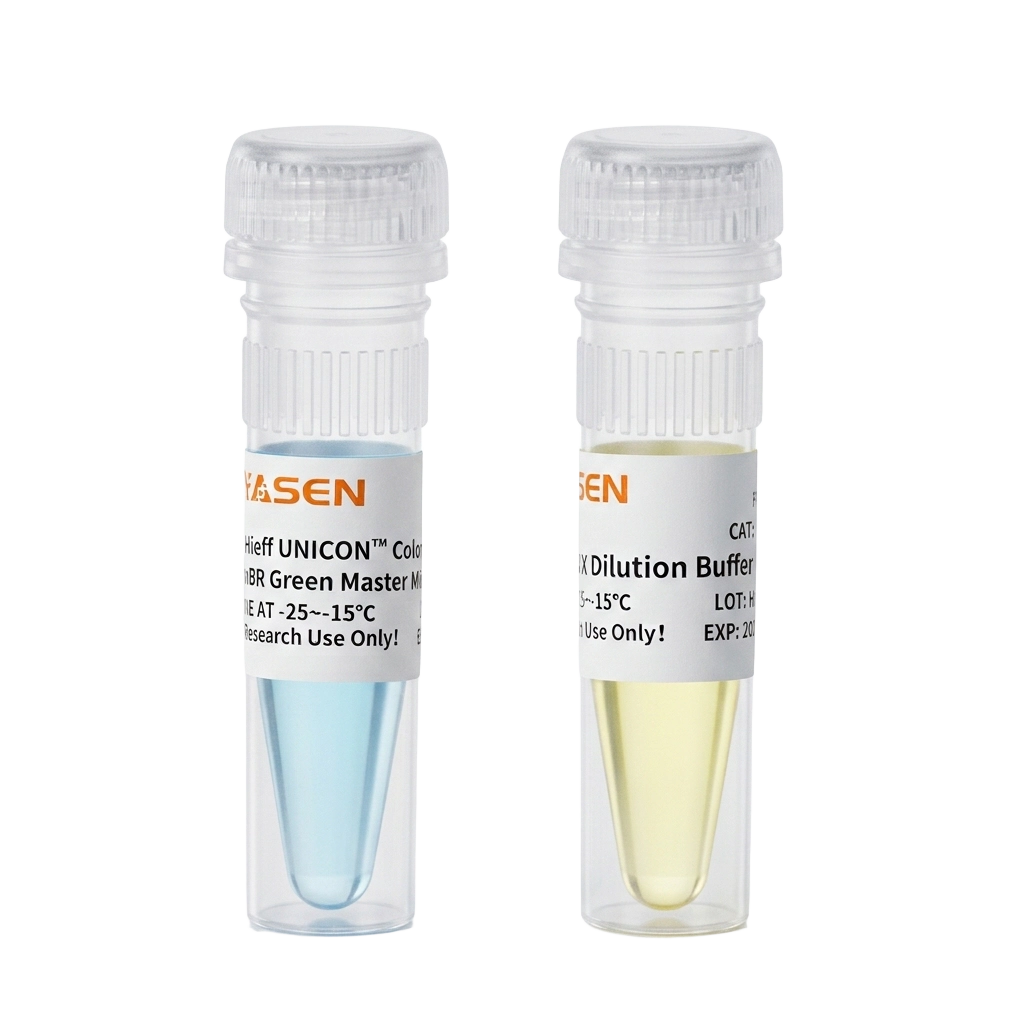


Hieff UNICON™ ColorGPS qPCR Master Mix (Low Rox), yüksek floresan yoğunluğu, yüksek hassasiyet ve özgüllük ve yüksek amplifikasyon verimi sunan 2× gerçek zamanlı kantitatif PCR amplifikasyonu için bir ön çözeltidir. Çekirdek bileşen olan Hieff UNICON™ Taq DNA Polimerazı, numune hazırlama sırasında primer tavlamasından kaynaklanan spesifik olmayan amplifikasyonu etkili bir şekilde engelleyebilen antikor yöntemi ile sıcak başlatılır. Aynı zamanda formül, PCR reaksiyonunun amplifikasyon verimliliğini artıran faktörler ve farklı GC içeriklerine sahip genlerin (30~70%) amplifikasyonunu eşitleyen kolaylaştırıcılar ekler, böylece kantitatif PCR geniş bir kantitatif bölge aralığında iyi bir doğrusal ilişki elde edebilir. Ürün, pipetleme işlemini izlemek için farklı boyaların karışık renk değişim reaksiyonunu kullanır ve bu da pipetleme hatalarının oluşumunu etkili bir şekilde azaltır.
Özellikler
Pipetleme Takibi: Kaçırılan/Eklenen Hataların Riskini Azaltın
Mükemmel Amplifikasyon: Geniş bir doğrusal aralıkta iyi doğrusallık
Yüksek Hassasiyet: 2 kat konsantrasyon farkına sahip şablonları doğru bir şekilde ayırt edebilir
İyi Tekrarlanabilirlik: Tekrarlanan kuyularda küçük kuyular arası değişkenlik, daha iyi tekrarlanabilirlikle sonuçlanır
Kararlı ve Güvenilir: Reaksiyon sistemi oda sıcaklığında 24 saat saklanabilir ve ürün 20 dondurma-çözme döngüsünden sonra bile etkilenmez.
Uygulamalar
Gen İfadesi Fark Analizi
Mutlak Kantitatif Analiz
Özellikler
| Konsantrasyon | 2 ×(qPCR Karışımı) |
| Tespit yöntemi | Boya yöntemi |
| PCR yöntemi | qPCR |
| Polimeraz | Taq DNA Polimerazı |
| Örnek türü | DNA |
| Uygulama ekipmanları | Applied Biosystems 7500, 7500 Fast, ViiA7;Stratagene MX4000, MX3005P, MX3000P ve düşük konsantrasyonlarda ROX Referans Boyası eklenmesini gerektiren diğer floresan kantitatif PCR cihazları |
| Ürün Türü | Gerçek zamanlı floresan kantitatif PCR için ön karışım |
| (Başvuru) için başvur | Gen ifadesi |
Bileşenler
| Bileşenler No. | İsim | 11189ES03 | 11189ES08 | 11189ES60 |
| 11189-A | Hieff UNICON™ Renkli GPS qPCR Ana Karışım (LOw (Rox) | 1 ml | 5×1 mL | 100×1 mL |
| 11189-B | 10×Seyreltme Tamponu | 1 ml | 1 ml | 20×1 mL |
Nakliye ve Depolama
Bu ürün -25~-15℃'de 1 yıl süreyle saklanmalıdır.
Rakamlar
 Şekil 1. Dinamik aralıkta güvenilir sonuçlar elde edilebilir.
10^1-10^7 gradyanlı 2 µL plazmit şablonu kullanılarak ilgili genler çoğaltıldı. Hieff UNICON™ ColorGPS ana karışımı, geniş bir doğrusal aralıkta iyi bir doğrusallık elde ederek, 7 büyüklük mertebesindeki bir şablon miktarı aralığını etkili bir şekilde tespit edebilir.
 Figür2. 2 katlı şablon konsantrasyon farklılıklarını doğru bir şekilde ayırt edebilir.
Şablon olarak 2 katlı bir gradyanda seyreltilmiş 2 µL plazmid kullanılarak ilgili genler çoğaltıldı. Hieff UNICON™ ColorGPS ana karışımı şablon konsantrasyon farklılıklarını doğru bir şekilde çözebilir.
 Figür3. Kuyular arası küçük değişkenlik gözlendi ve bu da daha iyi tekrarlanabilirliği gösterdi.
Şablon olarak düzinelerce plazmid kopyası kullanılarak, ilgili kullanım kılavuzlarında belirtilen prosedürlere göre farklı floresan kantitatif reaktiflerle amplifikasyon gerçekleştirildi. SD değerleri, diğer ters transkripsiyon reaktifleriyle karşılaştırıldığında, yeni ürünün tekrar kuyuları arasında daha küçük farklara ve daha iyi tekrarlanabilirliğe sahip olduğunu göstermektedir.
 Figür4. Daha esnek, standart veya hızlı prosedürlere uygundur.
Standart prosedürde, denatürasyon süresi ve uzatma süresi sırasıyla 10 saniye ve 30 saniyeye ayarlanırken, hızlı prosedürde denatürasyon süresi ve uzatma süresi sırasıyla 3 saniye ve 10 saniyeye ayarlanarak 10 hedef gene karşılık gelen Ct değerleri tespit edilir. Sonuçlar, hem standart hem de hızlı prosedürlerde yeni ürünle elde edilen Ct değerlerinin güçlü bir korelasyona sahip olduğunu ve yeni ürünün hızlı prosedür kullanılarak iyi sonuçlar elde edebileceğini göstermektedir.
 Figür5Reaksiyon sistemi hazırlandıktan sonra oda sıcaklığında 24 saat stabil kalabilmektedir.
Fare, insan 293 hücreleri ve Arabidopsis thaliana'dan farklı genler hedef olarak kullanılarak, reaksiyon sistemi hazırlandıktan sonra tespitten önce 24 saat boyunca farklı sıcaklıklarda karanlıkta bekletildi. Hemen işleme kıyasla, farklı genler için tespit farkı 0,5 Ct'yi geçmez, bu da uzun süreli işlemlerle de kararlı sonuçların elde edilebileceğini gösterir.
Belgeler:
Kılavuzlar
Storage
FAQ
1. The instrument has not been calibrated for a long time or it is aging. Usually, the instrument needs to be calibrated once a year. It is necessary to have an instrument engineer perform the calibration or replace the aging components.
2. A 10 μL reaction system was used. The normal system is a 20 μL system. Using half of the normal system would result in an excessively low total concentration of Rox, increasing the probability of BadRox occurrence. It is recommended to conduct the experiment using the 20 μL system.
2.Is the length of the product too long? If the length of the product is set to 500bp or more, this situation may occur. It is recommended that during primer design, the length of the product be controlled within the range of 80-300bp.
3. Are the primers inappropriate? If the primers are not designed correctly, they need to be redesigned. If the primers are correctly designed but seem to be degraded, PAGE electrophoresis can be used to check the integrity of the primers.
4. Template degradation: Prepare the template anew and repeat the experiment.
2. What if CT is ≥ 30 but the repeatability is very poor? At this point, due to the low abundance of the effective template, the randomness of collisions between the template and the primers increases, thereby causing a greater difference between the replicons. It is recommended to try adding 2-3 replicons, and then eliminate the data with large differences for data analysis.
Citations
Documents
Applications
Ayrıca sevebilirsiniz
Sorgu
SSS
Ürün yalnızca araştırma amaçlıdır ve insanlarda veya hayvanlarda terapötik veya teşhis amaçlı kullanım için tasarlanmamıştır. Ürünler ve içerikler, Yeasen Biotechnology'nin sahip olduğu patentler, ticari markalar ve telif haklarıyla korunmaktadır. Ticari marka sembolleri, tüm bölgelerde tescilli olmayıp, menşe ülkesini gösterir.
Bazı uygulamalar üçüncü tarafların ek fikri mülkiyet haklarına ihtiyaç duyabilir.
Yeasen, araştırmalarımızın güvenlik ve etik standartları sağlarken kritik soruları ele alması gerektiğine inanarak etik bilime kendini adamıştır.