
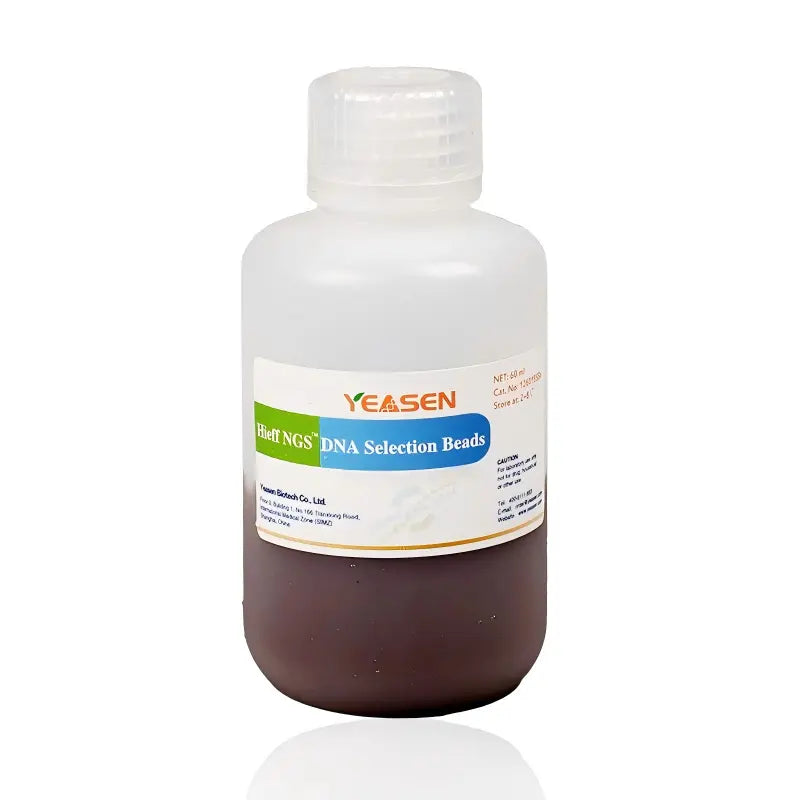



ลูกปัดคัดเลือก DNA ของ Hieff NGS™ ได้รับการเตรียมขึ้นโดยยึดตามหลักการ SPRI (Solid Phase Reverse Immobilization) และสามารถใช้สำหรับการทำให้บริสุทธิ์ DNA และการเลือกขนาดในระหว่างการเตรียมไลบรารีการจัดลำดับรุ่นถัดไป (NGS) ลูกปัดคัดเลือก DNA ของ Hieff NGS™ สามารถใช้งานร่วมกับชุดเตรียมไลบรารี DNA และ RNA ต่างๆ ได้ และเป็นทางเลือกที่ดี ลูกปัด AMPure-
ส่วนประกอบ
| ส่วนประกอบ หมายเลข | ชื่อ | 12601ES08 | 12601ES56 | 12601ES75 |
| 12601 | ลูกปัดคัดแยก DNA Hieff NGS™ | 5 มล. | 60 มล. | 450 มล. |
ข้อมูลจำเพาะ
| สายผลิตภัณฑ์ | DNA สะอาดและคัดเลือกลูกปัด |
| วัสดุเริ่มต้น | ดีเอ็นเอ |
| ความเข้ากันได้ | ดีเอ็นเอ |
| เทคโนโลยีการแยกตัว | ลูกปัดแม่เหล็ก |
| ประเภทผลิตภัณฑ์ขั้นสุดท้าย | ดีเอ็นเอ |
| สำหรับใช้กับ (แอปพลิเคชั่น) | การเลือกขนาด DNA |
การขนส่งและการเก็บรักษา
ลูกปัดจะถูกจัดส่งพร้อมกับถุงน้ำแข็งและสามารถเก็บไว้ที่อุณหภูมิ 2°C-8°C ได้นานหนึ่งปี
คำแนะนำ
- 1. การเตรียมพร้อม
ให้ปรับสมดุลลูกปัดคัดแยกที่อุณหภูมิห้องเป็นเวลาอย่างน้อย 30 นาที ก่อนใช้งาน
- 2. การเลือกขนาด DNA
ขั้นตอนการดำเนินการเลือกขนาดแสดงอยู่ในรูปที่ 1 และโปรโตคอลเป็นดังต่อไปนี้
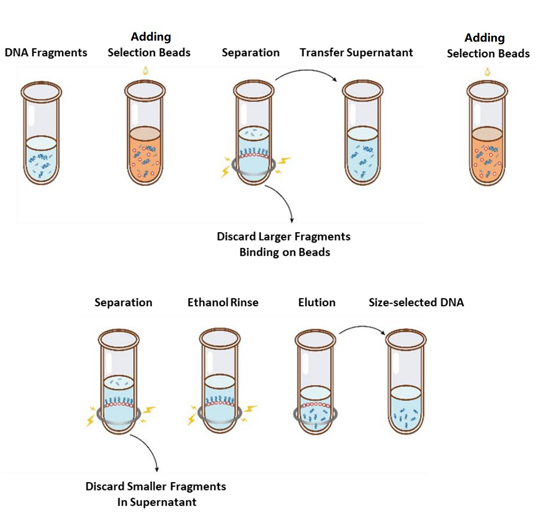
รูปที่ 1 แผนผังขั้นตอนการเลือกขนาด DNA
2.1 ผสมลูกปัดให้เข้ากันด้วยการเขย่าหรือปิเปตขึ้นลงทุกครั้งก่อนใช้งาน
2.2 เติมลูกปัดคัดเลือกรอบแรกลงในตัวอย่าง (ดูตารางที่ 1) ผสมให้เข้ากันโดยใช้เครื่องวอร์เท็กซ์หรือปิเปตขึ้นลงอย่างน้อย 10 ครั้ง
2.3 ฟักที่อุณหภูมิห้องเป็นเวลา 5 นาที
2.4 หมุนหลอดลงสักครู่แล้ววางบนฐานแม่เหล็ก เมื่อสารละลายใส (ประมาณ 5 นาที) ให้ย้ายส่วนที่เป็นของเหลวใสกว่าลงในหลอด PCR หลอดใหม่
2.5 เติมลูกปัดคัดรอบที่ 2 ลงในตัวอย่างจากขั้นตอน 2.4 ตามตารางที่ 1 ผสมให้เข้ากันโดยใช้การเขย่าหรือปิเปตขึ้นและลงอย่างน้อย 10 ครั้ง
2.6 ฟักที่อุณหภูมิห้องเป็นเวลา 5 นาที
2.7 หมุนหลอดลงสักครู่แล้ววางบนฐานแม่เหล็ก เมื่อสารละลายใส (ประมาณ 5 นาที) ให้ดูดของเหลวส่วนบนออกแล้วทิ้งไป
2.8 วางหลอดทดลองบนฐานแม่เหล็ก แล้วเติมเอธานอล 80% ที่เตรียมใหม่ 200 μL ลงไปโดยไม่รบกวนลูกปัด ฟักที่อุณหภูมิห้องเป็นเวลา 30 วินาที ดูดเอธานอลออกแล้วทิ้งไป
2.9 ทำซ้ำขั้นตอน 2.8 หนึ่งครั้งเพื่อซักรวมสองครั้ง
2.10 กำจัดเอธานอลที่เหลือด้วยปลายปิเปตขนาด 10 µL วางหลอดทดลองบนขาตั้งแม่เหล็ก ปล่อยให้ลูกปัดที่เลือกแห้งโดยเปิดฝาทิ้งไว้จนกระทั่งมีรอยแตกร้าวปรากฏขึ้น (ประมาณ 5 นาที)
หมายเหตุ: อย่าทำให้ลูกปัดที่เลือกแห้งเกินไป เพราะอาจทำให้เป้าหมาย DNA ที่ได้รับการฟื้นฟูลดลง
2.11 ถอดหลอดออกจากฐานแม่เหล็ก เติม ddH2O (≥20 µL) ในปริมาณที่เหมาะสม และผสมให้เข้ากันโดยใช้เครื่องวอร์เท็กซ์หรือปิเปตขึ้นลงอย่างน้อย 10 ครั้ง
2.12 ฟักที่อุณหภูมิห้องเป็นเวลา 5 นาที
หมุนหลอดลงสักครู่แล้ววางบนฐานแม่เหล็ก เมื่อสารละลายใส (ประมาณ 5 นาที) ให้ถ่ายของเหลวส่วนบน 20 μL ลงในหลอดใหม่
- 3.เงื่อนไขที่แนะนำสำหรับการเลือกขนาด DNA
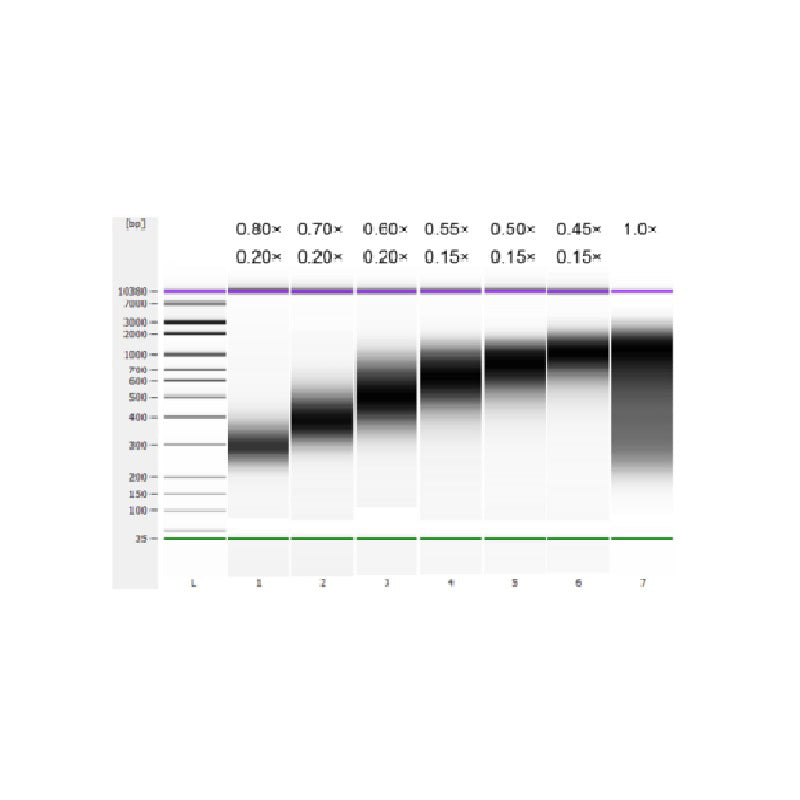
ดีเอ็นเอจากต่อมไทมัสของลูกวัวถูกแบ่งส่วนโดยใช้คลื่นเสียงความถี่สูงเพื่อเตรียมชิ้นส่วนขนาด 100-1,000 คู่เบส และทำการคัดเลือกขนาดสองรอบตามตารางที่ 1 จากนั้นวิเคราะห์ผลลัพธ์โดยใช้เครื่อง Agilent 2100 Bioanalyzer (รูปที่ 2)
ตารางที่ 1 เงื่อนไขที่แนะนำสำหรับการเลือกขนาด DNA
| ความยาวของชิ้นส่วน DNA | 250-350 บ. | 320-420 บ. | 450-550 บ. | 550-700 บ. | 700-900 บ. | 800-1,000 คู่ |
| อัตราส่วนของลูกปัด: ดีเอ็นเอรอบที่ 1 | 0.80× | 0.70× | 0.60× | 0.55× | 0.50× | 0.45× |
| อัตราส่วนของลูกปัด: ดีเอ็นเอสำหรับครั้งที่ 2 กลม | 0.20× | 0.20× | 0.20× | 0.15× | 0.15× | 0.15× |
หมายเหตุ: "×" ในตารางระบุปริมาตรของตัวอย่าง DNA ตัวอย่างเช่น หากความยาวของส่วนที่แทรกในคลังข้อมูลคือ 250 bp และปริมาตรของตัวอย่าง DNA คือ 100 μL ปริมาตรของลูกปัดแม่เหล็กที่ใช้ในการคัดแยกรอบแรกคือ 0.80×100 μL=80 μL ปริมาตรของลูกปัดแม่เหล็กที่ใช้ในการคัดแยกรอบที่สองคือ 0.20×100 μL=20 μL
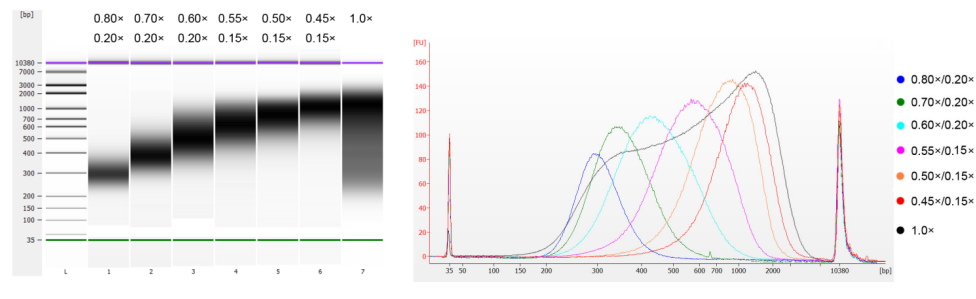
รูปที่ 2 อิเล็กโทรเฟอโรแกรมของชิป DNA ความไวสูง Agilent 2100
หมายเหตุ:
1. เพื่อความปลอดภัยและสุขภาพของคุณ โปรดสวมเสื้อคลุมแล็บและถุงมือแบบใช้แล้วทิ้งขณะผ่าตัด
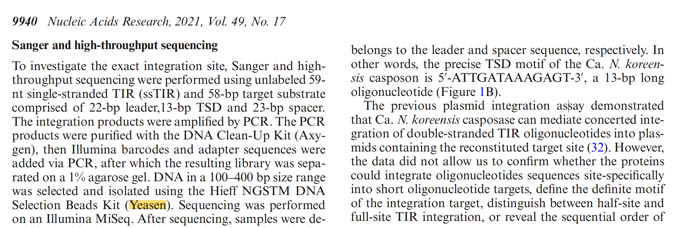
อ้างจาก "การรวมลำดับเฉพาะโดยตระกูล 1 casposase จาก Candidatus Nitrosopumilus koreensis AR1. กรดนิวคลีอิก Res. 2021;49(17):9938-9952. doi:10.1093/nar/gkab725"
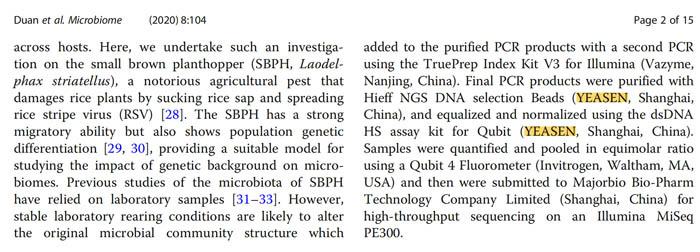
อ้างจาก "การติดเชื้อ Wolbachia เมื่อไม่นานนี้ทำให้ชุมชนจุลินทรีย์ในประชากร Laodelphax striatellus ป่าเปลี่ยนแปลงไป Microbiome 2020;8(1):104 เผยแพร่เมื่อวันที่ 2 กรกฎาคม 2020 doi:10.1186/s40168-020-00878-x"
[1] Wang X, Yuan Q, Zhang W และคณะ การรวมลำดับเฉพาะโดยแฟมิลี 1 แคสโปเซสจาก Candidatus Nitrosopumilus koreensis AR1. กรดนิวคลีอิก Res. 2021;49(17):9938-9952. doi:10.1093/nar/gkab725(IF:16.971)
[2] Duan XZ, Sun JT, Wang LT และคณะ การติดเชื้อ Wolbachia เมื่อเร็ว ๆ นี้ทำให้ชุมชนจุลินทรีย์ในประชากร Laodelphax striatellus เปลี่ยนแปลงไป ไมโครไบโอม 2020;8(1):104 เผยแพร่เมื่อวันที่ 2 กรกฎาคม 2020 doi:10.1186/s40168-020-00878-x(IF:11.607)
[3] เพลง B, Almatrafi E, Sang F, และคณะการจัดการตะกอนที่ผ่านการบำบัดด้วยเฟนตันด้วยไบโอชาร์และปุ๋ยหมักมูลแกะ: ผลกระทบต่อลักษณะวิวัฒนาการของชุมชนแบคทีเรีย J Environ Manage 2022;316:115218 doi:10.1016/j.jenvman.2022.115218(IF:6.789)
[4] Huang C, Mei Q, Lou L และคณะ Ulcerative Colitis in Response to Fecal Microbiota Transplantation via Modulation of Gut Microbiota and Th17/Treg Cell Balance. Cells. 2022;11(11):1851. เผยแพร่เมื่อวันที่ 5 มิถุนายน 2022 doi:10.3390/cells11111851(IF:6.600)
[5] Ghosh S, Yang X, Wang L, Zhang C, Zhao L. การให้อาหารพรีไบโอติกแบบแอคทีฟเฟสทำให้จุลินทรีย์ในลำไส้เปลี่ยนแปลง กระตุ้นให้เกิดการบรรเทาภาวะไขมันเกาะตับและคอเลสเตอรอลในซีรั่มที่ไม่ขึ้นกับน้ำหนักในหนูที่ได้รับอาหารไขมันสูง Comput Struct Biotechnol J. 2020;19:448-458. เผยแพร่เมื่อวันที่ 24 ธันวาคม 2020 doi:10.1016/j.csbj.2020.12.011(IF:6.018)
[6] Gao X, Yu B, Yu J และคณะ Developmental Profiling of Dietary Carbohydrate Digestion in Piglets. Front Microbiol. 2022;13:896660. เผยแพร่เมื่อวันที่ 29 เมษายน 2022 doi:10.3389/fmicb.2022.896660(IF:5.640)
[7] Li P, Zhang Y, Yan F, Zhou X. ลักษณะของแบคทีเรียโฟจ vB_Kox_ZX8 ที่แยกได้จาก Klebsiella oxytoca ทางคลินิกและผลการรักษาต่อภาวะแบคทีเรียในกระแสเลือดของหนู Front Microbiol. 2021;12:763136. เผยแพร่เมื่อวันที่ 3 ธันวาคม 2021 doi:10.3389/fmicb.2021.763136(IF:5.640)
[8] Lin Z, Luo P, Huang D, Wu Y, Li F, Liu H. กลยุทธ์ที่ใช้มัลติโอมิกส์สำหรับการวิเคราะห์ความเป็นพิษของอะคริลาไมด์ในแบบจำลอง Saccharomyces cerevisiae Chem Biol Interact 2021;349:109682 doi:10.1016/j.cbi.2021.109682(IF:5.194)
[9] ซัน X, Lv W, วัง Y และคณะ ยีน Mrgprb2 มีบทบาทในปฏิกิริยาแอนาฟิแลคตอยด์ที่เกิดจากการฉีด Houttuynia cordata เจ เอทโนฟาร์มาคอล. 2022;289:115053. ดอย:10.1016/j.jep.2022.115053(IF:4.360)
[10] Ma H, Lai B, Zan C, Di X, Zhu X, Wang K. GLO1 มีส่วนสนับสนุนต่อการดื้อยาของ Escherichia coli ผ่านการเหนี่ยวนำให้เกิด β-Lactamases สเปกตรัมขยายประเภท PER Infect Drug Resist. 2022;15:1573-1586. เผยแพร่เมื่อวันที่ 5 เมษายน 2022 doi:10.2147/IDR.S358578(IF:4.003)
[11] Zhong Y, Zhao W, Tang Z และคณะ การวิเคราะห์ทรานสคริปโตมิกส์เชิงเปรียบเทียบของระยะการพัฒนาที่แตกต่างกันของรังไข่ในกุ้งน้ำจืดหนองแดง Procambarus clarkii BMC Genomics 2021;22(1):199 เผยแพร่เมื่อวันที่ 21 มีนาคม 2021 doi:10.1186/s12864-021-07537-x(IF:3.969)
[12] Lian C, Yang H, Lan J และคณะ การวิเคราะห์เปรียบเทียบจีโนมคลอโรพลาสต์เผยให้เห็นความสัมพันธ์เชิงวิวัฒนาการและความหลากหลายภายในสายพันธุ์ในพืชสมุนไพร Isodon rubescens PLoS One 2022;17(4):e0266546 เผยแพร่เมื่อวันที่ 6 เมษายน 2022 doi:10.1371/journal.pone.0266546(IF:3.240)
(13) Diao G, Huang J, Zheng X และคณะ พรอสตาแกลนดิน E2 ทำหน้าที่สองอย่างในการควบคุมการเคลื่อนที่ของเซลล์เดนไดรต์ Int J Mol Med. 2021;47(1):207-218. doi:10.3892/ijmm.2020.4801(IF:3.098)
[14] Bing XL, Zhao DS, Peng CW, Huang HJ, Hong XY. ความคล้ายคลึงและการเปลี่ยนแปลงเชิงพื้นที่ของชุมชนแบคทีเรียและเชื้อราในประชากรเพลี้ยกระโดดในนาข้าว (Hemiptera: Delphacidae) Insect Sci. 2020;27(5):947-963. doi:10.1111/1744-7917.12782(IF:2.791)
[15] Li X, Zhou S, Zhang J, Zhou Z, Xiong Q. Directional Changes in the Intestinal Bacterial Community in Black Soldier Fly (Hermetia illucens) Larvae. Animals (Basel). 2021;11(12):3475. เผยแพร่เมื่อวันที่ 6 ธันวาคม 2021 doi:10.3390/ani11123475(IF:2.752)
[16] Yang J, Peng Y, Kong W. การระบุและลำดับจีโนมที่สมบูรณ์ของไวรัสมัลเบอร์รี่คริปติก 1 Arch Virol. 2022;167(2):687-690. doi:10.1007/s00705-021-05350-1(IF:2.574)
[17] Chang Y, Xia X, Sui L และคณะ การตั้งอาณานิคมของเชื้อราก่อโรคในแมลงแบบเอ็นโดไฟต์ช่วยเพิ่มความต้านทานโรคพืชโดยการเปลี่ยนแปลงชุมชนแบคทีเรียในเอ็นโดไฟต์ J Basic Microbiol. 2021;61(12):1098-1112. doi:101002/งานม.202100494(IF:2.281)
[18] Ding CY, Ma YM, Li B และคณะ การระบุและวิเคราะห์การทำงานของยีนที่แสดงออกแตกต่างกันใน Myzus persicae (Hemiptera: Aphididae) ในการตอบสนองต่อ Trans-anethole J Insect Sci. 2022;22(1):3. doi:10.1093/jisesa/ieab094(IF:1.857)
Storage
FAQ
2) The proportion of magnetic beads is incorrect. It is recommended to select the appropriate proportion according to the instructions.
3) The incubation time is insufficient. Ensure that the incubation time is at least 5 minutes.
4) During magnetic bead separation, when the two wheels perform magnetic bead adsorption, the magnetic beads are collected. A 10 μL pipette can be connected in series before the 200 μL pipette for liquid transfer, which can prevent the collection of magnetic beads.
5) During the magnetic bead washing process, the ethanol solution was not prepared freshly, resulting in an insufficiently high ethanol concentration. It is recommended that the ethanol concentration be no less than 70%, and for small fragments, it should be no less than 80%.
6) Excessive drying: If the magnetic beads are dried for too long, the surface will crack, making it difficult to elute the DNA and resulting in a decrease in yield. It is recommended that the drying time should not be too long; the moment the surface begins to crack, drying should be stopped.
7) Insufficient volume of elution solution: The final elution solution should completely cover the magnetic beads within the tube.
8) Sample reasons: The sample purity is low and contains impurities. When there are a large amount of impurities in the sample, it may cause the magnetic beads to aggregate and harden, resulting in insufficient elution. Using a pipette, try to blow the magnetic beads apart as much as possible, extend the elution time, and increase the product recovery rate. If there are many large fragments in the sample, the large fragments will cause the magnetic beads to aggregate. During elution, you can prolong the time or, if necessary, incubate at 37 degrees to improve the yield.
Citations
Documents
| Brochure |
|---|
| Magnetic_Beads_for_DNA_RNA_and_mRNA_Enrichment.pdf |
Applications
คุณอาจชอบ
การสอบถาม
คำถามที่พบบ่อย
ผลิตภัณฑ์นี้มีวัตถุประสงค์เพื่อการวิจัยเท่านั้น และไม่ได้มีวัตถุประสงค์เพื่อใช้ในการรักษาหรือวินิจฉัยโรคในมนุษย์หรือสัตว์ ผลิตภัณฑ์และเนื้อหาได้รับการคุ้มครองโดยสิทธิบัตร เครื่องหมายการค้า และลิขสิทธิ์ที่เป็นของ
แอปพลิเคชั่นบางตัวอาจต้องใช้สิทธิ์ในทรัพย์สินทางปัญญาของบุคคลที่สามเพิ่มเติม