
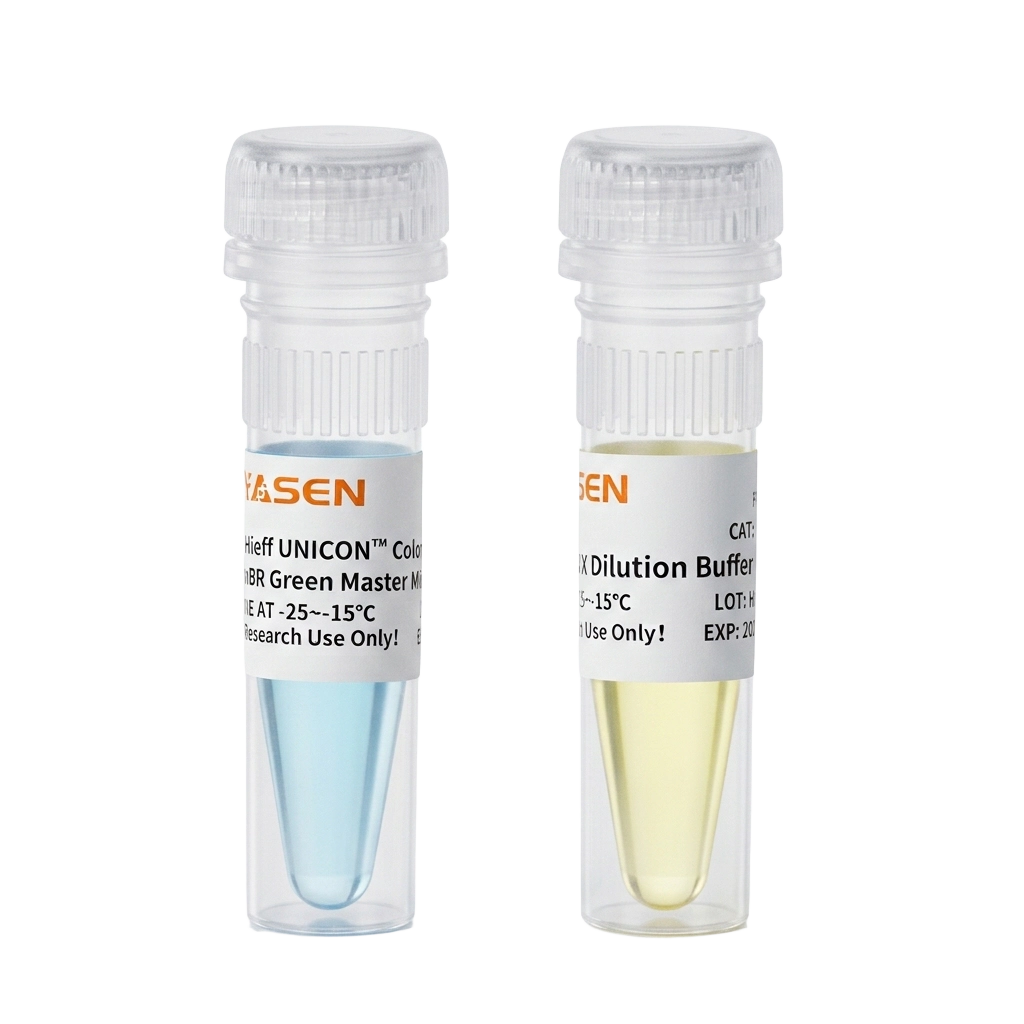


Hieff UNICON™ ColorGPS qPCR Master Mix (High Rox) är en förlösning för 2x realtids kvantitativ PCR-amplifiering, med hög fluorescensintensitet, hög känslighet och specificitet och högt amplifieringsutbyte. Kärnkomponenten, Hieff UNICON™ Taq DNA-polymeras, är varmstartad med antikroppsmetod, som effektivt kan hämma ospecifik amplifiering orsakad av primer-annealing under provberedningen. Samtidigt lägger formeln till faktorer för att förbättra amplifieringseffektiviteten för PCR-reaktionen och underlättar för att utjämna amplifieringen av gener med olika GC-innehåll (30~70%), så att den kvantitativa PCR kan erhålla ett bra linjärt förhållande i ett brett spektrum av kvantitativa regioner. Produkten använder den blandade färgändringsreaktionen av olika färgämnen för att övervaka pipetteringsprocessen, vilket effektivt minskar förekomsten av pipeteringsfel.
Drag
Pipettspårning: Minska risken för missade/tilläggsfel
Utmärkt förstärkning: Bra linjäritet över ett brett linjärt område
Hög precision: Kan exakt särskilja mallar med en 2-faldig koncentrationsskillnad
Bra repeterbarhet: Liten variation mellan brunnar i replikatbrunnar, vilket resulterar i bättre repeterbarhet
Stabilt och pålitligt: Reaktionssystemet kan förvaras i rumstemperatur i 24 timmar, och produkten förblir opåverkad efter 20 frys-upptiningscykler
Ansökningar
Analys av genuttrycksskillnad
Absolut kvantitativ analys
Specifikationer
| Koncentration | 2 ×(qPCR-mix) |
| Detektionsmetod | Färgningsmetod |
| PCR-metod | qPCR |
| Polymeras | Taq DNA-polymeras |
| Typ av prov | DNA |
| Appliceringsutrustning | Biosystems 5700, 7000, 7300, 7700, 7900, 7900HT, 7900HT Fast, StepOne, StepOnePlus och andra fluorescenskvantitativa PCR-instrument som kräver tillsats av höga koncentrationer av ROX Reference Dye |
| Produkttyp | Premix för kvantitativ PCR för fluorescens i realtid |
| Ansök till (ansökan) | Genuttryck |
Komponenter
| Komponentnr. | Namn | 11190ES03 | 11190ES08 | 11190ES60 |
| 11190-A | Hieff UNICON™ ColorGPS qPCR Master Mix (Hög Rox) | 1 ml | 5×1 ml | 100×1 ml |
| 11190-B | 10×Utspädningsbuffert | 1 ml | 1 ml | 20×1 ml |
Frakt och förvaring
Denna produkt bör förvaras vid -25~-15 ℃ i 1 år.
Siffror
 Figur 1. Pålitliga resultat kan erhållas inom det dynamiska området.
Med användning av 2 µL plasmidmallar med en gradient på 10^1-10^7 amplifierades de relaterade generna. Hieff UNICON™ ColorGPS master mix kan effektivt detektera ett mallmängdsintervall på 7 storleksordningar, vilket uppnår god linjäritet inom ett brett linjärt område.
 Figur2. Kan exakt särskilja mallkoncentrationsskillnader på 2-faldigt.
Med användning av 2 µL plasmid utspädd i en 2-faldig gradient som mall amplifierades de relaterade generna. Hieff UNICON™ ColorGPS mastermix kan lösa mallkoncentrationsskillnader exakt.
 Figur3. Liten variation mellan brunnar observeras, vilket visar bättre repeterbarhet.
Med hjälp av dussintals kopior av plasmiden som mall utfördes amplifiering med olika fluorescerande kvantitativa reagens enligt de procedurer som anges i deras respektive bruksanvisningar. SD-värdena indikerar att den nya produkten, jämfört med andra omvänd transkriptionsreagens, har mindre skillnader mellan replikatbrunnar och bättre repeterbarhet.
 Figur4. Mer flexibel, lämplig för standard eller snabba procedurer.
I standardproceduren är denatureringstiden och förlängningstiden inställd på 10 sekunder respektive 30 sekunder, medan i snabbproceduren är denatureringstiden och förlängningstiden satt till 3 sekunder respektive 10 sekunder för att detektera Ct-värdena motsvarande 10 målgener.Resultaten visar att de Ct-värden som erhålls med den nya produkten i både standard- och snabbprocedurer har en stark korrelation, och den nya produkten kan uppnå goda resultat med snabbproceduren.
 Figur5. Efter att reaktionssystemet har framställts kan det förbli stabilt vid rumstemperatur i 24 timmar.
Med hjälp av olika gener från mus, mänskliga 293-celler och Arabidopsis thaliana som mål, efter att ha förberett reaktionssystemet, placerades den i mörker vid olika temperaturer i 24 timmar före upptäckt. Jämfört med omedelbar bearbetning överstiger inte detektionsskillnaden för olika gener 0,5 Ct, vilket indikerar att stabila resultat även kan erhållas med långvariga operationer.
Dokument:
Manualer
Storage
FAQ
For example, for 20 μL of cDNA stock solution, add 180 μL of sterile ultrapure water to dilute it 10 times, resulting in 200 μL of diluted template. Take 90 μL of the diluted template and add 10 μL of 10× Dilution Buffer, mix well, and then use it. You can choose not to do this, but it will not affect the result.
1)The instrument has not been calibrated for a long time or it is aging. Usually, the instrument needs to be calibrated once a year. It is necessary to have an instrument engineer perform the calibration or replace the aging components.
2)A 10 μL reaction system was used. The normal system is a 20 μL system. Using half of the normal system would result in an excessively low total concentration of Rox, increasing the probability of BadRox occurrence. It is recommended to conduct the experiment using the 20 μL system.
2)Is the length of the product too long? If the length of the product is set to 500bp or more, this situation may occur. It is recommended that during primer design, the length of the product be controlled within the range of 80-300bp.
3)Are the primers inappropriate? If the primers are not designed correctly, they need to be redesigned. If the primers are correctly designed but seem to be degraded, PAGE electrophoresis can be used to check the integrity of the primers.
4)Template degradation: Prepare the template anew and repeat the experiment.
The melting curve shows that the melting peak shape of NTC does not overlap with that of the corresponding gene, and the TM value of NTC is smaller than that of the corresponding gene. In this case, the product corresponding to NTC is a primer dimer. If the melting curve peak shape of the corresponding gene is a single peak, the collection of the signal of the related gene will not be affected.
The melting curve shows that the melting peak shape of NTC overlaps with that of the corresponding gene. In this case, the product corresponding to NTC is likely to be the product of the corresponding gene. The system has been contaminated. We need to check one by one whether the water, primers, or reagents have been contaminated. If none of them have been contaminated, it might be aerosol contamination. Based on the obtained amplification data, the ΔCT value is calculated to determine whether the contamination has a significant impact on the system. If ΔCT ≥ 5, it indicates that the contamination has a minor effect and can be ignored.
Improve the accuracy of the pipette's aspiration. Pipettes usually need to be calibrated regularly, once a year.
The overlapping peaks in the melting curve are located to the right of the main peak.
1). It is possible that the non-specific amplification occurred due to poor specificity of the primers. The primers need to be redesigned.
2). It is possible that the template DNA was contaminated with genomic DNA. It is recommended to use an RNA extraction kit that removes the genomic DNA for RNA extraction, or to add a step of removing the genomic DNA during reverse transcription to reprepare the cDNA template.
Citations
Documents
| Manual |
|---|
| 11190ES-Hieff_UNICON_ColorGPS_qPCR_Master_Mix_High_Rox_-Ver.EN20241218.pdf |
| Brochure |
|---|
| qPCR_solutions.pdf |


Du kanske också gillar
Förfrågan
Vanliga frågor
Produkten är endast avsedd för forskningsändamål och är inte avsedd för terapeutisk eller diagnostisk användning hos människor eller djur. Produkter och innehåll skyddas av patent, varumärken och upphovsrätt som ägs av Yeasen Biotechnology. Varumärkessymboler anger ursprungsland, inte nödvändigtvis registrering i alla regioner.
Vissa applikationer kan kräva ytterligare immateriella rättigheter från tredje part.
Yeasen är dedikerad till etisk vetenskap, och anser att vår forskning bör behandla kritiska frågor samtidigt som den säkerställer säkerhet och etiska standarder.