
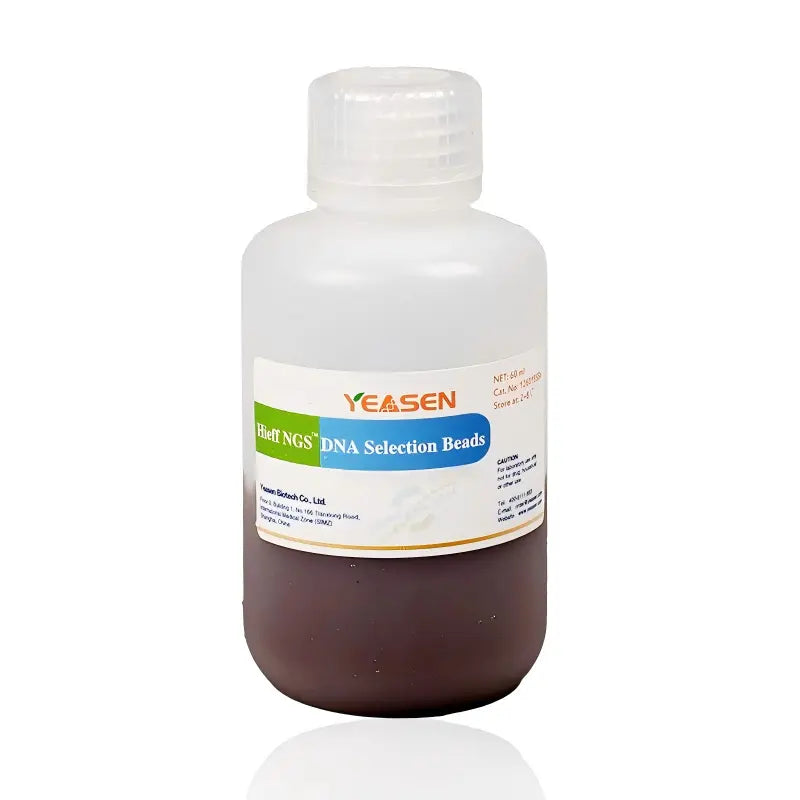



Hieff NGS™ DNA Selection Beads disiapkan berdasarkan prinsip SPRI (Solid Phase Reverse Immobilisasi) dan dapat digunakan untuk pemurnian DNA dan pemilihan ukuran selama persiapan pustaka sequencing generasi berikutnya (NGS). Hieff NGS™ DNA Selection Beads kompatibel dengan berbagai kit persiapan pustaka DNA dan RNA dan merupakan alternatif yang baik untuk Manik-manik AMPure.
Komponen
| Komponen No. | Nama | nomor telepon 12601ES08 | 12601ES56 | 12601ES75 |
| 12601 | Manik-manik Seleksi DNA Hieff NGS™ | 5 ml air | 60 ml air | 450 ml air |
Spesifikasi
| Lini Produk | Pembersihan dan pemilihan DNA Manik-manik |
| Bahan Awal | DNA |
| Kesesuaian | DNA |
| Teknologi Isolasi | Manik Magnetik |
| Jenis Produk Akhir | DNA |
| Untuk Digunakan Dengan (Aplikasi) | Pembersihan DNA, pemilihan ukuran DNA |
Pengiriman dan Penyimpanan
Manik-manik tersebut dikirim dengan bungkusan es dan dapat disimpan pada suhu 2°C-8°C selama satu tahun.
Instruksi
- 1. Persiapan
Seimbangkan manik-manik seleksi pada suhu ruangan setidaknya 30 menit sebelum digunakan.
- 2. Pemilihan Ukuran DNA
Alur operasi pemilihan ukuran ditunjukkan pada Gambar 1 dan protokolnya adalah sebagai berikut.
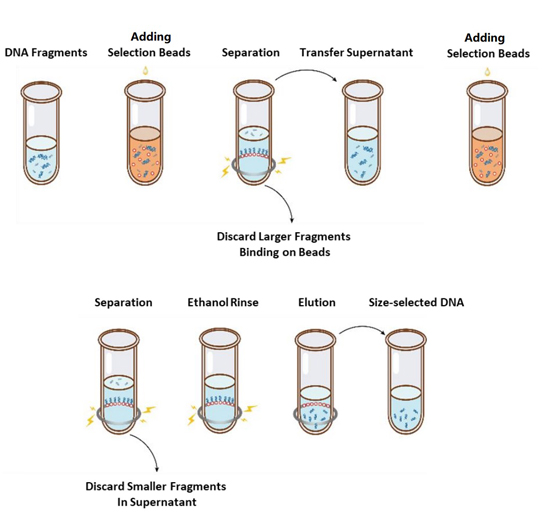
Gambar 1. Diagram Alir Pemilihan Ukuran DNA
2.1 Aduk manik-manik secara menyeluruh dengan cara memutarnya atau memipetnya ke atas dan ke bawah setiap kali sebelum digunakan.
2.2 Tambahkan putaran pertama manik-manik seleksi ke dalam sampel (lihat Tabel 1). Aduk hingga merata dengan cara memutar atau memipet ke atas dan ke bawah setidaknya 10 kali.
2.3 Inkubasi pada suhu ruangan selama 5 menit.
2.4 Putar tabung reaksi sebentar dan letakkan pada dudukan magnet. Bila larutan sudah bening (sekitar 5 menit), pindahkan supernatan ke tabung PCR baru.
2.5 Tambahkan putaran kedua manik-manik seleksi ke sampel dari langkah 2.4 sesuai dengan Tabel 1. Aduk rata dengan cara memutar atau memipet ke atas dan ke bawah setidaknya 10 kali.
2.6 Inkubasi pada suhu ruangan selama 5 menit.
2.7 Putar tabung sebentar dan letakkan pada dudukan magnet. Bila larutan sudah bening (sekitar 5 menit), aspirasikan cairan supernatan dan buang.
2.8 Simpan tabung pada dudukan magnet dan tambahkan 200 μL etanol 80% yang baru disiapkan tanpa mengganggu manik-manik, inkubasi pada suhu ruangan selama 30 detik. Aspirasi etanol dan buang.
2.9 Ulangi langkah 2.8 satu kali untuk total dua kali pencucian.
2.10 Buang sisa etanol dengan ujung pipet 10 µL. Simpan tabung di dudukan magnet, keringkan manik-manik seleksi dengan tutup terbuka hingga retakan muncul (sekitar 5 menit).
Catatan: Jangan terlalu mengeringkan manik-manik seleksi. Ini dapat mengakibatkan target DNA pemulihan yang lebih rendah.
2.11 Keluarkan tabung dari dudukan magnet. Tambahkan ddH2O dalam jumlah yang sesuai (≥20 µL) dan aduk hingga merata dengan cara memutar atau memipet ke atas dan ke bawah setidaknya 10 kali.
2.12 Inkubasi pada suhu ruangan selama 5 menit.
Putar tabung sebentar dan letakkan pada dudukan magnet. Bila larutan sudah bening (sekitar 5 menit), pindahkan 20 μL supernatan ke tabung baru.
- 3.Kondisi yang Direkomendasikan untuk Pemilihan Ukuran DNA
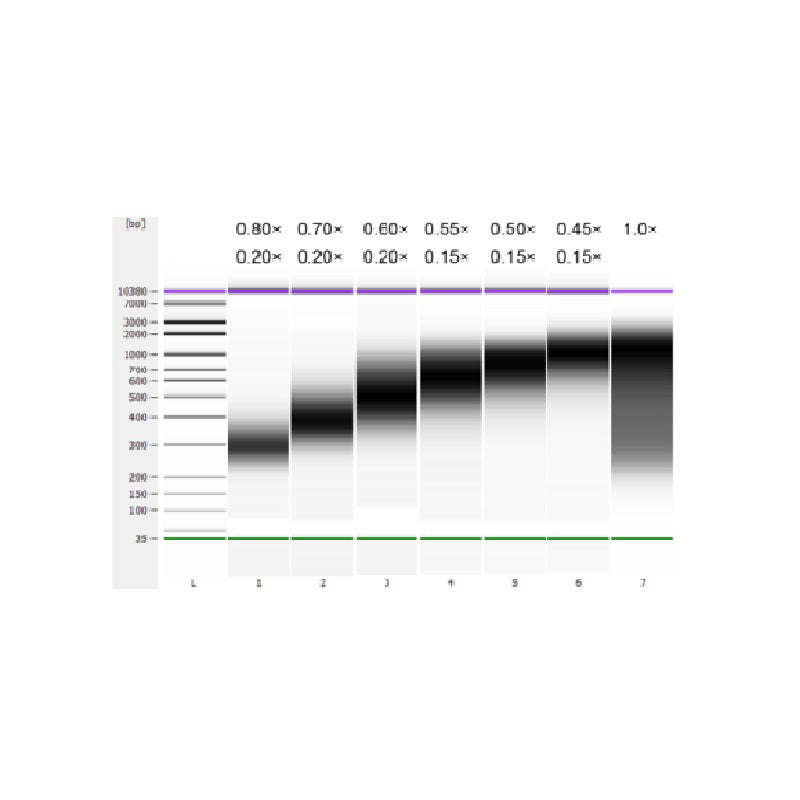
DNA kelenjar timus sapi difragmentasi dengan sonikasi untuk menyiapkan fragmen berukuran 100-1.000 bp, dan dilakukan dua putaran pemilihan ukuran sesuai Tabel 1. Hasilnya dianalisis menggunakan Agilent 2100 Bioanalyzer (Gambar 2).
Tabel 1. Kondisi yang direkomendasikan untuk pemilihan ukuran DNA
| Panjang fragmen DNA | 250-350bp | 320-420bp | 450-550bp | 550-700bp | 700-900bp | 800-1.000bp |
| Rasio Manik-manik: DNA untuk Putaran Pertama | 0,80× | 0,70 kali | 0,60× | 0,55 kali | 0,50 kali | 0,45x |
| Rasio Manik-manik: DNA untuk ke 2 Bulat | 0,20× | 0,20× | 0,20× | 0,15× | 0,15× | 0,15× |
Catatan: "×" dalam tabel menunjukkan volume sampel DNA. Misalnya, jika panjang sisipan pustaka adalah 250 bp dan volume sampel DNA adalah 100 μL, volume manik magnetik yang digunakan dalam putaran pertama penyortiran adalah 0,80×100 μL=80 μL; volume manik magnetik yang digunakan dalam putaran kedua penyortiran adalah 0,20×100 μL=20 μL.
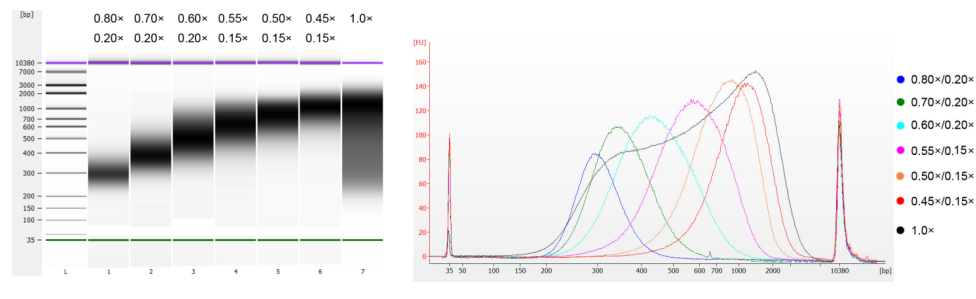
Gambar 2. Elektroforogram chip DNA sensitivitas tinggi Agilent 2100
Catatan:
1. Demi keselamatan dan kesehatan Anda, harap kenakan jas lab dan sarung tangan sekali pakai saat beroperasi.
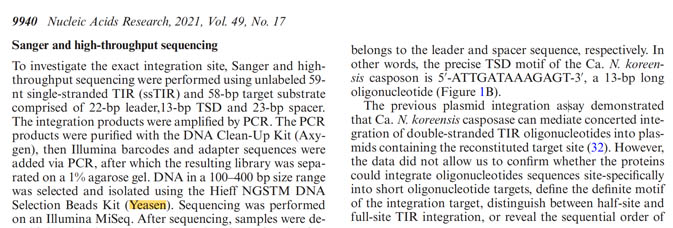
Dikutip dari "Integrasi spesifik urutan oleh keluarga 1 casposase dari Candidatus Nitrosopumilus koreensis AR1. Jurnal Asam Nukleat 2021;49(17):9938-9952. doi:10.1093/nar/gkab725"
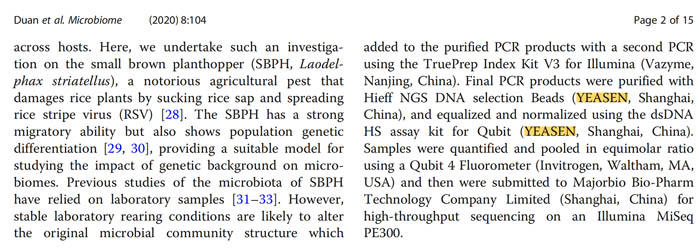
Dikutip dari "Infeksi Wolbachia baru-baru ini mengubah komunitas mikroba pada populasi Laodelphax striatellus liar. Mikrobioma. 2020;8(1):104. Diterbitkan 2 Juli 2020. doi:10.1186/s40168-020-00878-x"
[1] Wang X, Yuan Q, Zhang W, et al. Integrasi spesifik urutan oleh casposase keluarga 1 dari Candidatus Nitrosopumilus koreensis AR1. Jurnal Asam Nukleat 2021;49(17):9938-9952. doi:10.1093/nar/gkab725(IF:16.971)
[2] Duan XZ, Sun JT, Wang LT, dkk. Infeksi terkini oleh Wolbachia mengubah komunitas mikroba pada populasi Laodelphax striatellus liar. Mikrobioma. 2020;8(1):104. Diterbitkan 2 Juli 2020. doi:10.1186/s40168-020-00878-x(IF:11.607)
[3] Lagu B, Almatrafi E, Sang F, dkk.Pengelolaan sedimen yang diolah Fenton dengan biochar dan kompos kotoran domba: Dampaknya terhadap karakteristik evolusi komunitas bakteri. J Environ Manage. 2022;316:115218. doi:10.1016/j.jenvman.2022.115218(IF:6.789)
[4] Huang C, Mei Q, Lou L, dkk. Kolitis Ulseratif sebagai Respon terhadap Transplantasi Mikrobiota Feses melalui Modulasi Mikrobiota Usus dan Keseimbangan Sel Th17/Treg. Sel. 2022;11(11):1851. Diterbitkan 5 Juni 2022. doi:10.3390/cells11111851(IF:6.600)
[5] Ghosh S, Yang X, Wang L, Zhang C, Zhao L. Pemberian prebiotik fase aktif mengubah mikrobiota usus, menginduksi pengurangan steatosis hati dan kolesterol serum yang tidak bergantung pada berat badan pada tikus yang diberi diet tinggi lemak. Comput Struct Biotechnol J. 2020;19:448-458. Diterbitkan 24 Desember 2020. doi:10.1016/j.csbj.2020.12.011(IF:6.018)
[6] Gao X, Yu B, Yu J, dkk. Profil Perkembangan Pencernaan Karbohidrat Makanan pada Anak Babi. Front Microbiol. 2022;13:896660. Diterbitkan 29 April 2022. doi:10.3389/fmicb.2022.896660(IF:5.640)
[7] Li P, Zhang Y, Yan F, Zhou X. Karakteristik Bakteriofag, vB_Kox_ZX8, yang Diisolasi dari Klebsiella oxytoca Klinis dan Efek Terapinya pada Bakteremia Tikus. Front Microbiol. 2021;12:763136. Diterbitkan 3 Desember 2021. doi:10.3389/fmicb.2021.763136(IF:5.640)
[8] Lin Z, Luo P, Huang D, Wu Y, Li F, Liu H. Strategi berbasis multi-omik untuk analisis toksisitas akrilamida dalam model Saccharomyces cerevisiae. Chem Biol Interact. 2021;349:109682. doi:10.1016/j.cbi.2021.109682(IF:5.194)
[9] Sun X, Lv W, Wang Y, dkk. Gen Mrgprb2 berperan dalam reaksi anafilaktoid yang disebabkan oleh injeksi Houttuynia cordata. J Etnofarmakol. 2022;289:115053. doi:10.1016/j.jep.2022.115053(IF:4.360)
[10] Ma H, Lai B, Zan C, Di X, Zhu X, Wang K. GLO1 Berkontribusi pada Resistensi Obat Escherichia coli Melalui Induksi β-Laktamase Spektrum Luas Tipe PER. Infect Drug Resist. 2022;15:1573-1586. Diterbitkan 5 April 2022. doi:10.2147/IDR.S358578(IF:4.003)
[11] Zhong Y, Zhao W, Tang Z, dkk. Analisis transkriptomik komparatif dari berbagai tahap perkembangan ovarium pada udang karang rawa merah Procambarus clarkii. BMC Genomics. 2021;22(1):199. Diterbitkan 21 Maret 2021. doi:10.1186/s12864-021-07537-x(IF:3.969)
[12] Lian C, Yang H, Lan J, dkk. Analisis komparatif genom kloroplas mengungkap hubungan filogenetik dan variasi intraspesifik pada tanaman obat Isodon rubescens. PLoS One. 2022;17(4):e0266546. Diterbitkan 6 April 2022. doi:10.1371/journal.pone.0266546(IF:3.240)
[13] Diao G, Huang J, Zheng X, dkk. Prostaglandin E2 memiliki peran ganda dalam mengatur migrasi sel dendritik. Int J Mol Med. 2021;47(1):207-218. doi:10.3892/ijmm.2020.4801(IF:3.098)
[14] Bing XL, Zhao DS, Peng CW, Huang HJ, Hong XY. Kesamaan dan variasi spasial komunitas bakteri dan jamur pada populasi wereng padi sawah (Hemiptera: Delphacidae). Insect Sci. 2020;27(5):947-963. doi:10.1111/1744-7917.12782(IF:2.791)
[15] Li X, Zhou S, Zhang J, Zhou Z, Xiong Q. Perubahan Arah dalam Komunitas Bakteri Usus pada Larva Lalat Tentara Hitam (Hermetia illucens). Hewan (Basel). 2021;11(12):3475. Diterbitkan 6 Desember 2021. doi:10.3390/ani11123475(IF:2.752)
[16] Yang J, Peng Y, Kong W. Identifikasi dan urutan genom lengkap virus kriptik mulberry 1. Arch Virol. 2022;167(2):687-690. doi:10.1007/s00705-021-05350-1(IF:2.574)
[17] Chang Y, Xia X, Sui L, dkk. Kolonisasi endofit pada jamur entomopatogen meningkatkan ketahanan tanaman terhadap penyakit dengan mengubah komunitas bakteri endofit. J Basic Microbiol. 2021;61(12):1098-1112. doi:10.1002/pekerjaanm.202100494(JIKA:2.281)
[18] Ding CY, Ma YM, Li B, dkk. Identifikasi dan Analisis Fungsional Gen yang Diekspresikan Secara Berbeda di Myzus persicae (Hemiptera: Aphididae) sebagai Respon terhadap Trans-anethole. J Insect Sci. 2022;22(1):3. doi:10.1093/jisesa/ieab094(IF:1.857)
Storage
FAQ
2) The proportion of magnetic beads is incorrect. It is recommended to select the appropriate proportion according to the instructions.
3) The incubation time is insufficient. Ensure that the incubation time is at least 5 minutes.
4) During magnetic bead separation, when the two wheels perform magnetic bead adsorption, the magnetic beads are collected. A 10 μL pipette can be connected in series before the 200 μL pipette for liquid transfer, which can prevent the collection of magnetic beads.
5) During the magnetic bead washing process, the ethanol solution was not prepared freshly, resulting in an insufficiently high ethanol concentration. It is recommended that the ethanol concentration be no less than 70%, and for small fragments, it should be no less than 80%.
6) Excessive drying: If the magnetic beads are dried for too long, the surface will crack, making it difficult to elute the DNA and resulting in a decrease in yield. It is recommended that the drying time should not be too long; the moment the surface begins to crack, drying should be stopped.
7) Insufficient volume of elution solution: The final elution solution should completely cover the magnetic beads within the tube.
8) Sample reasons: The sample purity is low and contains impurities. When there are a large amount of impurities in the sample, it may cause the magnetic beads to aggregate and harden, resulting in insufficient elution. Using a pipette, try to blow the magnetic beads apart as much as possible, extend the elution time, and increase the product recovery rate. If there are many large fragments in the sample, the large fragments will cause the magnetic beads to aggregate. During elution, you can prolong the time or, if necessary, incubate at 37 degrees to improve the yield.
Citations
Documents
| Brochure |
|---|
| Magnetic_Beads_for_DNA_RNA_and_mRNA_Enrichment.pdf |
Applications
Anda mungkin juga menyukai
Pertanyaan
FAQ
Produk ini hanya untuk keperluan penelitian dan tidak ditujukan untuk penggunaan terapeutik atau diagnostik pada manusia atau hewan. Produk dan konten dilindungi oleh paten, merek dagang, dan hak cipta milik
Aplikasi tertentu mungkin memerlukan hak kekayaan intelektual pihak ketiga tambahan.