
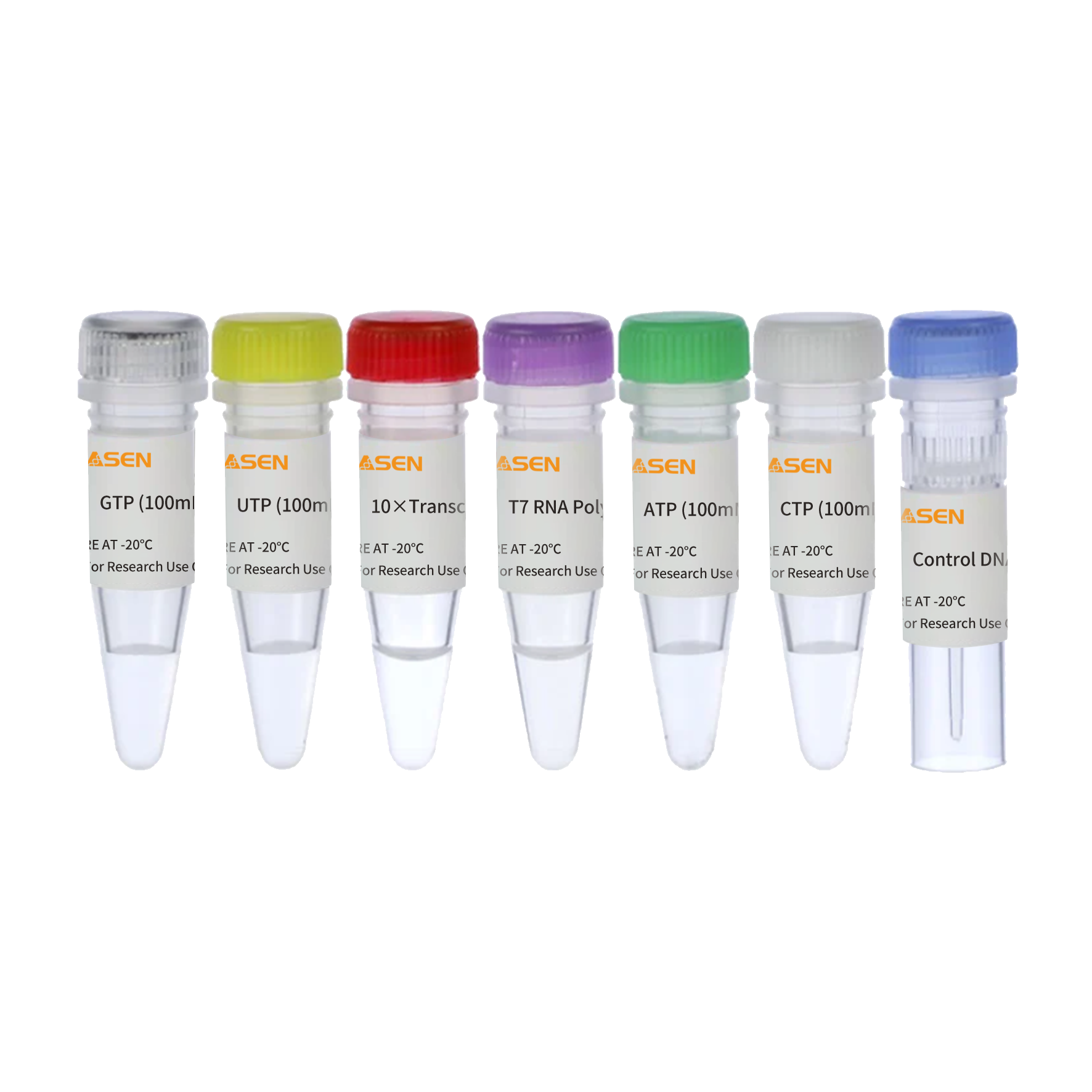

Le kit de synthèse d'ARN à haut rendement T7 optimise le système de réaction de transcription. Le kit peut synthétiser efficacement l'ARN monocaténaire en utilisant l'ARN polymérase T7, l'ADN double brin linéaire avec la séquence promotrice T7 comme matrice, les NTP comme substrat pour contrôler la séquence d'ADN en aval du promoteur. Pendant la transcription, des nucléotides modifiés peuvent être ajoutés au substrat pour préparer de l'ARN marqué à la biotine ou par un colorant.
Ce kit permet de synthétiser des transcriptions longues et courtes, l'ARN peut être produit à 100-200 μg avec 1 μg de matrice d'ADN en entrée. L'ARN synthétisé par transcription peut être utilisé pour diverses applications en aval, telles que la recherche sur la structure et la fonction de l'ARN, la protection par ARNase, l'hybridation de sondes, l'ARNi, la microinjection et in vitro traduction.
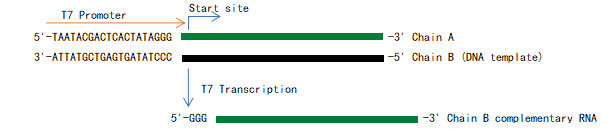
Figure 1 : In vitro Processus de transcription de l'ARN
Fonctionnalité
- Jusqu'à 180 μg d'ARN par réaction à partir de 1 μg du modèle de contrôle
- Système de réaction optimisé pour le procédé IVT
- Diminuer la production d'ARNdb
- Intégrité et pureté de l'ARN supérieures
Application
- In vitro Synthèse d'ARN
Composants
| Composants N° | Nom | 10623ES50 (50 T) | 10623ES60 (100 T) | 10623ES70 (500 T) |
| 10623-A | Mélange d'ARN polymérase T7 | 100 μL | 200 μL | 1 ml |
| 10623-B | Tampon de transcription 10× | 100 μL | 200 μL | 1 ml |
| 10623-C | ATP (100 mM) | 100 μL | 200 μL | 1 ml |
| 10623-D | CTP (100 mM) | 100 μL | 200 μL | 1 ml |
| 10623-F | GTP (100 mM) | 100 μL | 200 μL | 1 ml |
| 10623-F | Câble UTP (100 mM) | 100 μL | 200 μL | 1 ml |
| 10623-G | Modèle d'ADN de contrôle (500 ng/μL) | 10 μL | 20 μL | 100 μL |
Expédition et stockage
Transport de glace sèche. Conserver à -15℃ ~ -25℃, valable deux ans.
Chiffres
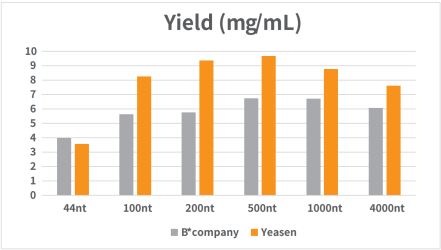
Figure 1. L'ARN standard a été synthétisé in vitro à l'aide du kit de synthèse d'ARN T7.
La réaction a été incubée dans un instrument PCR à 37 °C pendant 2 heures, puis purifiée par des billes magnétiques (Cat. n° 12602). Le résultat du rendement a été analysé par spectrophotomètre NanoDrop comme indiqué dans la figure 1.
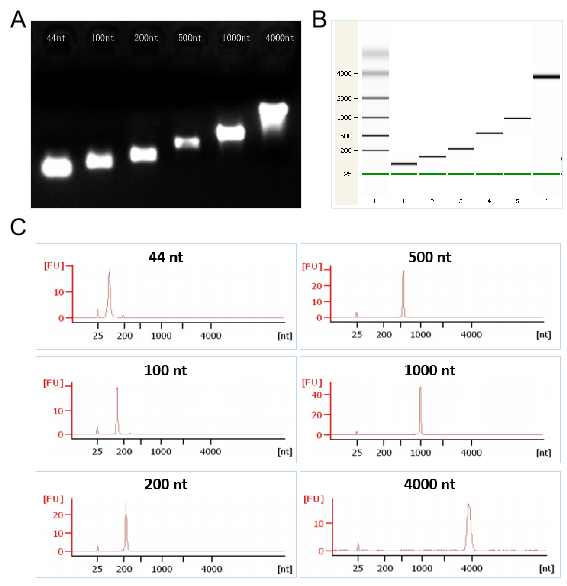
Figures 2. Démonstration de la transcription de différentes longueurs d'ARN par le kit T7 respectivement dans l'électrophorétogramme (Figures 2A), le diagramme d'électrophorèse capillaire (Figures 2B) et le chromatogramme (Figures 2C)
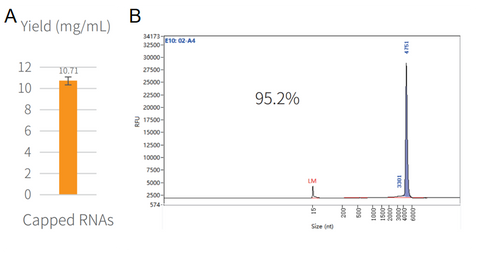
Figure 3. Synthèse d’ARN coiffé in vitro.
La réaction a été incubée dans un instrument PCR à 37 °C pendant 2 h, puis purifiée par des billes magnétiques (réf. 12602). Le résultat du rendement a été analysé par spectrophotomètre NanoDrop comme indiqué sur la figure 3A. Le résultat de l'intégrité a été analysé par électrophorèse capillaire comme indiqué sur la figure 3B.
1. Faible rendement de transcription
La qualité du modèle est étroitement liée au rendement. Si le rendement du groupe expérimental est significativement inférieur à celui du groupe témoin, les raisons possibles sont les suivantes :
① le modèle expérimental contient des composants inhibiteurs ;
② Il y a quelque chose qui ne va pas dans le modèle.
Suggestions:
① Re-purifier le modèle ;
② Déterminer la quantification du modèle et son intégrité ;
③ Prolongez le temps de réaction ;
④ Augmenter la quantité de modèles saisis ;
⑤ Essayez d’autres promoteurs et ARN polymérases.
2. Faible rendement des transcriptions courtes
Un fragment d'initiation de transcription court inhibera la réaction. Lorsque le produit de transcription est inférieur à 100 nt, l'allongement du temps de réaction à 4-8 heures ou l'augmentation de la quantité de matrice à 2 μg augmentera le rendement en ARN.
3. La longueur de la transcription de l'ARN est supérieure à celle attendue
Si l'électrophorèse montre que la bande de produit est plus grande que la taille attendue, les raisons possibles sont les suivantes :
①Le modèle plasmidique peut ne pas être complètement linéarisé ;
②L'extrémité 3' du brin sens présente une structure proéminente ;
③L’ARN a une structure secondaire qui n’est pas complètement dénaturée.
Suggestions:
①Vérifiez si le modèle est complètement linéarisé et, si nécessaire, effectuez une linéarisation supplémentaire ;
②Sélectionnez une enzyme de restriction appropriée pour éviter les surplombs 3', ou utilisez l'ADN polymérase Klenow Fragment / T4 pour terminer la transcription avant de continuer ;
③Utilisez un gel dénaturé pour détecter les produits d’ARN.
4. La longueur de la transcription de l'ARN est inférieure à celle attendue
Si l'électrophorèse montre que la bande de produit est plus petite que la taille attendue, les raisons possibles sont les suivantes :
①Le modèle contient une séquence de terminaison similaire à l’ARN polymérase T7 ;
②Le contenu GC du modèle est élevé.
Suggestions:
①Abaissez la température de réaction (par exemple, 30°C). Parfois, l'abaissement de la température peut augmenter la longueur de la transcription, mais cela réduira le rendement. Ou essayez différentes ARN polymérases pour la transcription ;
②Si la teneur en GC du modèle est élevée, utilisez 42℃ pour transcrire, ou ajouter du SSB pour augmenter le rendement et la longueur de la transcription.
5. Élimination des produits de transcription par électrophorèse
Il y a un phénomène de traînée lors de l'électrophorèse.
Raisons possibles :
①Contaminé par la RNase lors d’une opération expérimentale ;
②Modèle d’ADN contaminé par la RNase.
Suggestions:
①Utilisez des pointes de pipette et des tubes EP sans RNase, portez des gants et des masques en latex jetables et tous les réactifs sont préparés avec de l'eau sans RNase.
②Re-purifier l’ADN modèle.
[1] Dong Z, Zheng N, Hu C et al.L'ARN de type microARN 8 (Nb-milR8) de Nosema bombycis augmente la pathogénicité fongique en modulant l'expression du gène BmPEX16 chez son hôte, Bombyx mori. Microbiol Spectr. 2021;9(2):e0104821. doi:10.1128/Spectrum.01048-21(IF:7.171)
[2] Wang X, Tang S, Ye S, et al. Quantification ultrasensible du miR-195-5p circulant avec cascade d'amplification par déplacement triple brin. Talanta. 2022 ; 242 : 123300. doi : 10.1016/j.talanta.2022.123300(IF : 6.057)
Storage
FAQ
The optimization of the IVT system can be achieved by adjusting the template, the amount of T7 enzyme used, and if it is co-transcription with cap addition, the ratio between the cap and NTP can be considered; for enzymatic cap addition, the conditions can be optimized in terms of the dosage of the cap-adding enzyme, 2-O-methyltransferase, and SAM. Regarding the template, apart from the requirement of complete linearization, there is another point, which is sequence design. For example, in the 5'UTR region, pay attention to uAUG and Kozak sequence; for CDS, consider the codon preference, GC3 content, and dinucleotide preference, etc.; 3'UTR: RBP and miRNA binding sites: and another point is the secondary structure of RNA. The stable secondary structure of the 5'UTR pre-sequence will reduce the expression of mRNA; the stable secondary structure of 3'UTR will increase the stability of mRNA and promote the expression of the encoded protein. For the recommended IVT system and more detailed tips, please refer to the mRNA in vitro synthesis experiment manual of Vivian Biotechnology.
The average yield is between 120-220 ug/ul (the yield is highly dependent on the sequence design). In the co-transcription method, the mRNA yield is 8 g/L. With process optimization, the yield will increase. Currently, the quality parameters of the available processes include observing the fluorescence value of GFP and measuring the cap addition rate using LC-MS.
The T7 pol enzyme will use the product RNA as a template and continue to extend the RNA at its 3' end. The extended sequence will form complementary pairing with the 3' end sequence of the original RNA molecule, thereby creating a hairpin structure.
The T7 pol enzyme can use RNA as a template to replicate RNA molecules, and synthesize the complementary strand.
(At present, there is no effective method for removing dsRNA. However, there is a patent report suggesting that a fiber column (sigma) could be tried.)
1. Reduce the concentration of magnesium ions; however, reducing the concentration of magnesium ions will also lead to a decrease in the production of RNA, and a balance point needs to be reached.
2. Increase the reaction temperature of IVT to 50-56℃. This temperature can effectively reduce the content of dsRNA in the product; however, the requirements for equipment for high-temperature reactions will vary, and it may also increase the cost.
3. In the IVT reaction system, certain dispersants such as urea and formamide are added; our process research team has also conducted some experiments on this route, which can achieve the effect of inhibiting dsRNA. However, whether it is suitable for process scaling-up still needs further research.
This kind of precipitation occurs by chance and is also closely related to the sequence design.
Solution: (1) Reduce the concentration of magnesium ions, but this will result in a decrease in yield. The amount of T7 enzyme needs to be increased and the reaction time (from 2 hours to 3-4 hours) needs to be extended; (2) The form of NTP (the presence of magnesium ions at a high concentration, such as 46 mM, does not select NTP, but when the magnesium ion concentration decreases, the yield of NTP (Tris salt form) does not change much, and the yield of the triNa form of NTP decreases significantly.
Citations
Documents
| Manual |
|---|
| 10623_Manual_HB230115_EN.pdf |
Applications

Vous pouvez aussi aimer
Enquête
FAQ
Le produit est destiné à des fins de recherche uniquement et n'est pas destiné à un usage thérapeutique ou diagnostique chez l'homme ou l'animal. Les produits et le contenu sont protégés par des brevets, des marques déposées et des droits d'auteur appartenant à Yeasen Biotechnology. Les symboles de marque indiquent le pays d'origine, pas nécessairement l'enregistrement dans toutes les régions.
Certaines applications peuvent nécessiter des droits de propriété intellectuelle tiers supplémentaires.
Yeasen se consacre à la science éthique, estimant que nos recherches doivent répondre à des questions cruciales tout en garantissant la sécurité et les normes éthiques.