
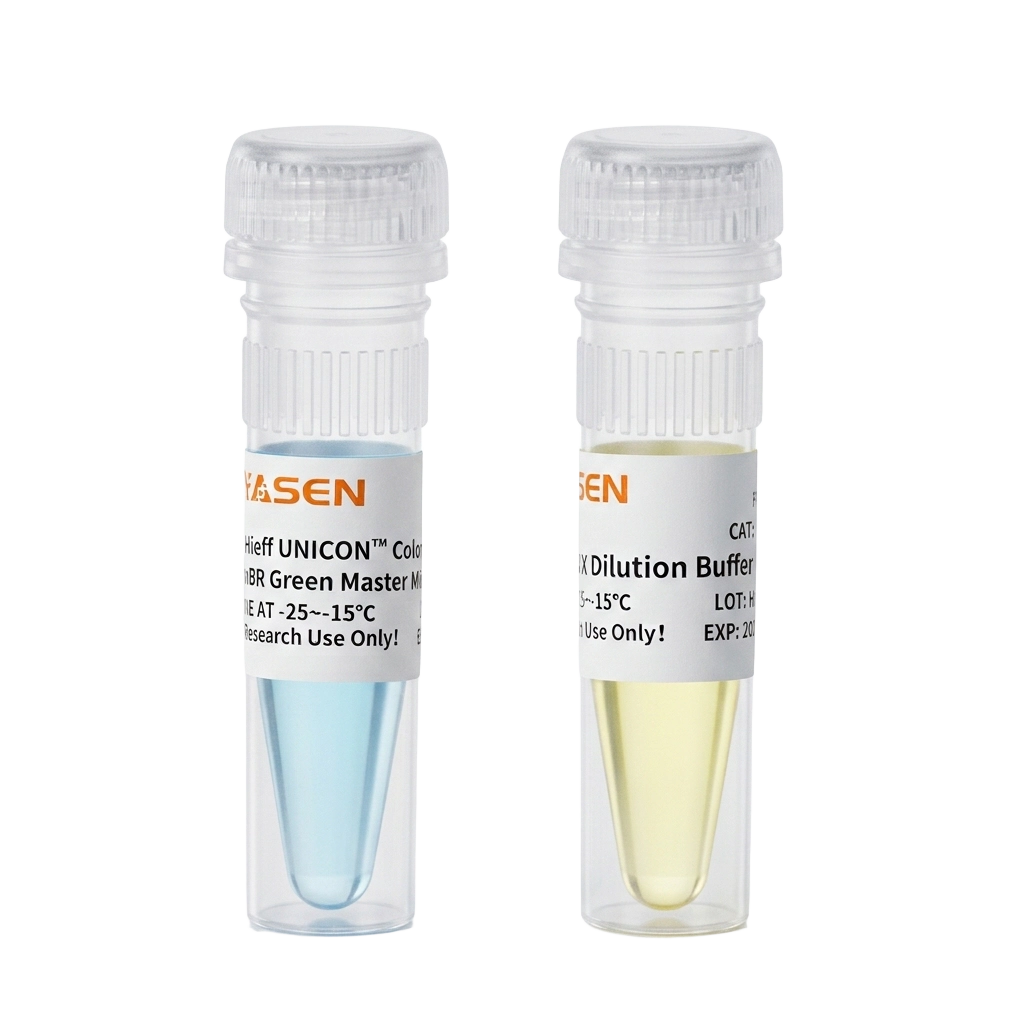


Hieff UNICON™ ColorGPS qPCR Master Mix (No Rox) ist eine Vorlösung für die 2× quantitative PCR-Amplifikation in Echtzeit mit hoher Fluoreszenzintensität, hoher Sensitivität und Spezifität sowie hoher Amplifikationsausbeute. Die Kernkomponente, Hieff UNICON™ Taq DNA-Polymerase, wird durch eine Antikörpermethode heißgestartet, wodurch unspezifische Amplifikationen, die durch Primer-Annealing während der Probenvorbereitung verursacht werden, wirksam gehemmt werden können. Gleichzeitig fügt die Formel Faktoren hinzu, die die Amplifikationseffizienz der PCR-Reaktion verbessern, und erleichtert die Amplifikation von Genen mit unterschiedlichem GC-Gehalt (30–70 %), sodass die quantitative PCR in einem breiten Bereich quantitativer Regionen eine gute lineare Beziehung erzielen kann. Das Produkt nutzt die gemischte Farbwechselreaktion verschiedener Farbstoffe, um den Pipettiervorgang zu überwachen, wodurch das Auftreten von Pipettierfehlern wirksam reduziert wird.
Merkmale
Pipettierverfolgung: Reduzieren Sie das Risiko von übersehenen/Zugabefehlern
Hervorragende Verstärkung: Gute Linearität über einen weiten linearen Bereich
Hohe Präzision: Kann Vorlagen mit einem 2-fachen Konzentrationsunterschied genau unterscheiden
Gute Wiederholbarkeit: Geringe Variabilität zwischen den Vertiefungen in Replikationsvertiefungen, was zu einer besseren Wiederholbarkeit führt
Stabil und zuverlässig: Das Reaktionssystem kann 24 Stunden bei Raumtemperatur gelagert werden und das Produkt bleibt nach 20 Gefrier-Auftau-Zyklen unverändert
Anwendungen
Analyse der Genexpression-Unterschiede
Absolute quantitative Analyse
Technische Daten
| Konzentration | 2 ×(qPCR-Mischung) |
| Nachweisverfahren | Färbemethode |
| PCR-Methode | qPCR |
| Polymerase | Taq DNA-Polymerase |
| Art der Probe | DNA |
| Anwendungsgeräte | Bio-Rad CFX96, CFX384, iCycler iQ, iQ5, MyiQ; MiniOpticon, Opticon, Opticon 2, Chromo4; Cepheid SmartCycler; Eppendorf Mastercycler ep realplex, realplex 2 s; Illumina Eco qPCR; Qiagen/Corbett Rotor-Gene Q, Rotor-Gene 3000, Rotor-Gene 6000; Roche Applied Science LightCycler 480; Thermo Scientific PikoReal Cycler und andere Fluoreszenz-quantitative PCR-Instrumente, die keine Zugabe von ROX-Referenzfarbstoff erfordern |
| Produkttyp | Premix für die quantitative Fluoreszenz-PCR in Echtzeit |
| Bewerben bei (Bewerbung) | Genexpression |
Komponenten
| Komponenten Nr. | Name | 11188ES03 | 11188ES08 | 11188ES60 |
| 11188-A | Hieff UNICON™ ColorGPS qPCR Master-Mix (Kein Rox) | 1 ml | 5×1 ml | 100×1 ml |
| 11188-B | 10×Verdünnungspuffer | 1 ml | 1 ml | 20×1 ml |
Versand und Lagerung
Dieses Produkt sollte 1 Jahr lang bei -25–15 °C gelagert werden.
Zahlen
 Abbildung 1. Innerhalb des Dynamikbereichs können zuverlässige Ergebnisse erzielt werden.
Mithilfe von 2 µL Plasmidvorlagen mit einem Gradienten von 10^1-10^7 wurden die entsprechenden Gene amplifiziert. Hieff UNICON™ Der ColorGPS-Mastermix kann einen Vorlagenmengenbereich von 7 Größenordnungen effektiv erkennen und erreicht eine gute Linearität innerhalb eines breiten linearen Bereichs.
 Figur2. Kann Konzentrationsunterschiede der Vorlage von bis zu 2-fach genau unterscheiden.
Unter Verwendung von 2 µL Plasmid, verdünnt in einem 2-fachen Gradienten, als Vorlage wurden die entsprechenden Gene amplifiziert. Hieff UNICON™ Der ColorGPS-Mastermix kann Konzentrationsunterschiede in der Vorlage präzise auflösen.
 Figur3. Es wird eine geringe Variabilität zwischen den Vertiefungen beobachtet, was auf eine bessere Wiederholbarkeit hinweist.
Unter Verwendung von Dutzenden von Plasmidkopien als Vorlage wurde die Amplifikation mit verschiedenen fluoreszierenden quantitativen Reagenzien gemäß den in den jeweiligen Bedienungsanleitungen angegebenen Verfahren durchgeführt. Die SD-Werte zeigen, dass das neue Produkt im Vergleich zu anderen Reverse-Transkriptionsreagenzien kleinere Unterschiede zwischen Replikationsvertiefungen und eine bessere Wiederholbarkeit aufweist.
 Figur4. Flexibler, für Standard- oder Schnellverfahren geeignet.
Beim Standardverfahren werden die Denaturierungszeit und die Verlängerungszeit auf 10 Sekunden bzw. 30 Sekunden eingestellt, während beim Schnellverfahren die Denaturierungszeit und die Verlängerungszeit auf 3 Sekunden bzw. 10 Sekunden eingestellt werden, um die Ct-Werte zu erkennen, die den 10 Zielgenen entsprechen.Die Ergebnisse zeigen, dass die mit dem neuen Produkt sowohl im Standard- als auch im Schnellverfahren erzielten Ct-Werte eine starke Korrelation aufweisen und dass das neue Produkt im Schnellverfahren gute Ergebnisse erzielen kann.
 Figur5. Nachdem das Reaktionssystem hergestellt wurde, kann es 24 Stunden lang bei Raumtemperatur stabil bleiben.
Unter Verwendung verschiedener Gene von Mäusen, menschlichen 293-Zellen und Arabidopsis thaliana als Ziel wurde das Reaktionssystem nach der Vorbereitung vor der Erkennung 24 Stunden lang bei unterschiedlichen Temperaturen im Dunkeln aufbewahrt. Im Vergleich zur sofortigen Verarbeitung überschreitet der Erkennungsunterschied für verschiedene Gene 0,5 Ct nicht, was darauf hindeutet, dass auch bei lang andauernden Operationen stabile Ergebnisse erzielt werden können.
DDokumente:
Benutzerhandbücher
Storage
FAQ

1. The instrument has not been calibrated for a long time or it is aging. Usually, the instrument needs to be calibrated once a year. It is necessary to have an instrument engineer perform the calibration or replace the aging components.
2. A 10 μL reaction system was used. The normal system is a 20 μL system. Using half of the normal system would result in an excessively low total concentration of Rox, increasing the probability of BadRox occurrence. It is recommended to conduct the experiment using the 20 μL system.
2. Is the length of the product too long? If the length of the product is set to 500bp or more, this situation may occur. It is recommended that during primer design, the length of the product be controlled within the range of 80-300bp.
3. Are the primers inappropriate? If the primers are not designed correctly, they need to be redesigned. If the primers are correctly designed but seem to be degraded, PAGE electrophoresis can be used to check the integrity of the primers.
4.Template degradation: Prepare the template anew and repeat the experiment.
2. What if CT is ≥ 30 but the repeatability is very poor? At this point, due to the low abundance of the effective template, the randomness of collisions between the template and the primers increases, thereby causing a greater difference between the replicons. It is recommended to try adding 2-3 replicons, and then eliminate the data with large differences for data analysis.
Citations
Documents
| Brochure |
|---|
| Comprehensive_And_Professional_qPCR_Solution.pdf |
Applications
Sie können auch mögen
Anfrage
FAQ
Das Produkt ist nur für Forschungszwecke bestimmt und nicht für die therapeutische oder diagnostische Anwendung bei Menschen oder Tieren. Produkte und Inhalte sind durch Patente, Marken und Urheberrechte von
Für bestimmte Anwendungen sind möglicherweise zusätzliche geistige Eigentumsrechte Dritter erforderlich.