
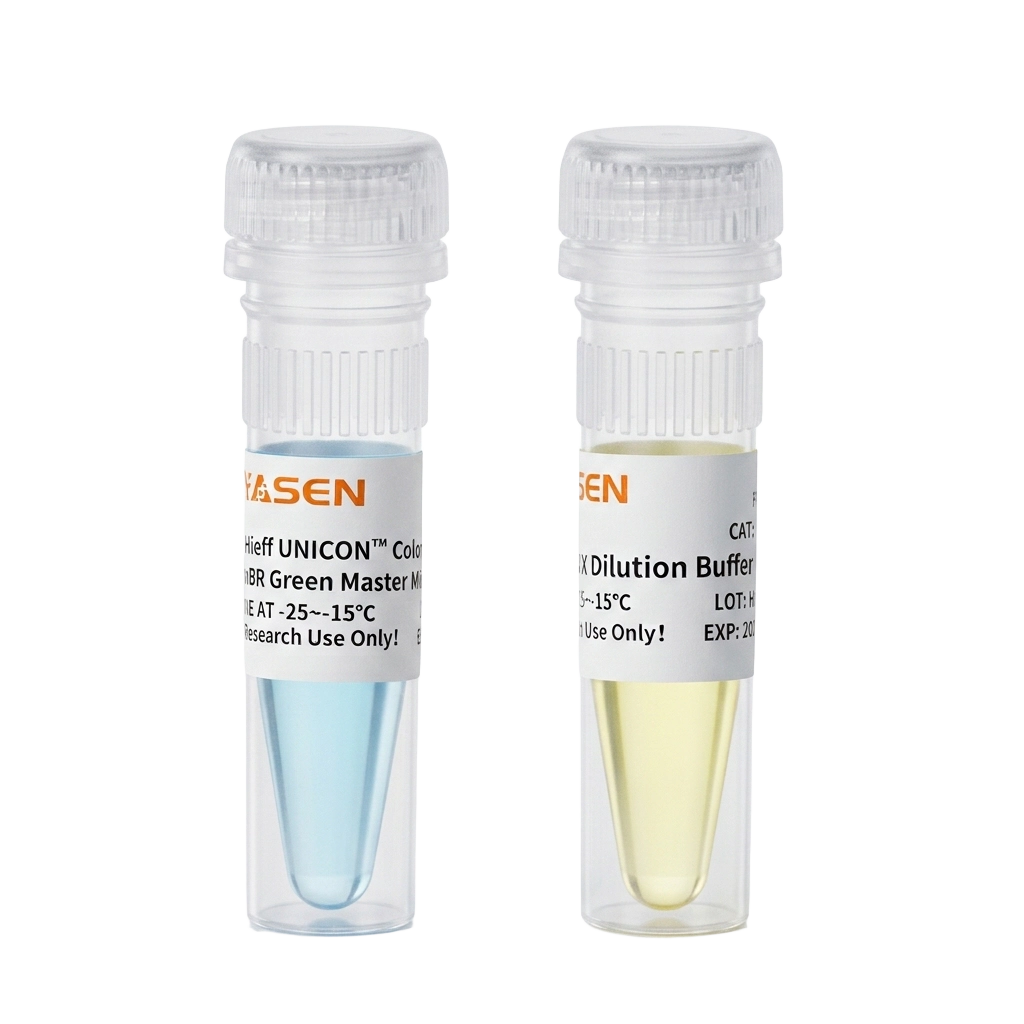


Hieff UNICON™ ColorGPS qPCR Master Mix (Low Rox) là dung dịch tiền khuếch đại PCR định lượng thời gian thực 2x, có cường độ huỳnh quang cao, độ nhạy và độ đặc hiệu cao, và hiệu suất khuếch đại cao. Thành phần cốt lõi, Hieff UNICON™ Taq DNA Polymerase, được khởi động nóng bằng phương pháp kháng thể, có thể ức chế hiệu quả sự khuếch đại không đặc hiệu do gắn mồi trong quá trình chuẩn bị mẫu. Đồng thời, công thức bổ sung các yếu tố để tăng hiệu quả khuếch đại của phản ứng PCR và các chất xúc tác để cân bằng sự khuếch đại của các gen có hàm lượng GC khác nhau (30~70%), do đó PCR định lượng có thể thu được mối quan hệ tuyến tính tốt trong nhiều vùng định lượng. Sản phẩm sử dụng phản ứng thay đổi màu hỗn hợp của các loại thuốc nhuộm khác nhau để theo dõi hoạt động hút, giúp giảm hiệu quả xảy ra lỗi hút.
Đặc trưng
Theo dõi việc hút: Giảm nguy cơ bỏ sót/lỗi thêm
Độ khuếch đại tuyệt vời: Độ tuyến tính tốt trên phạm vi tuyến tính rộng
Độ chính xác cao: Có thể phân biệt chính xác các mẫu có nồng độ chênh lệch gấp 2 lần
Độ lặp lại tốt: Độ biến thiên nhỏ giữa các giếng trong các giếng sao chép, dẫn đến độ lặp lại tốt hơn
Ổn định và đáng tin cậy: Hệ thống phản ứng có thể được lưu trữ ở nhiệt độ phòng trong 24 giờ và sản phẩm vẫn không bị ảnh hưởng sau 20 chu kỳ đông lạnh-tan băng
Ứng dụng
Phân tích sự khác biệt biểu hiện gen
Phân tích định lượng tuyệt đối
Thông số kỹ thuật
| Sự tập trung | 2 ×(Hỗn hợp qPCR) |
| Phương pháp phát hiện | Phương pháp nhuộm |
| Phương pháp PCR | qPCR |
| Polymerase | DNA polymerase Taq |
| Loại mẫu | ADN |
| Thiết bị ứng dụng | Applied Biosystems 7500, 7500 Fast, ViiA7;Stratagene MX4000, MX3005P, MX3000P và các thiết bị PCR định lượng huỳnh quang khác yêu cầu bổ sung nồng độ thấp Thuốc nhuộm tham chiếu ROX |
| Loại sản phẩm | Premix cho PCR định lượng huỳnh quang thời gian thực |
| Nộp đơn vào (ứng dụng) | Biểu hiện gen |
Thành phần
| Số thành phần | Tên | 11189ES03 | 11189ES08 | 11189ES60 |
| 11189-MỘT | Hieff UNICON™ ColorGPS qPCR Master Mix (Lôichúng tôi (Rox) | 1mL | 5×1 mL | 100×1 mL |
| 11189-B | 10×Đệm pha loãng | 1mL | 1mL | 20×1mL |
Vận chuyển và lưu trữ
Sản phẩm này nên được bảo quản ở nhiệt độ -25~-15℃ trong vòng 1 năm.
Các con số
 Hình 1. Có thể thu được kết quả đáng tin cậy trong phạm vi động.
Sử dụng 2 µL khuôn mẫu plasmid với độ dốc 10^1-10^7, các gen liên quan đã được khuếch đại. Hieff UNICON™ Bộ trộn màu ColorGPS có thể phát hiện hiệu quả phạm vi lượng mẫu lên tới 7 cấp độ, đạt được tính tuyến tính tốt trong phạm vi tuyến tính rộng.
 Nhân vật2. Có thể phân biệt chính xác sự khác biệt nồng độ mẫu gấp 2 lần.
Sử dụng 2 µL plasmid pha loãng theo gradient 2 lần làm khuôn mẫu, các gen liên quan đã được khuếch đại. Hieff UNICON™ ColorGPS master mix có thể phân giải chính xác sự khác biệt về nồng độ mẫu.
 Nhân vật3. Sự thay đổi nhỏ giữa các giếng được quan sát thấy, cho thấy khả năng lặp lại tốt hơn.
Sử dụng hàng chục bản sao của plasmid làm khuôn mẫu, quá trình khuếch đại được thực hiện với các thuốc thử định lượng huỳnh quang khác nhau theo các quy trình được chỉ định trong hướng dẫn sử dụng tương ứng. Các giá trị SD cho thấy rằng, so với các thuốc thử phiên mã ngược khác, sản phẩm mới có sự khác biệt nhỏ hơn giữa các giếng sao chép và khả năng lặp lại tốt hơn.
 Nhân vật4. Linh hoạt hơn, phù hợp với các quy trình tiêu chuẩn hoặc nhanh chóng.
Trong quy trình chuẩn, thời gian biến tính và thời gian kéo dài được đặt lần lượt là 10 giây và 30 giây, trong khi trong quy trình nhanh, thời gian biến tính và thời gian kéo dài được đặt lần lượt là 3 giây và 10 giây để phát hiện các giá trị Ct tương ứng với 10 gen mục tiêu. Kết quả cho thấy các giá trị Ct thu được bằng sản phẩm mới trong cả quy trình chuẩn và quy trình nhanh đều có mối tương quan mạnh và sản phẩm mới có thể đạt được kết quả tốt khi sử dụng quy trình nhanh.
 Nhân vật5. Sau khi hệ thống phản ứng được chuẩn bị xong, nó có thể ổn định ở nhiệt độ phòng trong 24 giờ.
Sử dụng các gen khác nhau từ chuột, tế bào 293 của người và Arabidopsis thaliana làm mục tiêu, sau khi chuẩn bị hệ thống phản ứng, hệ thống được đặt trong bóng tối ở các nhiệt độ khác nhau trong 24 giờ trước khi phát hiện. So với quá trình xử lý ngay lập tức, sự khác biệt về phát hiện đối với các gen khác nhau không vượt quá 0,5 Ct, cho thấy rằng kết quả ổn định cũng có thể đạt được với các hoạt động kéo dài.
Tài liệu:
Hướng dẫn sử dụng
Storage
FAQ

1. The instrument has not been calibrated for a long time or it is aging. Usually, the instrument needs to be calibrated once a year. It is necessary to have an instrument engineer perform the calibration or replace the aging components.
2. A 10 μL reaction system was used. The normal system is a 20 μL system. Using half of the normal system would result in an excessively low total concentration of Rox, increasing the probability of BadRox occurrence. It is recommended to conduct the experiment using the 20 μL system.
2.Is the length of the product too long? If the length of the product is set to 500bp or more, this situation may occur. It is recommended that during primer design, the length of the product be controlled within the range of 80-300bp.
3. Are the primers inappropriate? If the primers are not designed correctly, they need to be redesigned. If the primers are correctly designed but seem to be degraded, PAGE electrophoresis can be used to check the integrity of the primers.
4. Template degradation: Prepare the template anew and repeat the experiment.
2. What if CT is ≥ 30 but the repeatability is very poor? At this point, due to the low abundance of the effective template, the randomness of collisions between the template and the primers increases, thereby causing a greater difference between the replicons. It is recommended to try adding 2-3 replicons, and then eliminate the data with large differences for data analysis.
Citations
Documents
Applications
Bạn cũng có thể thích
Cuộc điều tra
Câu hỏi thường gặp
Sản phẩm chỉ dành cho mục đích nghiên cứu và không dùng để điều trị hoặc chẩn đoán ở người hoặc động vật. Sản phẩm và nội dung được bảo vệ bởi các bằng sáng chế, nhãn hiệu và bản quyền thuộc sở hữu của
Một số ứng dụng có thể yêu cầu thêm quyền sở hữu trí tuệ của bên thứ ba.