
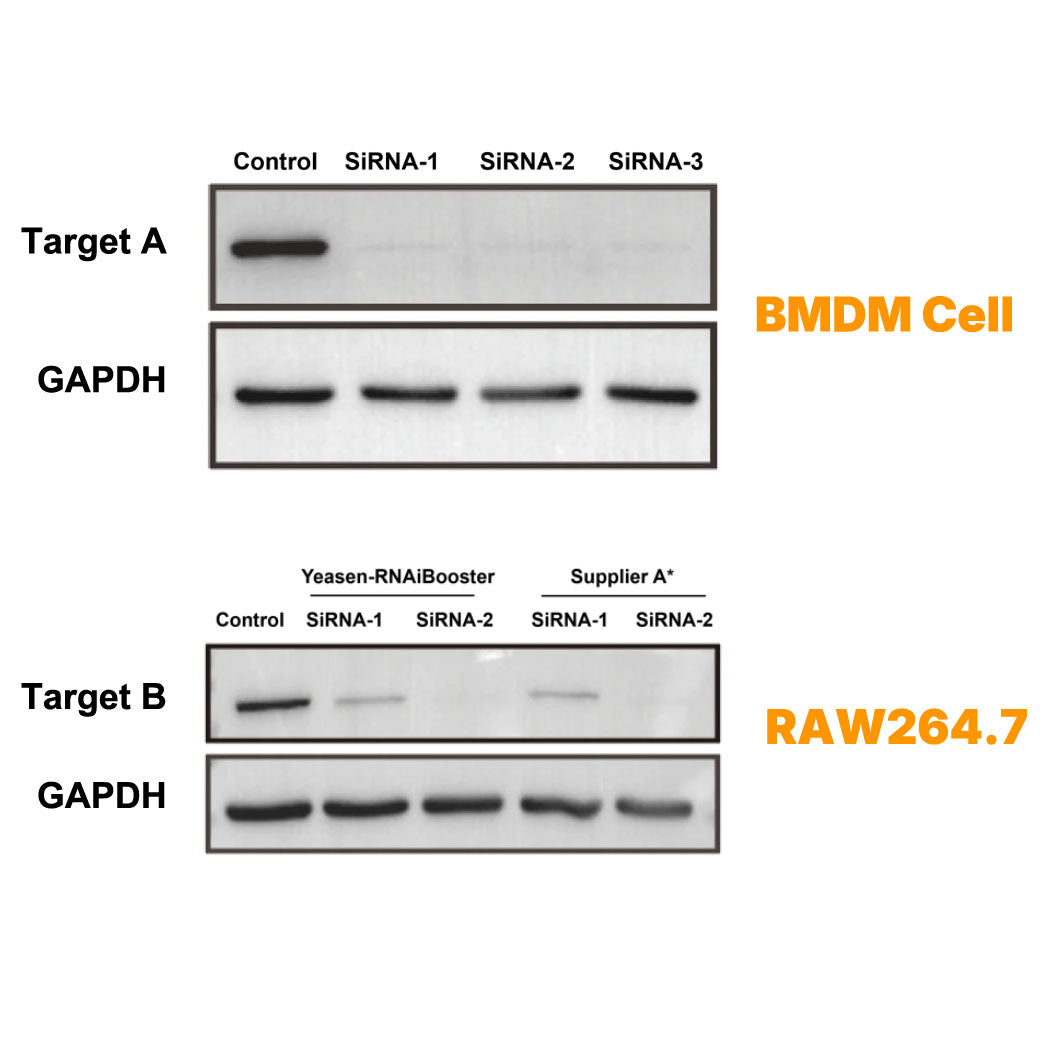
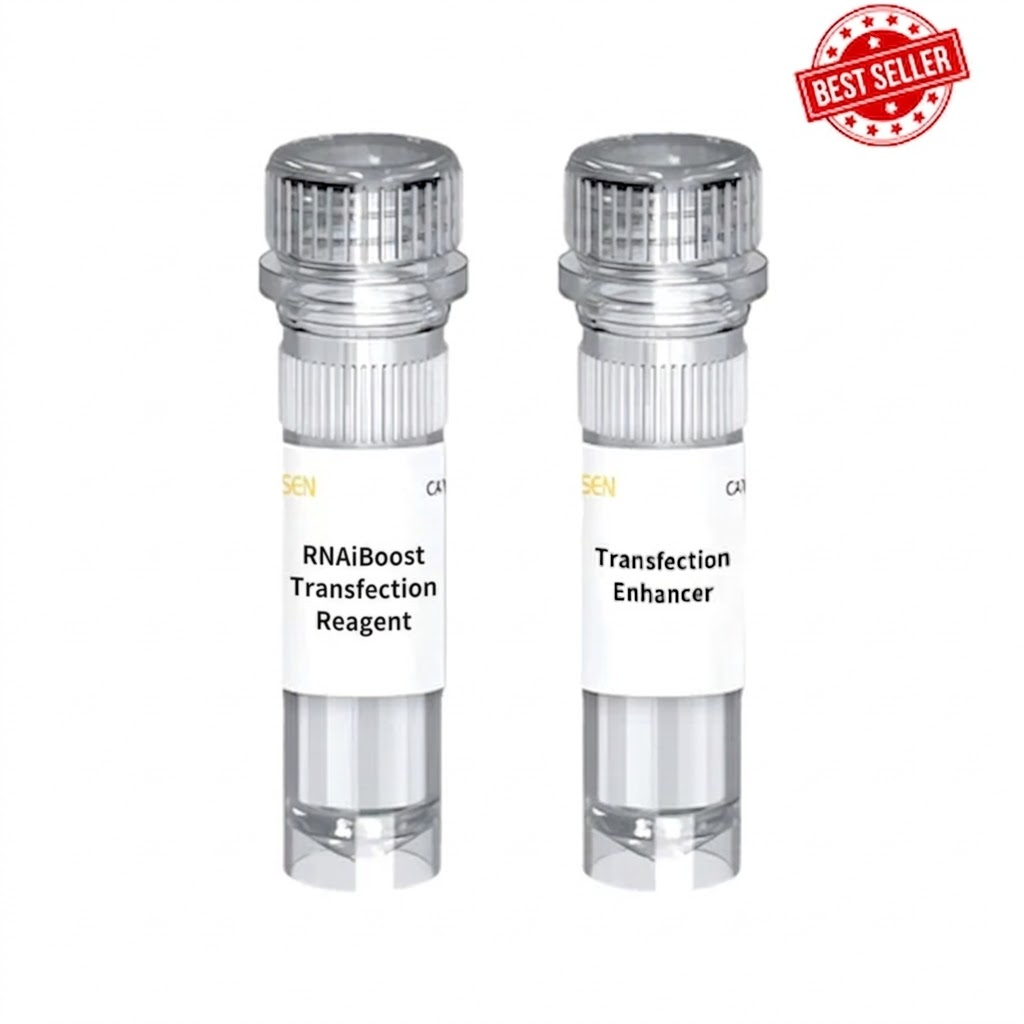


Hieff™ RNAiBoost in vitro transfection reagent relies on an exclusive delivery platform to efficiently and precisely deliver siRNA into cells, achieving >90% target gene silencing even in hard-to-transfect systems such as primary cells, with operation completed in 5 minutes, specifically designed for knockdown in primary and other hard-to-transfect cell lines, compatible with serum and antibiotics, and no medium change required post-transfectionWrite information about product introduction. Features Higher transfection efficiency: Achieves >90% target gene knockdown even in hard-to-transfect primary cells Lower siRNA requirement: Delivers high knockdown efficiency with siRNA concentrations as low...
Hieff™ RNAiBoost in vitro transfection reagent relies on an exclusive delivery platform to efficiently and precisely deliver siRNA into cells, achieving >90% target gene silencing even in hard-to-transfect systems such as primary cells, with operation completed in 5 minutes, specifically designed for knockdown in primary and other hard-to-transfect cell lines, compatible with serum and antibiotics, and no medium change required post-transfectionWrite information about product introduction.
Features
Higher transfection efficiency: Achieves >90% target gene knockdown even in hard-to-transfect primary cells
Lower siRNA requirement: Delivers high knockdown efficiency with siRNA concentrations as low as 2–50 nM
Simplified workflow: Complex formation in just 5 minutes; fully compatible with serum and antibiotics—no media change required
Components
|
Components No. |
Name |
40807ES01 |
40807ES03 |
40807ES04 |
|
40807-A |
RNAiBoost Transfection Reagent |
100 μL |
0.75 mL |
1.5 mL |
|
40807-B |
Enhancer |
300 μL |
3 × 0.75 mL |
3 × 1.5 mL |
Figures
High Knockdown Efficiency

Figure 1. siRNA transfection across different cells using Booster DNA&RNA Transfection Reagent versus supplier T*. The result demonstrates superior siRNA transfection efficiency of Booster.

Figure 2: Hard-to-Transfect Cell Lines-STC-1

Figure 3: Hard-to-Transfect Cell Lines-HepG2

Figure 4: Hard-to-Transfect Cell Lines-HK-2
Customer Cases
Primary Cell Transfection Cases
|
Cell Type |
Abbreviation |
Nucleic Acid Type |
|
BMDM |
siRNA((6-Well Plate) |
|
|
HUVEC |
siRNA |
|
|
BMDM |
siRNA(12-Well Plate) |
Tumor Cell Transfection Cases
|
Cell Type |
Abbreviation |
Nucleic Acid Type |
|
CEMT-4 |
siRNA |
|
|
HePG2 |
siRNA |
|
|
MCF-7 |
siRNA |
|
|
THP-1 |
siRNA |
|
|
Human monocytic leukemia cell(and-induced-to-MO-Macrophages) |
THP-1 |
siRNA |
|
THP-1 |
siRNA |
|
|
LLC |
siRNA |
|
|
U937 |
siRNA |
Tissue Cell Transfection Cases
|
Cell Type |
Abbreviation |
Nucleic Acid Type |
|
BEAS-2B |
siRNA |
|
|
HK-2 |
siRNA |
|
|
H9c2 |
siRNA |
|
|
HEK293 |
siRNA |
|
|
LX2 |
siRNA |
|
|
MCF |
siRNA |
|
|
NIH-3T3 |
siRNA |
|
|
RAW264.7 |
siRNA(6-Well Plate) |
|
|
RAW264.7 |
siRNA(24-Well Plate) |
|
|
RBE |
siRNA |
|
|
STC1 |
siRNA |
Try it for free!
Get a free sample of RNAiBoost and validate its performance in your own lab.
👉 [Request Sample Now]. Worldwide Shipping!
Learn More
Next-Gen siRNA Transfection | Achieve 90% Gene Knockdown with Ease
DNA Transfection?
The novel reagent here.
Storage
FAQ
40807ES is a lipid nanoparticle-based transfection reagent.
Citations
Documents
Applications


You may also like
Inquiry
FAQ
The product is for research purposes only and is not intended for therapeutic or diagnostic use in humans or animals. Products and content are protected by patents, trademarks, and copyrights owned by Yeasen Biotechnology. Trademark symbols indicate the country of origin, not necessarily registration in all regions.
Certain applications may require additional third-party intellectual property rights.
Yeasen is dedicated to ethical science, believing our research should address critical questions while ensuring safety and ethical standards.