
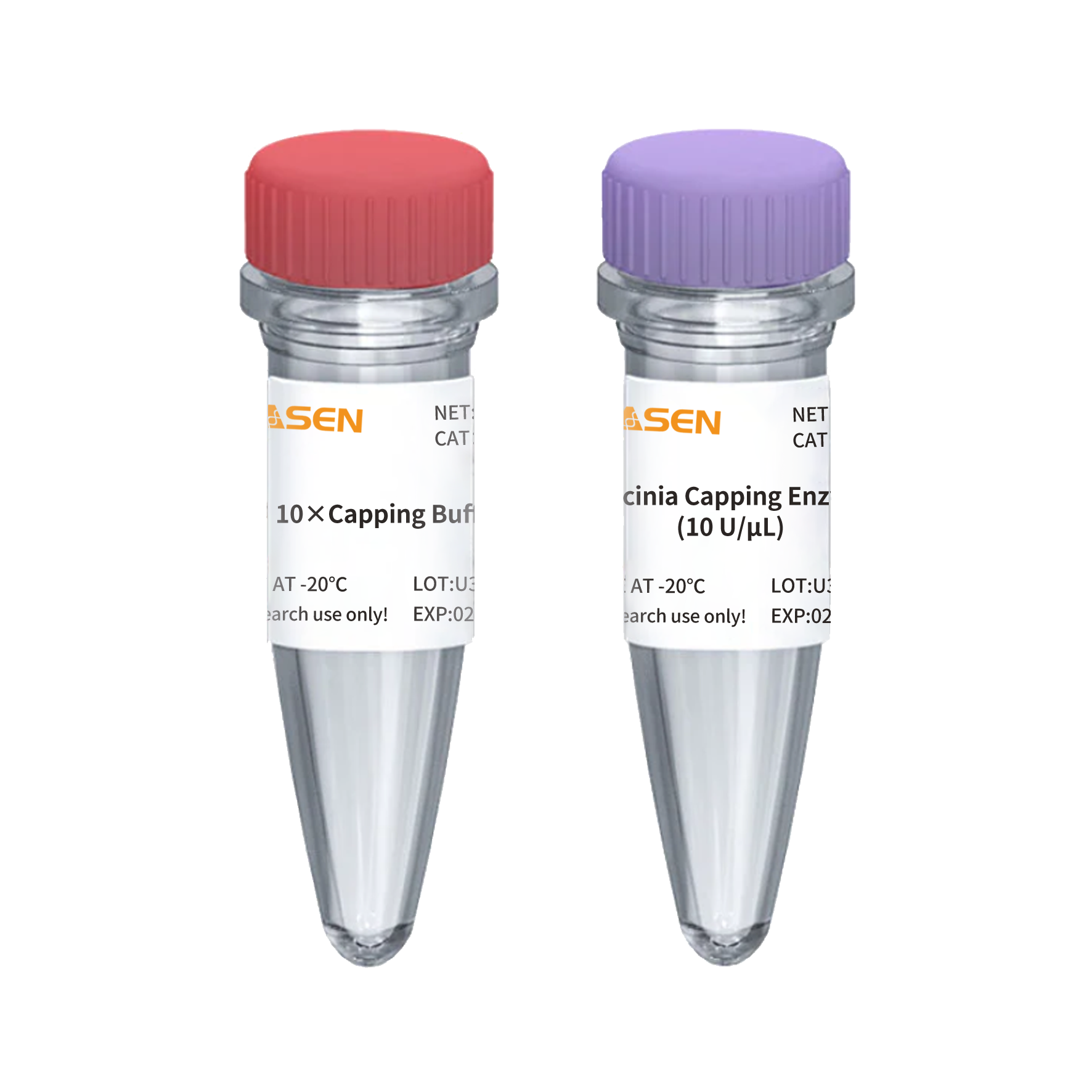
mRNA -vaccinia -afdek enzym (10 u/μl) _ 10615ES

YeasenSKU: 10615ES84

Maat: 2 KU
Prijs:
Verkoopprijs$365.00
Voorraad:
Op voorraad

Eukaryoten mRNA vormt een speciale structuur aan het 5'-uiteinde na transcriptie, wat de cap-structuur is. De cap-structuur speelt een belangrijke rol in de stabiliteit, het transport en de translatie van mRNA. Het vacciniavirus-capping-enzym is een effectief enzym dat de vorming van de cap-structuur kan katalyseren. Het bestaat uit twee subeenheden D1 en D12. Het heeft ook RNA-trifosfatase-activiteit, guanylaatacyltransferase-activiteit en guaninemethyltransferase-activiteit die de 7-methylguanine-cap-structuur (m7Gppp) aan het 5'-uiteinde van het RNA (m7Gppp5'N) kunnen verbinden. Het vacciniavirus-capping-enzym kan het RNA binnen één uur in de juiste richting cappen als het aanwezig is in een geschikte concentratie van cappingbuffer, guanosinetrifosfaat (GTP), S-adenosylmethionine (SAM), enz.

Functie

  • Geïsoleerd uit een recombinante bron
  • Getest op de afwezigheid van endonucleasen, exonucleasen, RNasen

Sollicitatie

  • Capping van mRNA vóór translatie-onderzoeken/in vitro-translatie
  • Labelen van het 5'-uiteinde van mRNA

Specificatie

Bron Recombinant E. coli met vacciniavirus capping-enzymgen
Optimale temperatuur 37℃
Opslagbuffer 20 mM Tris-HCl pH 8,0, 100 mM NaCl, 1 mM DTT, 0,1 mM EDTA, 0,1% Triton X-100, 50% glycerine
Eenheid Definitie 1 eenheid: De hoeveelheid enzym die nodig is om 10 pmol GTP (α-32P) in een transcript met 80 nucleotiden (80 nt) bij 37℃ binnen 1 uur op te nemen.

Componenten

Componenten nr. Naam 10615ES84 (2.000 eenheden) 10615ES92 (10.000 eenheden) 10615ES96 (100.000 eenheden) 10615ES99 (5 miljoen)
10615 mRNA Vaccinia Capping Enzym (10 eenheden/μL) 200 μL 1 ml 10 ml 500 ml


Verzending en opslag

mRNA Vaccinia Capping Enzyme GMP-producten worden verzonden met droogijs en kunnen een jaar lang worden bewaard bij -15℃ ~ -25℃.

Cijfers
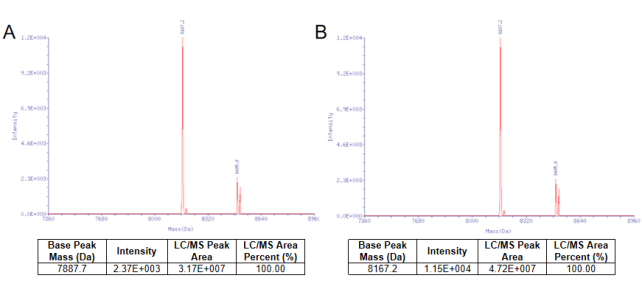
Figuur 1. De capping-efficiëntie bereikte bijna 100% door het vaccinia-capping-systeem van Yeasen. Nucleïnezuurmassaspectrometrie vóór de cap-reactie werd getoond in Figuur 1A. Nucleïnezuurmassaspectrometrie na de cap-reactie werd getoond in Figuur 1B.

Documenten:


Storage

mRNA Vaccinia Capping Enzyme GMP-grade products are shipped with dry ice and can be stored at -15℃ ~ -25℃ for one year.

FAQ

The purpose of preheating is to unfold the secondary structure of RNA and bring it to a single-stranded state. If this step is not carried out, it will affect the efficiency of capping. This part is indeed a current technical challenge in production. Some companies now directly predict the secondary structure of RNA when determining the template sequence. The capping enzyme only recognizes the first few nucleotides of mRNA. If it is determined that this structure will not result in the secondary structure of RNA, then heating can be omitted.
In industry, the most commonly used method for enzymatic cap addition is to treat IVT products with vaccinia virus cap-adding enzyme, which can modify them into Cap 0 mRNA. The Cap 0 structure can be further modified into Cap 1 (m7GpppmN) under the action of 2'O-methyltransferase. With enzymatic cap addition, the cap addition efficiency can reach over 95%. The co-transcription cap addition method is simple to operate, but because GTP competes with the cap dimer, the cap addition rate of this method is a little lower; both methods have their own advantages and disadvantages.
By increasing the amount of VCE, for example, adding 10 ul of 100 U of enzyme activity to a 100 ul system, the main purpose is to enhance the methyltransferase activity of VCE. It can also be achieved by increasing SAM (0.5 mmol) to enhance the guanine transfer activity and increase the cap formation rate. For instance, our new single-strand cap enzyme has a significantly improved cap formation rate. This is because its guanine transfer activity is better than that of traditional VCE. For traditional VCE, the small subunit D12 is prone to precipitation and polymer formation, which makes purification difficult and leads to loss, thus resulting in higher costs and inability to control batches.
Currently, the industry has not specifically targeted this aspect. In the industry, the main focus is on the efficiency of the cap application. The current best cap application rate is above 80%. Of course, the higher the better. There is still no absolute standard for this. For the synthesized mRNA, purification methods can be employed, such as the one-step membrane encapsulation method by Kang*. This significantly reduces the purification process. The traditional method uses Oligo d(T) columns for purification, with good results achieving a recovery rate of 70-80%; poor results have a recovery rate of 40-50%. An additional step of a hydrophobic column can also be added after the Oligo d(T) column.
The co-transcription requirement stipulates that the starting position of the template must begin with AGG*. The two-step method does not have any specific requirements for the position. However, our current products have the highest yield for the AGGG starting position, mainly due to the preference of the T7 enzyme.

Citations

Applications

Misschien vind je het ook leuk

Navraag

FAQ

Het product is alleen bedoeld voor onderzoeksdoeleinden en is niet bedoeld voor therapeutisch of diagnostisch gebruik bij mensen of dieren. Producten en inhoud worden beschermd door patenten, handelsmerken en auteursrechten die eigendom zijn van Yeasen Biotechnologie. Handelsmerksymbolen geven het land van herkomst aan, niet noodzakelijkerwijs registratie in alle regio's.

Voor bepaalde toepassingen zijn mogelijk aanvullende intellectuele eigendomsrechten van derden vereist.

Yeasen is toegewijd aan ethische wetenschap en is van mening dat ons onderzoek kritische vragen moet beantwoorden en tegelijkertijd de veiligheid en ethische normen moet waarborgen.