
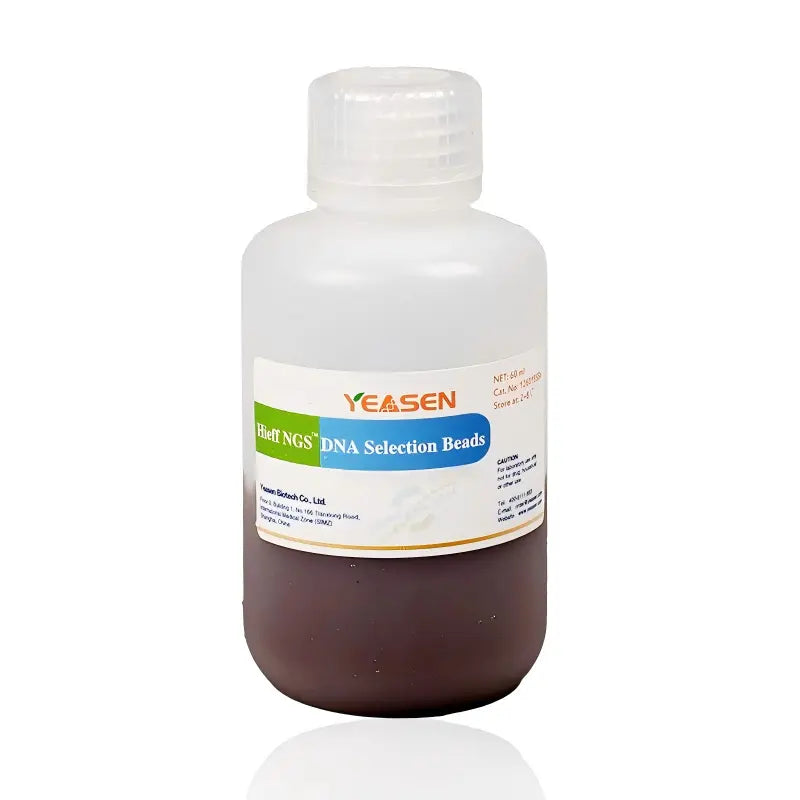



Hieff NGS ™ DNA選択ビーズは、固相可逆固定化(SPRI)原理に基づく磁性ビーズで、次世代シーケンシング(NGS)ライブラリ調製におけるDNA精製およびサイズ選択用に設計されています。幅広いDNAおよびRNAライブラリ調製キットと互換性があります。
特徴
プレミアム品質:高品質の原材料により、優れた回収率と正確なサイズ選択が保証されます。
高い互換性:すべての主要な DNA および RNA ライブラリ準備キットと互換性があります。
バッチの一貫性:厳格な品質管理により、ロット間の安定した信頼性の高いパフォーマンスが保証されます。
仕様
製品ライン
DNA洗浄および選択ビーズ
出発物質
DNA
互換性
DNA
分離技術
磁気ビーズ
最終製品タイプ
DNA
用途(アプリケーション)
DNAセランアップ、 DNAサイズ選択
ストレージ
この製品は2〜8℃で18ヶ月間保管してください。
数字
1.ワークフロー
図 1. DNA サイズ選択のワークフロー。
2.高い浄化回収効率
図 1. DNA サイズ選択のワークフロー。
高比率DNA精製:様々なブランドの磁気ビーズで同等のDNA回収効率が観察されました。低比率DNA精製:Yeasen磁気ビーズはより高いDNA回収効率を示しました。
3. 非常に一貫したサイズ選択精度
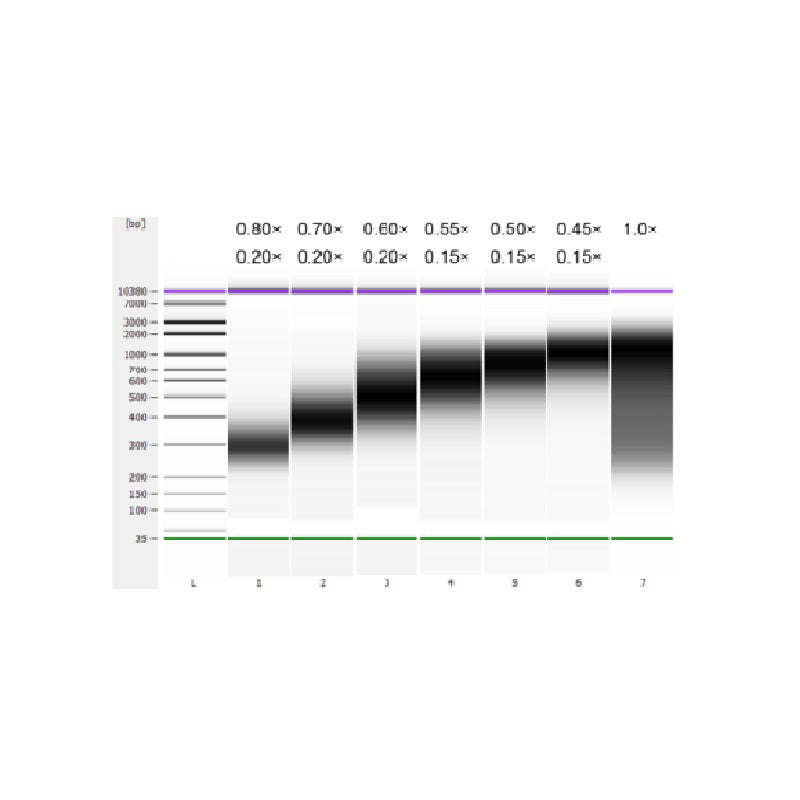
図3. DNAビーズ分離性能の比較。異なる分離比条件においても一貫した分離精度が観察されました。
文書:
安全データシート
12601 MSDS_HB250707.pdf
マニュアル
12601_マニュアル_HB250521.pdf
Hieff NGS ™ DNA選択ビーズは、固相可逆固定化(SPRI)原理に基づく磁性ビーズで、次世代シーケンシング(NGS)ライブラリ調製におけるDNA精製およびサイズ選択用に設計されています。幅広いDNAおよびRNAライブラリ調製キットと互換性があります。
特徴
- プレミアム品質:高品質の原材料により、優れた回収率と正確なサイズ選択が保証されます。
- 高い互換性:すべての主要な DNA および RNA ライブラリ準備キットと互換性があります。
- バッチの一貫性:厳格な品質管理により、ロット間の安定した信頼性の高いパフォーマンスが保証されます。
仕様
|
製品ライン |
DNA洗浄および選択ビーズ |
|
出発物質 |
DNA |
|
互換性 |
DNA |
|
分離技術 |
磁気ビーズ |
|
最終製品タイプ |
DNA |
|
用途(アプリケーション) |
DNAセランアップ、 DNAサイズ選択 |
ストレージ
この製品は2〜8℃で18ヶ月間保管してください。
数字
1.ワークフロー
図 1. DNA サイズ選択のワークフロー。
2.高い浄化回収効率

図 1. DNA サイズ選択のワークフロー。
高比率DNA精製:様々なブランドの磁気ビーズで同等のDNA回収効率が観察されました。低比率DNA精製:Yeasen磁気ビーズはより高いDNA回収効率を示しました。
3. 非常に一貫したサイズ選択精度

図3. DNAビーズ分離性能の比較。異なる分離比条件においても一貫した分離精度が観察されました。
文書:
安全データシート
マニュアル
Storage
FAQ
It can purify DNA fragments of 150bp or longer. If the purified DNA contains a large amount of fragments shorter than 150bp, please use product number 12600, which can purify DNA fragments of 50bp or longer.
You need to figure out the system on your own. The currently selected system for the selected fragments is the one described in the manual. For other fragment selections, you can refer to the selection system in the manual for adjustment.
It is not recommended to freeze for a long time, as the low temperature will damage the structure of the magnetic beads. Freezing and thawing once for NGS library sorting and purification does not significantly affect the performance for a short period of time. However, the actual result should be based on specific test results.
Keeping the magnetic beads at room temperature may have some impact on their recovery performance. It is not recommended to leave them at room temperature for too long. After use, it is advisable to store them at 4℃. The separation effect of PEG is easily affected by factors such as pH and temperature.
The DNA sorting and purification magnetic beads are based on a technology called Solid Phase Reversible Immobilization (SPRI). The buffer of the magnetic beads generally contains: magnetic beads, DNA, PEG, salt ions (mainly Na+), etc. Under the action of PEG and NaCl, the DNA molecules will undergo dehydration condensation, resulting in a change in DNA conformation and aggregation precipitation. The negatively charged ones can be eluted from the bound DNA molecules when using buffer solutions without enzymes or TE (low salt and low PEG content).
Under different PEG and salt ion concentrations, the conformations of different lengths of DNA are different. Moreover, longer DNA fragments carry more negative charges, so magnetic beads generally preferentially adsorb long DNA fragments. Sorting usually requires two rounds of magnetic bead separation. In the first round, magnetic beads bind to the DNA of larger molecular weight, and this part of the product is removed by discarding the magnetic beads. At this time, the target-sized DNA is in the supernatant; in the second round, magnetic beads bind to the larger molecular weight DNA in the remaining products, and the smaller molecular weight DNA is removed by discarding the supernatant. At this point, the target-sized DNA is on the magnetic beads, and through two rounds of magnetic bead separation, the sorting goal is achieved.
It is not recommended to use 12601. Instead, 12600 should be used. The minimum fragment that can be recovered is about 100bp. The recovery rate of 50bp or above may be affected.
Magnetic beads can adsorb both double-stranded DNA and single-stranded DNA, but they cannot distinguish between single-stranded or double-stranded DNA. The number of times single-stranded DNA can be purified by the magnetic beads can be referred to in the manual for double-stranded DNA.
12601ES is a non-specific adsorption magnetic bead that can also bind to RNA. If you want to remove RNA, you need to treat it with RNase A.
It is not recommended to use it. Although magnetic beads can also adsorb RNA fragments, the magnetic bead buffer is designed based on DNA characteristics and is not conducive to the stability of RNA structure. For RNA purification, it is recommended to use RNA purification magnetic beads (item number 12602ES).
1) The magnetic beads and DNA were not thoroughly mixed, resulting in insufficient adsorption. It is recommended to ensure thorough mixing of the reaction system.
2) The proportion of magnetic beads is incorrect. It is recommended to select the appropriate proportion according to the instructions.
3) The incubation time is insufficient. Ensure that the incubation time is at least 5 minutes.
4) During magnetic bead separation, when the two wheels perform magnetic bead adsorption, the magnetic beads are collected. A 10 μL pipette can be connected in series before the 200 μL pipette for liquid transfer, which can prevent the collection of magnetic beads.
5) During the magnetic bead washing process, the ethanol solution was not prepared freshly, resulting in an insufficiently high ethanol concentration. It is recommended that the ethanol concentration be no less than 70%, and for small fragments, it should be no less than 80%.
6) Excessive drying: If the magnetic beads are dried for too long, the surface will crack, making it difficult to elute the DNA and resulting in a decrease in yield. It is recommended that the drying time should not be too long; the moment the surface begins to crack, drying should be stopped.
7) Insufficient volume of elution solution: The final elution solution should completely cover the magnetic beads within the tube.
8) Sample reasons: The sample purity is low and contains impurities. When there are a large amount of impurities in the sample, it may cause the magnetic beads to aggregate and harden, resulting in insufficient elution. Using a pipette, try to blow the magnetic beads apart as much as possible, extend the elution time, and increase the product recovery rate. If there are many large fragments in the sample, the large fragments will cause the magnetic beads to aggregate. During elution, you can prolong the time or, if necessary, incubate at 37 degrees to improve the yield.
Citations
Documents
| Brochure |
|---|
| Magnetic_Beads_for_DNA_RNA_and_mRNA_Enrichment.pdf |
Applications
あなたも好きかもしれません
問い合わせ
よくある質問
この製品は研究目的のみに使用され、人間や動物の治療や診断に使用することを意図したものではありません。製品とコンテンツは、
特定のアプリケーションでは、追加のサードパーティの知的財産権が必要になる場合があります。