
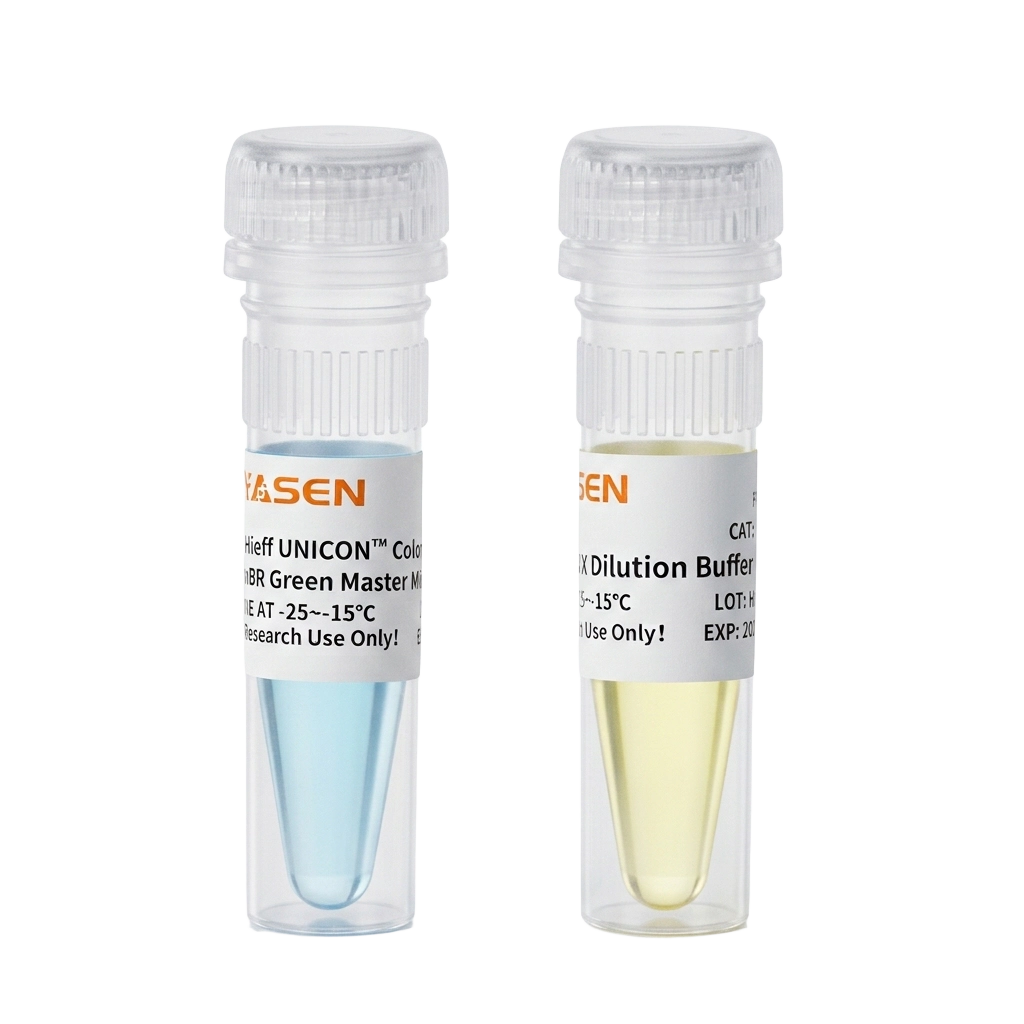
Hieff UNICON™ ColorGPS qPCR マスターミックス (Rox なし) _ 111​​88ES

YeasenSKU: 11188ES03

サイズ: 1mL
価格:
販売価格$55.00
在庫:
在庫あり

Hieff UNICON™ ColorGPS qPCR Master Mix (No Rox) は、2×リアルタイム定量PCR増幅用プレソリューションで、高い蛍光強度、高い感度と特異性、高い増幅収率を特徴としています。コア成分のHieff UNICON™ Taq DNAポリメラーゼは、抗体法でホットスタートされ、サンプル調製時のプライマーアニーリングによる非特異的増幅を効果的に抑制します。同時に、この配合では、PCR反応の増幅効率を高める因子と、GC含有量の異なる遺伝子(30〜70%)の増幅を均等化する促進因子が追加されているため、定量PCRは幅広い定量領域で良好な直線関係を得ることができます。この製品は、異なる染料の混合色変化反応を利用してピペッティング操作を監視し、ピペッティングエラーの発生を効果的に低減します。

特徴

ピペッティングトラッキング: 見逃しや追加ミスのリスクを軽減

優れた増幅: 広い直線範囲にわたって優れた直線性

高精度:2倍の濃度差を持つテンプレートを正確に区別できる

優れた再現性: 反復ウェル内のウェル間のばらつきが小さいため、再現性が向上します。

安定性と信頼性:反応システムは室温で24時間保存でき、20回の凍結融解サイクル後も製品は影響を受けません。

アプリケーション

遺伝子発現差異解析

絶対定量分析

仕様

集中

2 × (qPCR ミックス)

検出方法

染色法

PCR法

定量PCR

ポリメラーゼ

Taq DNAポリメラーゼ

サンプルの種類

DNA

アプリケーション機器

Bio-Rad CFX96、CFX384、iCycler iQ、iQ5、MyiQ、MiniOpticon、Opticon、Opticon 2、Chromo4、Cepheid SmartCycler、Eppendorf Mastercycler ep realplex、realplex 2 s、Illumina Eco qPCR、Qiagen/Corbett Rotor-Gene Q、Rotor-Gene 3000、Rotor-Gene 6000、Roche Applied Science LightCycler 480、Thermo Scientific PikoReal Cycler および ROX Reference Dye の添加を必要としないその他の蛍光定量 PCR 機器

製品タイプ

リアルタイム蛍光定量PCR用プレミックス

申請する(アプリケーション)

遺伝子発現

コンポーネント

コンポーネント番号

名前

1 1188 ES03

1 1188 ES08

1 1188 ES60

11188-A

Hieff UNICON ™ ColorGPS qPCR マスターミックス (ロックスなし)

1mL

5×1mL

100×1mL

11188-B

10×希釈バッファー

1mL

1mL

20×1mL

配送と保管

この製品は-25〜-15℃で1年間保存する必要があります。

数字

図1. ダイナミックレンジ内で信頼性の高い結果が得られます。

10^1-10^7 の勾配で 2 µL のプラスミド テンプレートを使用して、関連遺伝子を増幅しました。Hieff UNICON ™ ColorGPS マスター ミックスは、7 桁のテンプレート量範囲を効果的に検出し、広い直線範囲内で良好な直線性を実現します。

図2 . 2倍のテンプレート濃度の違いを正確に区別できます。

2 倍勾配で希釈したプラスミド 2 µL をテンプレートとして使用し、関連遺伝子を増幅しました。Hieff UNICON ™ ColorGPS マスター ミックスは、テンプレートの濃度差を正確に解決できます。

図3 . ウェル間のばらつきが小さく、再現性が優れていることがわかります。

数十個のプラスミドのコピーをテンプレートとして使用し、それぞれの取扱説明書に指定された手順に従って、さまざまな蛍光定量試薬で増幅を実行しました。SD 値は、他の逆転写試薬と比較して、新製品は複製ウェル間の差が小さく、再現性が優れていることを示しています。

図4より柔軟性が高く、標準的または迅速な手順に適しています。

標準手順では、変性時間と伸長時間をそれぞれ10秒と30秒に設定し、迅速手順では、変性時間と伸長時間をそれぞれ3秒と10秒に設定して、10個のターゲット遺伝子に対応するCt値を検出します。結果は、標準手順と迅速手順の両方で新製品で得られたCt値に強い相関関係があり、新製品は迅速手順を使用して良好な結果を達成できることを示しています。

図5.反応系を調製した後、室温で24時間安定に保つことができます。

マウス、ヒト293細胞、シロイヌナズナの異なる遺伝子をターゲットとして、反応系を調製した後、検出前に24時間、異なる温度で暗所に置いた。即時処理と比較して、異なる遺伝子の検出差は0.5 Ctを超えず、長時間操作でも安定した結果が得られることがわかる。

文書:

マニュアル

1 1188 _マニュアル_ Ver.EN20241218 .pdf

Storage

This product should be stored at -25~-15℃ for 18 months.

FAQ

Please refer to the "YiSheng Biotechnology YiSheng Biotechnology Dye Method Fluorescence Quantitative PCR Mix Selection Table" for details. Click here to learn more and help you choose the appropriate reagents.
For molecular enzyme reagents, simply invert and mix them together, then perform a gentle centrifugation. It is not recommended to vigorously shake to mix them.
Refer to the manual. Ultimately, it is necessary to ensure that after being mixed with the template, the volume is exactly 1×. For example, for 20 μL of cDNA stock solution, add 180 μL of sterile ultrapure water to dilute it 10 times, resulting in 200 μL of diluted template. Take 90 μL of the diluted template and add 10 μL of 10× Dilution Buffer, mix well, and then use it. You can choose not to do this, but it will not affect the result.
You can choose to use the cDNA stock solution or dilute it. Just make sure that the Ct value of the gene you want falls within the range of 15 to 30. Generally, for every 10-fold dilution of cDNA, the Ct value increases by 3.3.
Store in a dark place and the reaction system must not be left open. These two points are essential. It can be placed in a 4℃ refrigerator or at room temperature for 24 hours. Before using, gently shake and centrifuge the sample before loading it onto the instrument. Before loading, carefully check if the tubes or plates have been contaminated.
When designing primers, it is best to cross introns. The design method can refer to "Enjoyable! A single article to understand qPCR primer design, a must-have skill for experimental experts!" Also, validated primers can be selected. The selection method can refer to "Where to find ready-made qPCR primer sequences?"
The possible reasons are as follows:
1. The instrument has not been calibrated for a long time or it is aging. Usually, the instrument needs to be calibrated once a year. It is necessary to have an instrument engineer perform the calibration or replace the aging components.
2. A 10 μL reaction system was used. The normal system is a 20 μL system. Using half of the normal system would result in an excessively low total concentration of Rox, increasing the probability of BadRox occurrence. It is recommended to conduct the experiment using the 20 μL system.
The specificity of qPCR products can usually be determined through the melting curve. If it is still necessary to determine the products through gel electrophoresis, the qPCR product can undergo electrophoresis. Electrophoresis requires Loading Buffer, and the product cannot be directly loaded for electrophoresis.
1. Confirm whether the signal acquisition function is enabled in the program. If a two-step method is used, the signal acquisition should be set during the annealing extension stage.
2. Is the length of the product too long? If the length of the product is set to 500bp or more, this situation may occur. It is recommended that during primer design, the length of the product be controlled within the range of 80-300bp.
3. Are the primers inappropriate? If the primers are not designed correctly, they need to be redesigned. If the primers are correctly designed but seem to be degraded, PAGE electrophoresis can be used to check the integrity of the primers.
4.Template degradation: Prepare the template anew and repeat the experiment.
The analysis is conducted by observing the melting curve. The melting curve shows that the melting peak shape of NTC does not overlap with that of the corresponding gene, and the TM value of NTC is smaller than that of the corresponding gene. In this case, the product corresponding to NTC is a primer dimer. If the melting curve peak shape of the corresponding gene is a single peak, the collection of the signal of the related gene will not be affected. The melting curve shows that the melting peak shape of NTC overlaps with that of the corresponding gene. In this case, the product corresponding to NTC is likely to be the product of the corresponding gene. The system has been contaminated. We need to check one by one whether the water, primers, or reagents have been contaminated. If none of them have been contaminated, it might be aerosol contamination. Based on the obtained amplification data, the ΔCT value is calculated to determine whether the contamination has a significant impact on the system. If ΔCT ≥ 5, it indicates that the contamination has a minor effect and can be ignored.
It indicates the presence of genomic DNA contamination. It is recommended to use an RNA extraction kit that removes the genome for RNA extraction or during reverse transcription by adding a step to remove the genome. Alternatively, when designing the primers, a design across introns should be adopted.
1. If the CT value is less than 30, but the repeatability is very poor, what should we do? Improve the accuracy of sample addition. Avoid adding small volumes and reduce the error of addition. This can be achieved by preparing a large sample system, for example, mixing primers, water, and qPCR mix into a large system or using the method of mixing primers and water into a large system. The large system needs to be mixed evenly. Improve the accuracy of the pipette's aspiration. Pipettes usually need to be calibrated regularly, once a year.
2. What if CT is ≥ 30 but the repeatability is very poor? At this point, due to the low abundance of the effective template, the randomness of collisions between the template and the primers increases, thereby causing a greater difference between the replicons. It is recommended to try adding 2-3 replicons, and then eliminate the data with large differences for data analysis.
The overlapping peaks in the melting curve are located to the left of the main peak. This might be a situation caused by primer dimerization. One possible solution could be to increase the annealing temperature, reduce the primer concentration, or redesign the primers. The overlapping peaks in the melting curve are located to the right of the main peak. a. It is possible that the non-specific amplification occurred due to poor specificity of the primers. The primers need to be redesigned. b. It is possible that the template DNA was contaminated with genomic DNA. It is recommended to use an RNA extraction kit that removes the genomic DNA for RNA extraction, or to add a step of removing the genomic DNA during reverse transcription to reprepare the cDNA template.

Citations

Applications

あなたも好きかもしれません

問い合わせ

よくある質問

この製品は研究目的のみに使用され、人間や動物の治療や診断に使用することを意図したものではありません。製品とコンテンツは、Yeasen Biotechnology が所有する特許、商標、著作権によって保護されています。商標記号は原産国を示しますが、必ずしもすべての地域で登録されているわけではありません。

特定のアプリケーションでは、追加のサードパーティの知的財産権が必要になる場合があります。

Yeasen は倫理的な科学に専念しており、私たちの研究は安全性と倫理基準を確保しながら重要な問題に取り組むべきだと考えています。