

Frequently Bought Together
Kit Sintesis RNA Hasil Tinggi T7 mengoptimalkan sistem reaksi transkripsi. Kit ini dapat mensintesis RNA untai tunggal secara efisien dengan menggunakan RNA polimerase T7, DNA untai ganda linier dengan urutan promotor T7 sebagai cetakan, NTP sebagai substrat untuk mengendalikan urutan DNA di hilir promotor. Selama transkripsi, nukleotida yang dimodifikasi dapat ditambahkan ke substrat untuk menyiapkan biotin atau RNA berlabel pewarna.
Kit ini dapat mensintesis transkrip panjang dan transkrip pendek, RNA dapat diproduksi 100-200 μg dengan input cetakan DNA 1 μg. RNA yang disintesis melalui transkripsi dapat digunakan untuk berbagai aplikasi hilir, seperti penelitian struktur dan fungsi RNA, perlindungan RNase, hibridisasi probe, RNAi, mikroinjeksi, dan in vitro. terjemahan.
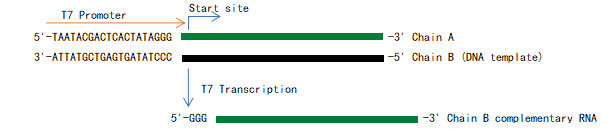
Gambar 1: In vitro Proses transkripsi RNA
Fitur
- Hingga 180 μg RNA per reaksi dari 1 μg templat kontrol
- Sistem reaksi yang dioptimalkan untuk proses IVT
- Mengurangi produksi dsRNA
- Integritas dan kemurnian RNA yang lebih tinggi
Aplikasi
- Dalam tabung reaksi Sintesis RNA
Komponen
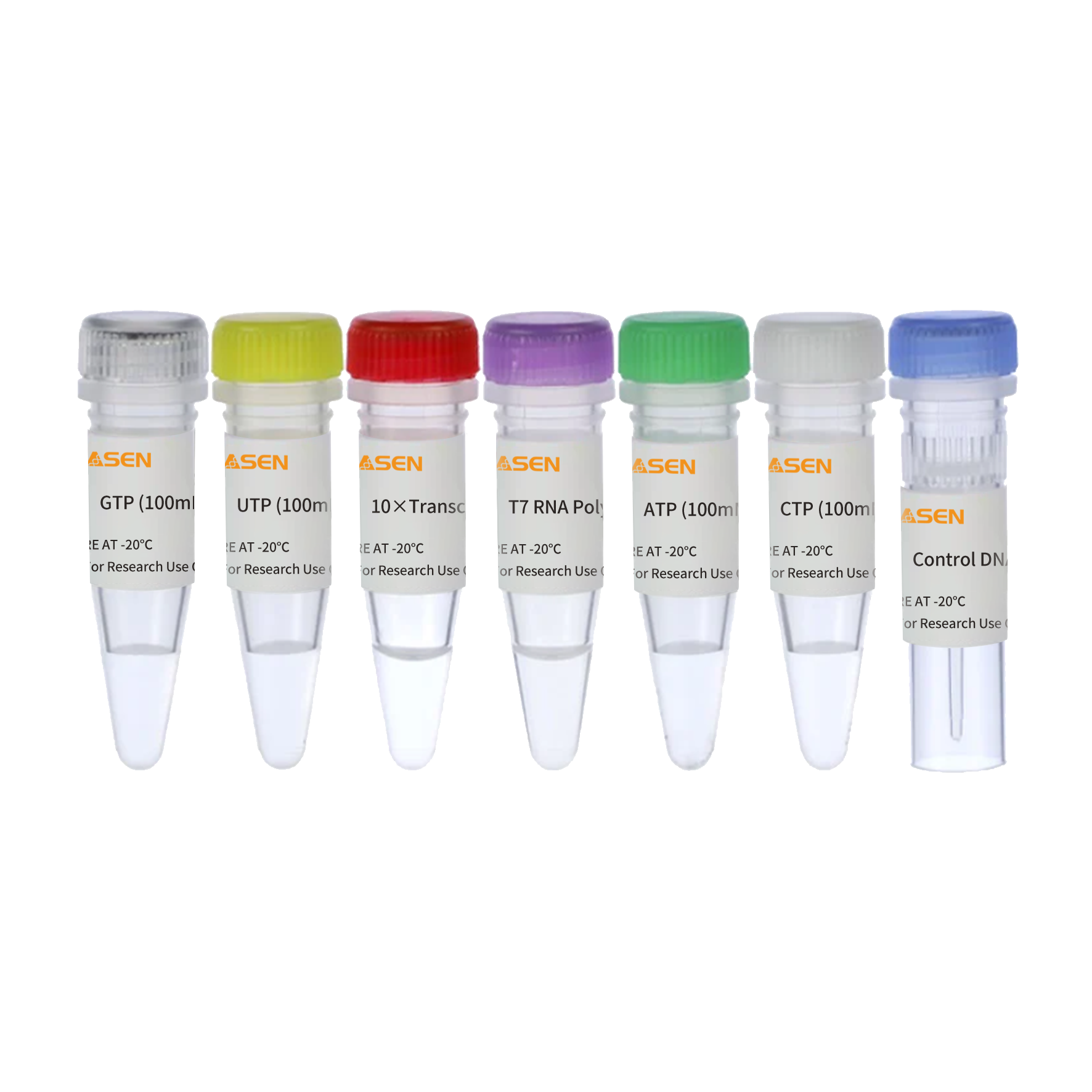
| Komponen No. | Nama | 10623ES50 (50T) | 10623ES60 (100 ton) | 10623ES70 (500 ton) |
| 10623-A | Campuran RNA Polimerase T7 | 100 mikroliter | 200 mikroliter | 1 ml air |
| 10623-B | 10×Penyangga Transkripsi | 100 mikroliter | 200 mikroliter | 1 ml air |
| 10623-C | ATP (100mM) | 100 mikroliter | 200 mikroliter | 1 ml air |
| 10623-D | CTP (100mM) | 100 mikroliter | 200 mikroliter | 1 ml air |
| 10623-E | GTP (100mM) | 100 mikroliter | 200 mikroliter | 1 ml air |
| 10623-F | UTP (100mM) | 100 mikroliter | 200 mikroliter | 1 ml air |
| 10623-G | Template DNA Kontrol (500ng/μL) | 10 mikroliter | 20 mikroliter | 100 mikroliter |
Pengiriman dan Penyimpanan
Transportasi es kering. Simpan pada suhu -15℃ ~ -25℃, berlaku selama dua tahun.
Angka
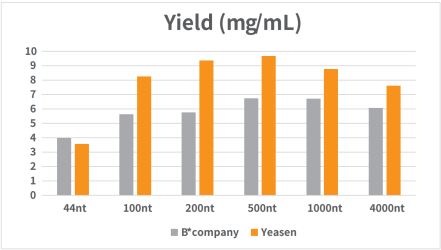
Gambar 1. RNA standar disintesis secara in vitro menggunakan kit sintesis RNA T7.
Reaksi diinkubasi dalam instrumen PCR pada suhu 37℃ selama 2 jam dan kemudian dimurnikan dengan manik-manik magnetik (Cat#12602). Hasil rendemen dianalisis dengan spektrofotometer NanoDrop seperti yang ditunjukkan pada Gambar 1.
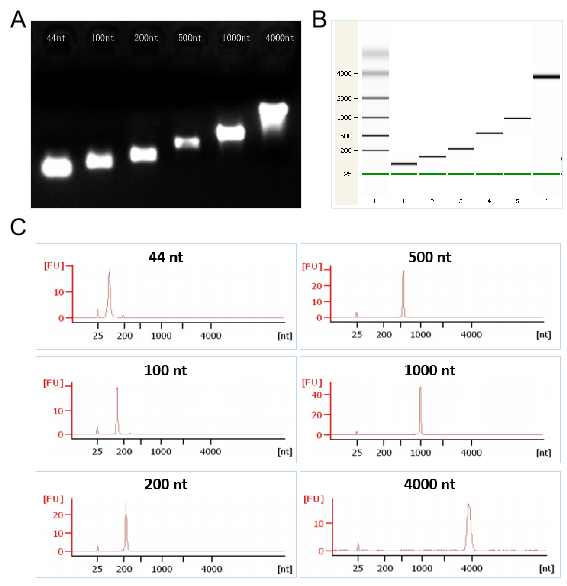
Gambar 2. Demonstrasi transkripsi RNA dengan panjang yang berbeda oleh kit T7 masing-masing dalam elektroforesisogram (Gambar 2A), diagram elektroforesis kapiler (Gambar 2B), dan kromatogram (Gambar 2C)
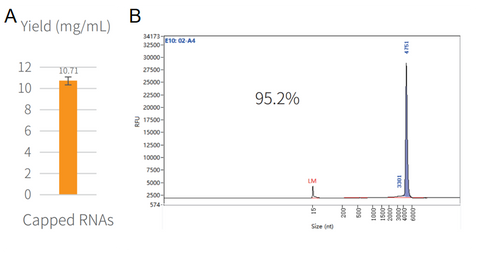
Gambar 3. Sintesis RNA yang ditutup secara in vitro.
Reaksi diinkubasi dalam instrumen PCR pada suhu 37℃ selama 2 jam, lalu dimurnikan dengan manik magnetik (Cat#12602). Hasil rendemen diuji dengan spektrofotometer NanoDrop seperti yang ditunjukkan pada Gambar 3A. Hasil integritas dianalisis dengan elektroforesis kapiler seperti yang ditunjukkan pada Gambar 3B.
1. Hasil transkrip rendah
Kualitas pola sangat erat kaitannya dengan hasil. Jika hasil kelompok eksperimen secara signifikan lebih rendah daripada kelompok kontrol, kemungkinan penyebabnya adalah:
① templat eksperimen mengandung komponen penghambat;
② Ada yang salah pada template.
Saran:
① Bersihkan kembali template;
② Tentukan kuantifikasi templat dan integritasnya;
③ Memperpanjang waktu reaksi;
④ Meningkatkan jumlah input template;
⑤ Cobalah promotor dan RNA polimerase lainnya.
2. Hasil transkrip pendek rendah
Fragmen inisiasi transkripsi yang pendek akan menghambat reaksi. Jika produk transkripsi kurang dari 100 nt, memperpanjang waktu reaksi menjadi 4-8 jam atau menambah jumlah templat menjadi 2 μg akan meningkatkan hasil RNA.
3. Panjang transkripsi RNA lebih besar dari yang diharapkan
Jika elektroforesis menunjukkan pita produk lebih besar dari ukuran yang diharapkan, kemungkinan penyebabnya adalah:
①Templat plasmid mungkin tidak sepenuhnya terlinearisasi;
②Ujung 3' dari untai sensor memiliki struktur yang menonjol;
③RNA memiliki struktur sekunder yang tidak terdenaturasi sepenuhnya.
Saran:
①Periksa apakah templat sepenuhnya terlinearisasi, dan jika perlu, lakukan linearisasi tambahan;
②Pilih enzim restriksi yang sesuai untuk menghindari overhang 3', atau gunakan Klenow Fragment /T4 DNA polimerase untuk menyelesaikan transkripsi sebelum melanjutkan;
③Gunakan gel terdenaturasi untuk mendeteksi produk RNA.
4. Panjang transkripsi RNA kurang dari yang diharapkan
Jika elektroforesis menunjukkan pita produk lebih kecil dari ukuran yang diharapkan, kemungkinan penyebabnya adalah:
①Templat mengandung urutan terminasi yang mirip dengan RNA polimerase T7;
②Konten GC dalam templat tinggi.
Saran:
①Turunkan suhu reaksi (misalnya, 30°C). Terkadang, menurunkan suhu dapat meningkatkan panjang transkripsi, tetapi akan mengurangi hasil. Atau, cobalah berbagai RNA polimerase untuk transkripsi;
②Jika kandungan GC template tinggi, gunakan 42℃ untuk mentranskripsi, atau menambahkan SSB untuk meningkatkan hasil dan panjang transkripsi.
5. Elektroforesis tailing produk transkripsi
Terdapat fenomena tailing pada saat elektroforesis.
Kemungkinan alasan:
①Terkontaminasi oleh RNase selama operasi eksperimen;
②Cetakan DNA yang terkontaminasi oleh RNase.
Saran:
①Gunakan ujung pipet bebas RNase dan tabung EP, kenakan sarung tangan lateks dan masker sekali pakai, dan semua reagen disiapkan dengan H2O bebas RNase.
②Memurnikan kembali DNA cetakan.
[1] Dong Z, Zheng N, Hu C, dkk.MikroRNA mirip RNA 8 (Nb-milR8) dari Nosema bombycis meningkatkan patogenisitas jamur dengan memodulasi ekspresi gen BmPEX16 pada inangnya, Bombyx mori. Microbiol Spectr. 2021;9(2):e0104821. doi:10.1128/Spectrum.01048-21(IF:7.171)
[2] Wang X, Tang S, Ye S, dkk. Kuantifikasi miR-195-5p yang sangat sensitif dengan kaskade amplifikasi perpindahan tiga untai. Talanta. 2022;242:123300. doi:10.1016/j.talanta.2022.123300(IF:6.057)
Storage
FAQ
The optimization of the IVT system can be achieved by adjusting the template, the amount of T7 enzyme used, and if it is co-transcription with cap addition, the ratio between the cap and NTP can be considered; for enzymatic cap addition, the conditions can be optimized in terms of the dosage of the cap-adding enzyme, 2-O-methyltransferase, and SAM. Regarding the template, apart from the requirement of complete linearization, there is another point, which is sequence design. For example, in the 5'UTR region, pay attention to uAUG and Kozak sequence; for CDS, consider the codon preference, GC3 content, and dinucleotide preference, etc.; 3'UTR: RBP and miRNA binding sites: and another point is the secondary structure of RNA. The stable secondary structure of the 5'UTR pre-sequence will reduce the expression of mRNA; the stable secondary structure of 3'UTR will increase the stability of mRNA and promote the expression of the encoded protein. For the recommended IVT system and more detailed tips, please refer to the mRNA in vitro synthesis experiment manual of Vivian Biotechnology.
The average yield is between 120-220 ug/ul (the yield is highly dependent on the sequence design). In the co-transcription method, the mRNA yield is 8 g/L. With process optimization, the yield will increase. Currently, the quality parameters of the available processes include observing the fluorescence value of GFP and measuring the cap addition rate using LC-MS.
The T7 pol enzyme will use the product RNA as a template and continue to extend the RNA at its 3' end. The extended sequence will form complementary pairing with the 3' end sequence of the original RNA molecule, thereby creating a hairpin structure.
The T7 pol enzyme can use RNA as a template to replicate RNA molecules, and synthesize the complementary strand.
(At present, there is no effective method for removing dsRNA. However, there is a patent report suggesting that a fiber column (sigma) could be tried.)
1. Reduce the concentration of magnesium ions; however, reducing the concentration of magnesium ions will also lead to a decrease in the production of RNA, and a balance point needs to be reached.
2. Increase the reaction temperature of IVT to 50-56℃. This temperature can effectively reduce the content of dsRNA in the product; however, the requirements for equipment for high-temperature reactions will vary, and it may also increase the cost.
3. In the IVT reaction system, certain dispersants such as urea and formamide are added; our process research team has also conducted some experiments on this route, which can achieve the effect of inhibiting dsRNA. However, whether it is suitable for process scaling-up still needs further research.
This kind of precipitation occurs by chance and is also closely related to the sequence design.
Solution: (1) Reduce the concentration of magnesium ions, but this will result in a decrease in yield. The amount of T7 enzyme needs to be increased and the reaction time (from 2 hours to 3-4 hours) needs to be extended; (2) The form of NTP (the presence of magnesium ions at a high concentration, such as 46 mM, does not select NTP, but when the magnesium ion concentration decreases, the yield of NTP (Tris salt form) does not change much, and the yield of the triNa form of NTP decreases significantly.
Citations
Documents
| Manual |
|---|
| 10623_Manual_HB230115_EN.pdf |
Applications

Anda mungkin juga menyukai
Pertanyaan
FAQ
Produk ini hanya untuk keperluan penelitian dan tidak ditujukan untuk penggunaan terapeutik atau diagnostik pada manusia atau hewan. Produk dan konten dilindungi oleh paten, merek dagang, dan hak cipta milik
Aplikasi tertentu mungkin memerlukan hak kekayaan intelektual pihak ketiga tambahan.