

Frequently Bought Together
T7 हाई यील्ड RNA सिंथेसिस किट ट्रांसक्रिप्शन रिएक्शन सिस्टम को ऑप्टिमाइज़ करता है। किट T7 RNA पॉलीमरेज़, रैखिक डबल-स्ट्रैंडेड DNA का उपयोग करके सिंगल-स्ट्रैंडेड RNA को कुशलतापूर्वक संश्लेषित कर सकता है, जिसमें T7 प्रमोटर अनुक्रम टेम्पलेट के रूप में होता है, NTPs प्रमोटर के डाउनस्ट्रीम DNA अनुक्रम को नियंत्रित करने के लिए सब्सट्रेट के रूप में होता है। ट्रांसक्रिप्शन के दौरान, बायोटिन या डाई-लेबल वाले RNA को तैयार करने के लिए संशोधित न्यूक्लियोटाइड को सब्सट्रेट में जोड़ा जा सकता है।
यह किट लंबी ट्रांसक्रिप्ट और छोटी ट्रांसक्रिप्ट को संश्लेषित कर सकती है, 1 μg डीएनए टेम्पलेट इनपुट के साथ 100-200 μg RNA का उत्पादन किया जा सकता है। ट्रांसक्रिप्शन द्वारा संश्लेषित RNA का उपयोग विभिन्न डाउनस्ट्रीम अनुप्रयोगों के लिए किया जा सकता है, जैसे कि RNA संरचना और कार्य अनुसंधान, RNase सुरक्षा, जांच संकरण, RNAi, माइक्रोइंजेक्शन और इन विट्रो अनुवाद.
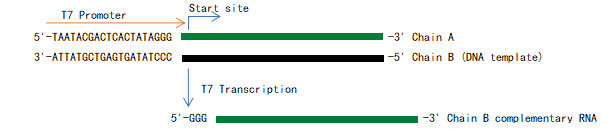
चित्र 1: इन विट्रो आरएनए प्रतिलेखन प्रक्रिया
विशेषता
- नियंत्रण टेम्पलेट के 1 μg से प्रति प्रतिक्रिया 180 μg तक RNA
- आईवीटी प्रक्रिया के लिए अनुकूलित प्रतिक्रिया प्रणाली
- डीएसआरएनए उत्पादन में कमी
- उच्चतर आरएनए अखंडता और शुद्धता
आवेदन
- कृत्रिम परिवेशीय आरएनए संश्लेषण
अवयव
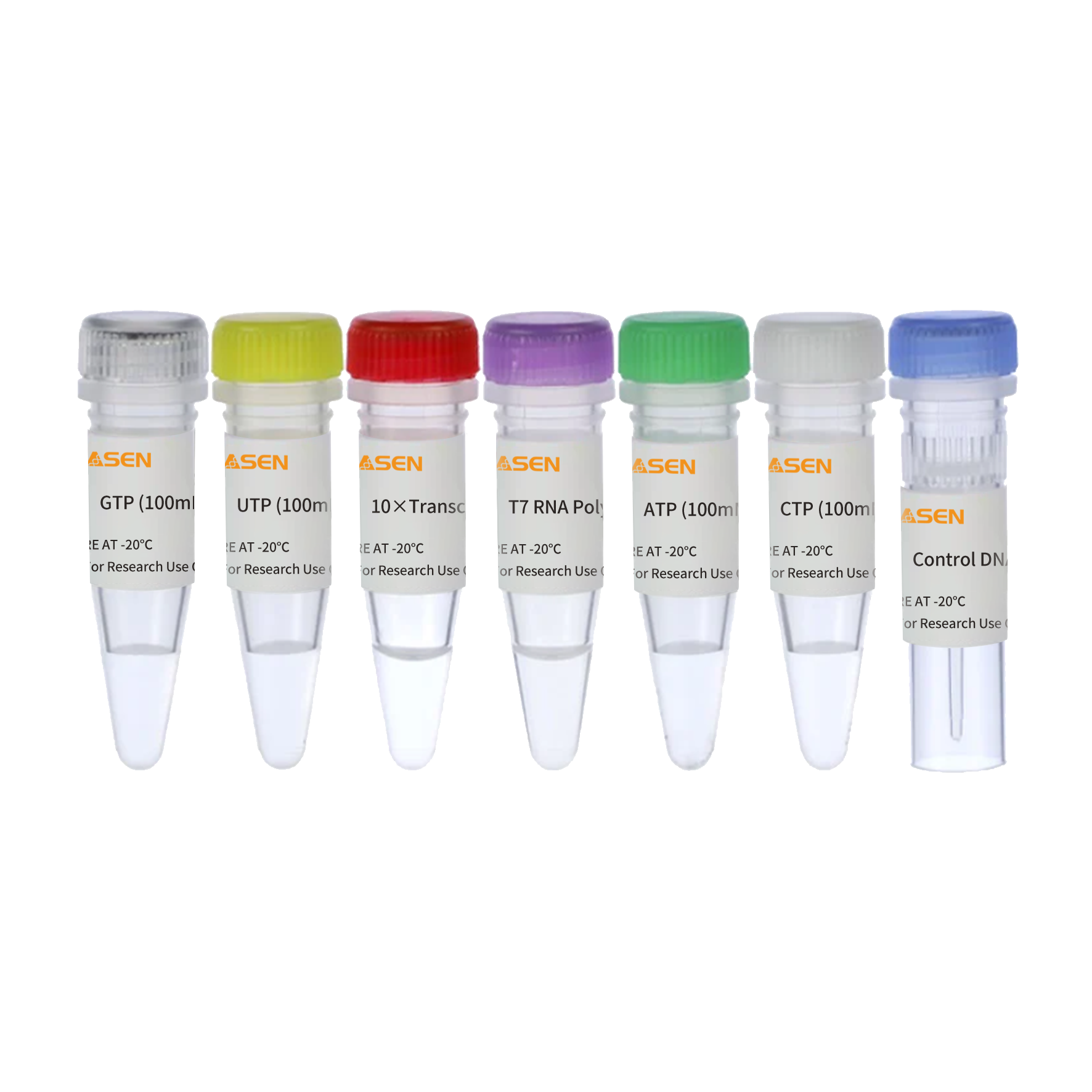
| घटक सं. | नाम | 10623ES50 (50 टी) | 10623ES60 (100 टी) | 10623ES70 (500 टी) |
| 10623-ए | टी7 आरएनए पोलीमरेज़ मिक्स | 100 μएल | 200 μएल | 1 एमएल |
| 10623-बी | 10×ट्रांसक्रिप्शन बफर | 100 μएल | 200 μएल | 1 एमएल |
| 10623-सी | एटीपी (100एमएम) | 100 μएल | 200 μएल | 1 एमएल |
| 10623-डी | सीटीपी (100एमएम) | 100 μएल | 200 μएल | 1 एमएल |
| 10623-ई | जीटीपी (100एमएम) | 100 μएल | 200 μएल | 1 एमएल |
| 10623-एफ | यूटीपी (100एमएम) | 100 μएल | 200 μएल | 1 एमएल |
| 10623-जी | नियंत्रण डीएनए टेम्पलेट (500ng/μL) | 10 μएल | 20 μएल | 100 μएल |
शिपिंग और भंडारण
सूखी बर्फ का परिवहन। -15℃ ~ -25℃ पर स्टोर करें, दो साल के लिए वैध।
आंकड़ों
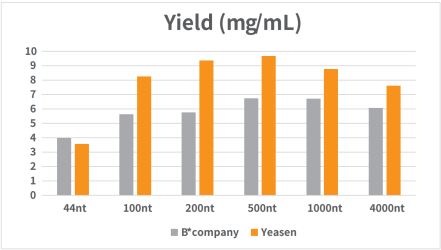
चित्र 1. मानक आरएनए को टी7 आरएनए संश्लेषण किट का उपयोग करके इन विट्रो में संश्लेषित किया गया।
प्रतिक्रिया को पीसीआर उपकरण में 37 डिग्री सेल्सियस पर 2 घंटे के लिए इनक्यूबेट किया गया और फिर चुंबकीय मोतियों (कैट#12602) द्वारा शुद्ध किया गया। उपज परिणाम का विश्लेषण नैनोड्रॉप स्पेक्ट्रोफोटोमीटर द्वारा किया गया जैसा कि चित्र 1 में दिखाया गया है।
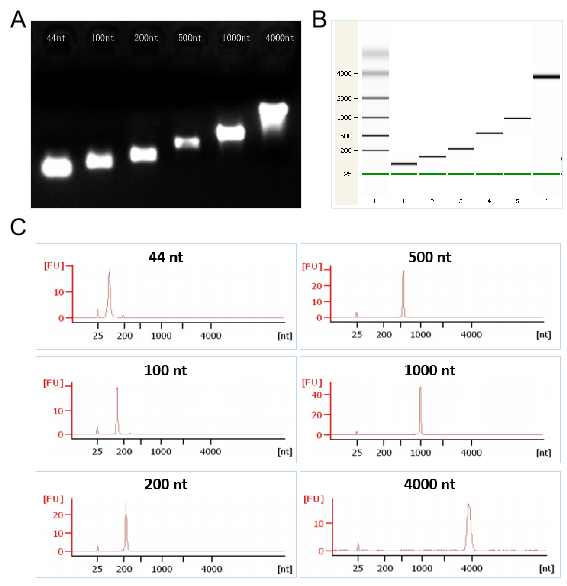
चित्र 2. इलेक्ट्रोफोरेटोग्राम (चित्र 2ए), केशिका वैद्युतकणसंचलन आरेख (चित्र 2बी) और क्रोमैटोग्राम (चित्र 2सी) में क्रमशः टी7 किट द्वारा आरएनए की विभिन्न लंबाइयों का प्रतिलेखन प्रदर्शन
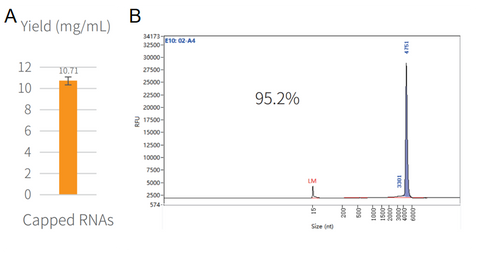
चित्र 3. इन विट्रो में कैप्ड आरएनए का संश्लेषण।
प्रतिक्रिया को पीसीआर उपकरण में 37 डिग्री सेल्सियस पर 2 घंटे के लिए इनक्यूबेट किया गया, और फिर चुंबकीय मोतियों (कैट#12602) द्वारा शुद्ध किया गया। उपज परिणाम को नैनोड्रॉप स्पेक्ट्रोफोटोमीटर द्वारा परखा गया जैसा कि चित्र 3ए में दिखाया गया है। अखंडता परिणाम का विश्लेषण केशिका वैद्युतकणसंचलन द्वारा किया गया जैसा कि चित्र 3बी में दिखाया गया है।
1. कम प्रतिलेख उपज
टेम्पलेट की गुणवत्ता उपज से बहुत हद तक संबंधित है। यदि प्रायोगिक समूह की उपज नियंत्रण समूह की तुलना में काफी कम है, तो संभावित कारण ये हैं:
① प्रायोगिक टेम्पलेट में निरोधात्मक घटक होते हैं;
② टेम्पलेट में कुछ गड़बड़ है.
सुझाव:
① टेम्पलेट को पुनः शुद्ध करें;
② टेम्पलेट परिमाणीकरण और इसकी अखंडता का निर्धारण करें;
③ प्रतिक्रिया समय बढ़ाएँ;
④ टेम्पलेट इनपुट की मात्रा बढ़ाएँ;
⑤ अन्य प्रमोटरों और आरएनए पॉलीमरेज़ का प्रयास करें।
2. लघु प्रतिलिपियों की कम उपज
एक छोटा प्रतिलेखन आरंभिक टुकड़ा प्रतिक्रिया को बाधित करेगा। जब प्रतिलेखन उत्पाद 100 nt से कम होता है, तो प्रतिक्रिया समय को 4-8 hs तक बढ़ाने या टेम्पलेट की मात्रा को 2 μg तक बढ़ाने से RNA की उपज बढ़ जाएगी।
3. आरएनए प्रतिलेखन लंबाई अपेक्षा से अधिक है
यदि वैद्युतकणसंचलन से पता चलता है कि उत्पाद बैंड अपेक्षित आकार से बड़ा है, तो संभावित कारण:
①प्लास्मिड टेम्पलेट पूरी तरह से रैखिक नहीं हो सकता है;
②सेंस स्ट्रैंड के 3' छोर पर एक प्रमुख संरचना होती है;
③आरएनए की द्वितीयक संरचना पूरी तरह से विकृत नहीं होती है।
सुझाव:
①जांचें कि क्या टेम्पलेट पूरी तरह से रैखिकीकृत है, और यदि आवश्यक हो, तो अतिरिक्त रैखिकीकरण करें;
②3' ओवरहैंग से बचने के लिए उपयुक्त प्रतिबंध एंजाइम का चयन करें, या आगे बढ़ने से पहले प्रतिलेखन को पूरा करने के लिए क्लेनो फ्रेगमेंट / टी4 डीएनए पॉलीमरेज़ का उपयोग करें;
③आरएनए उत्पादों का पता लगाने के लिए विकृत जेल का उपयोग करें।
4. आरएनए प्रतिलेखन लंबाई अपेक्षा से कम है
यदि वैद्युतकणसंचलन से पता चलता है कि उत्पाद बैंड अपेक्षित आकार से छोटा है, तो संभावित कारण:
①टेम्प्लेट में T7 RNA पोलीमरेज़ के समान समाप्ति अनुक्रम होता है;
②टेम्प्लेट में GC सामग्री उच्च है.
सुझाव:
①प्रतिक्रिया तापमान कम करें (उदाहरण के लिए, 30°C)। कभी-कभी तापमान कम करने से प्रतिलेखन की लंबाई बढ़ सकती है, लेकिन इससे उपज कम हो जाएगी। या प्रतिलेखन के लिए अलग-अलग आरएनए पॉलीमरेज़ आज़माएँ;
②यदि टेम्पलेट GC सामग्री अधिक है, तो 42℃ का उपयोग करें प्रतिलेखन के लिए, या उपज और प्रतिलेखन लंबाई बढ़ाने के लिए एसएसबी जोड़ें।
5. प्रतिलेखन उत्पादों का इलेक्ट्रोफोरेसिस टेलिंग
वैद्युतकणसंचालन के दौरान एक टेलिंग घटना होती है।
संभावित कारण:
①प्रायोगिक संचालन के दौरान RNase द्वारा दूषित;
②RNase द्वारा दूषित डीएनए टेम्पलेट.
सुझाव:
①RNase मुक्त पिपेट टिप्स और EP ट्यूब का उपयोग करें, डिस्पोजेबल लेटेक्स दस्ताने और मास्क पहनें, और सभी अभिकर्मकों को RNase मुक्त H2O के साथ तैयार किया जाता है।
②टेम्प्लेट डीएनए को पुनः शुद्ध करें।
[1] डोंग ज़ेड, झेंग एन, हू सी, एट अल।नोसेमा बॉम्बिसिस माइक्रोआरएनए-जैसे आरएनए 8 (एनबी-मिलआर8) अपने होस्ट, बॉम्बिक्स मोरी में बीएमपीईएक्स16 जीन अभिव्यक्ति को संशोधित करके फंगल रोगजनकता को बढ़ाता है। माइक्रोबायोल स्पेक्ट्र. 2021;9(2):e0104821. doi:10.1128/स्पेक्ट्रम.01048-21(IF:7.171)
[2] वांग एक्स, टैंग एस, यी एस, एट अल. ट्रिपल स्ट्रैंड विस्थापन प्रवर्धन कैस्केड के साथ परिसंचारी miR-195-5p का अल्ट्रासेंसिटिव क्वांटिटेशन। टालंता। 2022;242:123300. doi:10.1016/j.talanta.2022.123300(IF:6.057)
Storage
FAQ
The optimization of the IVT system can be achieved by adjusting the template, the amount of T7 enzyme used, and if it is co-transcription with cap addition, the ratio between the cap and NTP can be considered; for enzymatic cap addition, the conditions can be optimized in terms of the dosage of the cap-adding enzyme, 2-O-methyltransferase, and SAM. Regarding the template, apart from the requirement of complete linearization, there is another point, which is sequence design. For example, in the 5'UTR region, pay attention to uAUG and Kozak sequence; for CDS, consider the codon preference, GC3 content, and dinucleotide preference, etc.; 3'UTR: RBP and miRNA binding sites: and another point is the secondary structure of RNA. The stable secondary structure of the 5'UTR pre-sequence will reduce the expression of mRNA; the stable secondary structure of 3'UTR will increase the stability of mRNA and promote the expression of the encoded protein. For the recommended IVT system and more detailed tips, please refer to the mRNA in vitro synthesis experiment manual of Vivian Biotechnology.
The average yield is between 120-220 ug/ul (the yield is highly dependent on the sequence design). In the co-transcription method, the mRNA yield is 8 g/L. With process optimization, the yield will increase. Currently, the quality parameters of the available processes include observing the fluorescence value of GFP and measuring the cap addition rate using LC-MS.
The T7 pol enzyme will use the product RNA as a template and continue to extend the RNA at its 3' end. The extended sequence will form complementary pairing with the 3' end sequence of the original RNA molecule, thereby creating a hairpin structure.
The T7 pol enzyme can use RNA as a template to replicate RNA molecules, and synthesize the complementary strand.
(At present, there is no effective method for removing dsRNA. However, there is a patent report suggesting that a fiber column (sigma) could be tried.)
1. Reduce the concentration of magnesium ions; however, reducing the concentration of magnesium ions will also lead to a decrease in the production of RNA, and a balance point needs to be reached.
2. Increase the reaction temperature of IVT to 50-56℃. This temperature can effectively reduce the content of dsRNA in the product; however, the requirements for equipment for high-temperature reactions will vary, and it may also increase the cost.
3. In the IVT reaction system, certain dispersants such as urea and formamide are added; our process research team has also conducted some experiments on this route, which can achieve the effect of inhibiting dsRNA. However, whether it is suitable for process scaling-up still needs further research.
This kind of precipitation occurs by chance and is also closely related to the sequence design.
Solution: (1) Reduce the concentration of magnesium ions, but this will result in a decrease in yield. The amount of T7 enzyme needs to be increased and the reaction time (from 2 hours to 3-4 hours) needs to be extended; (2) The form of NTP (the presence of magnesium ions at a high concentration, such as 46 mM, does not select NTP, but when the magnesium ion concentration decreases, the yield of NTP (Tris salt form) does not change much, and the yield of the triNa form of NTP decreases significantly.
Citations
Documents
| Manual |
|---|
| 10623_Manual_HB230115_EN.pdf |
Applications

आपको यह भी पसंद आ सकता हैं
जाँच करना
उपवास
यह उत्पाद केवल शोध उद्देश्यों के लिए है और मनुष्यों या जानवरों में चिकित्सीय या नैदानिक उपयोग के लिए अभिप्रेत नहीं है। उत्पाद और सामग्री येसेन बायोटेक्नोलॉजी के स्वामित्व वाले पेटेंट, ट्रेडमार्क और कॉपीराइट द्वारा संरक्षित हैं। ट्रेडमार्क प्रतीक मूल देश को इंगित करते हैं, जरूरी नहीं कि सभी क्षेत्रों में पंजीकरण हो।
कुछ अनुप्रयोगों के लिए अतिरिक्त तृतीय-पक्ष बौद्धिक संपदा अधिकारों की आवश्यकता हो सकती है।
येसेन नैतिक विज्ञान के प्रति समर्पित हैं, उनका मानना है कि हमारे शोध में सुरक्षा और नैतिक मानकों को सुनिश्चित करते हुए महत्वपूर्ण प्रश्नों का समाधान किया जाना चाहिए।