
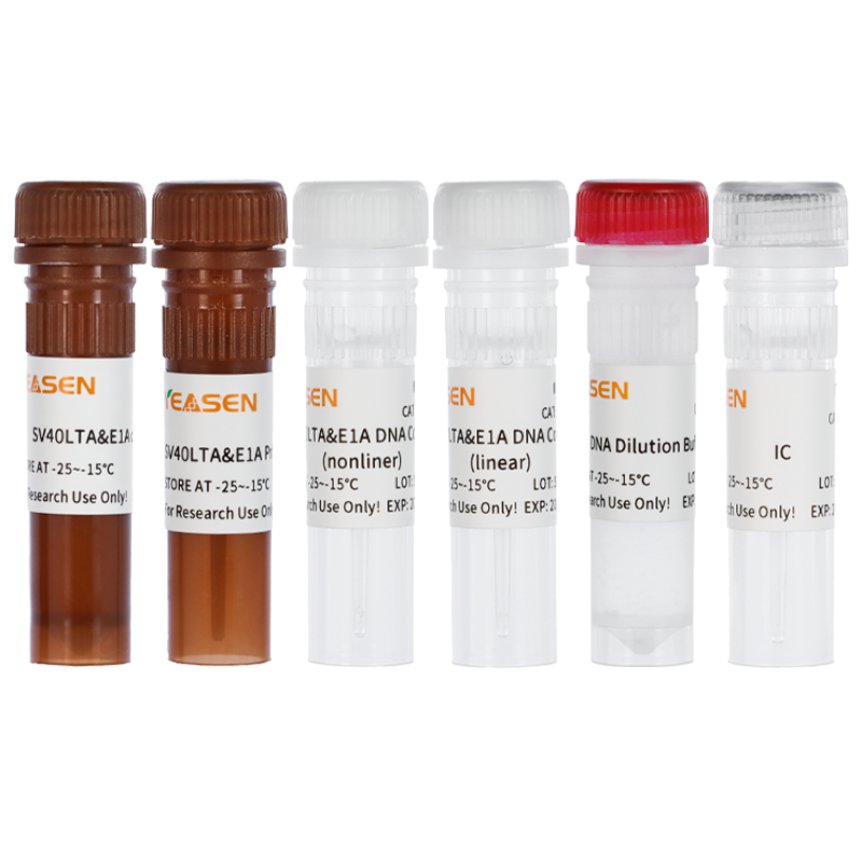


This kit is designed for the quantitative detection of residual host cell DNA—specifically SV40 Large T Antigen (LTA) and Adenovirus E1A sequences—in biopharmaceutical products derived from host cells such as HEK293T. Utilizing probe-based real-time PCR (qPCR), the assay enables highly specific and rapid quantification of SV40 LTA and E1A residual DNA, with a limit of detection as low as 10¹ copies/μL. The kit is fully compatible with Yeasen’s Magnetic Bead–Based Residual DNA Sample Preparation Kits (Cat# 18461ES) for streamlined sample processing. Validated Report Features Complies with regulations – Fully validated; validation...
This kit is designed for the quantitative detection of residual host cell DNA—specifically SV40 Large T Antigen (LTA) and Adenovirus E1A sequences—in biopharmaceutical products derived from host cells such as HEK293T.
Utilizing probe-based real-time PCR (qPCR), the assay enables highly specific and rapid quantification of SV40 LTA and E1A residual DNA, with a limit of detection as low as 10¹ copies/μL.
The kit is fully compatible with Yeasen’s Magnetic Bead–Based Residual DNA Sample Preparation Kits (Cat# 18461ES) for streamlined sample processing.
Features
- Complies with regulations – Fully validated; validation reports available.
- High-quality reagents – All components in-house developed; enzymes made in ultra-clean facility.
- Highly sensitive – Detection down to 10¹ copies/μL.
- Highly reproducible – Low within-run and between-run variability.
- Highly specific – Detects only SV40 LTA and E1A DNA—no cross-reactivity.
- Built-in control – Internal Control (IC) flags sample or reaction issues.
Components
|
Components No. |
Name |
41310ES50(50 T)
|
41310ES60(100 T)
|
|
41310-A |
SV40LTA&E1A qPCR Mix |
0.75 mL |
1.5 mL |
|
41310-B |
SV40LTA&E1A Primer&Probe Mix |
200 μL |
400 μL |
|
41310-C |
DNA Dilution Buffer |
2 × 1.8 mL |
4 × 1.8 mL |
|
41310-D |
SV40LTA&E1A DNA Control (nonliner) |
25 μL |
50 μL |
|
41310-E |
SV40LTA&E1A DNA Control (linear) |
25 μL |
50 μL |
|
41310-F |
IC |
50 μL |
100 μL |
*IC: Internal control.
Storage
This product should be stored at -25~-15℃ for 2 years. Both 41310-A and 41310-B should be stored protected from light.
Applicable Instrument Models
Include but not limited to:
Bio-Rad: CFX96 Optic Module.
Thermo Scientific: ABI 7500; ABI Quant Studio 5.
Figures
1. Detection Range
SV40LTA: Linear range = 1.8 × 10¹ ~ 1.8 × 10⁵ copies/μL, R² = 1.000, amplification efficiency = 100.25%, CV < 15% across all concentrations.
E1A: Linear range = 1.8 × 10¹ ~ 1.8 × 10⁵ copies/μL, R² = 1.000, amplification efficiency = 100.25%, CV < 15% across all concentrations.


Figure 1. SV40LTA standard curve (left) and amplification plot (right)


Figure 2. E1A standard curve (left) and amplification plot (right)
2. Limit of Quantitation (LOQ)
SV40LTA & E1A DNA at concentrations of 18, 9, 4.5, 2.25, and 1.8 copies/μL were tested in 10 replicates each. At ≥4.5 copies/μL, CVs were <20%, establishing the LOQ as 4.5 copies/μL.


Figure 3. qPCR detection of SV40LTA(lift) and E1A(right) at 4.5 copies/μL
|
Replicate Analyte |
SV40LTA (copies/μL) |
E1A (copies/μL) |
||
|
Quantity |
Recovery |
Quantity |
Recovery |
|
|
1 |
4.66 |
103.61% |
4.87 |
108.21% |
|
2 |
4.33 |
96.29% |
4.15 |
92.26% |
|
3 |
4.49 |
99.72% |
4.63 |
102.88% |
|
4 |
5.08 |
112.97% |
4.86 |
107.99% |
|
5 |
6.26 |
139.11% |
5.67 |
125.93% |
|
6 |
5.46 |
121.26% |
4.97 |
110.42% |
|
7 |
4.79 |
106.34% |
5.50 |
122.22% |
|
8 |
5.57 |
123.83% |
5.00 |
111.20% |
|
9 |
5.09 |
113.18% |
5.55 |
123.28% |
|
10 |
4.62 |
102.62% |
4.97 |
110.43% |
|
Mean |
5.04 |
\ |
5.02 |
\ |
|
CV% |
11.73% |
\ |
9.13% |
\ |
Documents:
Safety Data Sheet
Manuals
Storage
FAQ
Citations
Documents
Applications
Sie können auch mögen
Anfrage
FAQ
Das Produkt ist nur für Forschungszwecke bestimmt und nicht für die therapeutische oder diagnostische Anwendung bei Menschen oder Tieren. Produkte und Inhalte sind durch Patente, Marken und Urheberrechte von
Für bestimmte Anwendungen sind möglicherweise zusätzliche geistige Eigentumsrechte Dritter erforderlich.