


Frequently Bought Together
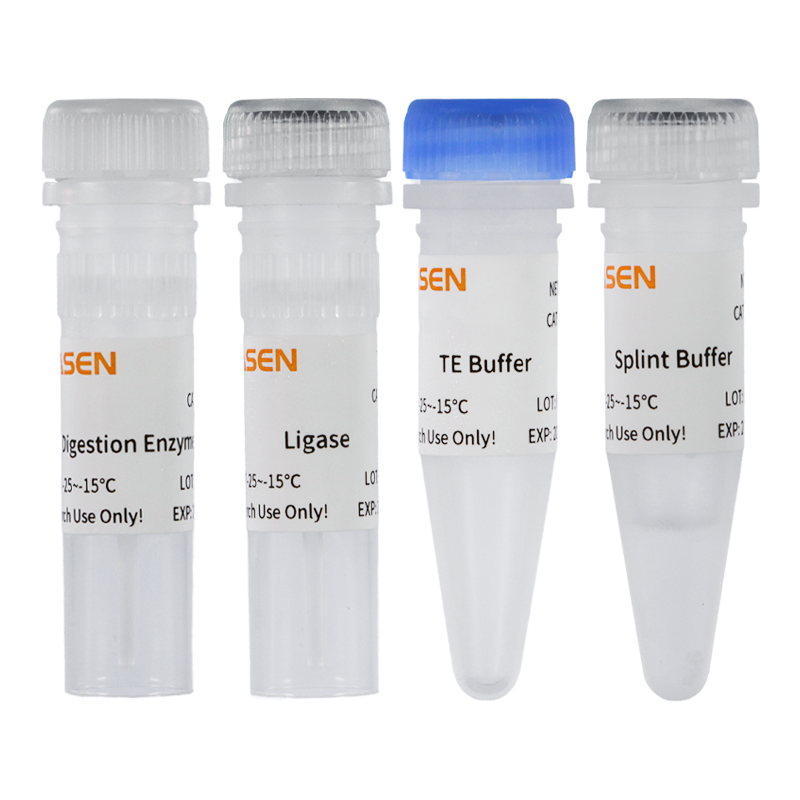
Hieff NGS™ Fast-Pace DNA Cyclization Kit is a single-strand cyclization kit specifically developed for the MGI high-throughput sequencing platform. Composed of high-quality enzymes and optimized buffers, it markedly improves reaction efficiency, enabling the entire cyclization workflow to be completed within 1 h.
Specifications
|
Cat.No. |
13339ES16 / 13339ES96 |
|
Size |
16 T / 96 T |
Components
|
Components No. |
|
Name |
13339ES16 |
13339ES96 |
|
13339-A |
|
TE Buffer |
0.75 mL |
3×1.5 mL |
|
13339-B |
|
Splint Buffer |
240 μL |
2×720 μL |
|
13339-C |
|
Ligase |
80 μL |
480 μL |
|
13339-D |
|
Digestion Enzyme |
32 μL |
192 μL |


Notes
I. Regarding Operation
1. For your safety and health, please wear a lab coat and disposable gloves during operation.
2. Before use, thaw each component of the kit at room temperature. After thawing, invert several times to mix thoroughly, briefly centrifuge, and keep on ice for use.
3. When preparing each reaction mixture, gentle pipetting or mild vortexing is recommended; vigorous vortexing may reduce library yield.
4. To avoid cross-contamination of samples, filtered tips are recommended; replace the tip when aspirating different samples.
5. It is recommended to perform each step reaction in a PCR instrument with a heated lid; preheat the PCR instrument to near the reaction temperature before use.
6. Regularly clean each experimental area (wipe with 0.5% sodium hypochlorite or 10% bleach) to ensure a clean experimental environment.
7. This product is for research use only!
II. Sample Requirements and Handling
Sample amount requirements
1. The recommended Input DNA amount for this kit is 1 pmol; if library yield is insufficient, the minimum input can be reduced to 0.5 pmol.
2. If special cyclization input requirements exist, the input can be adjusted as needed, but in principle should not exceed 2 pmol.
3. Different DNA fragment sizes at 1 pmol correspond to different masses. Calculate using Formula 1 or refer to Table 1 to select the required Input DNA amount:
Formula 1 Conversion between moles and mass of PCR products
Mass of 1 pmol PCR product (ng) = Main fragment size of PCR product (bp) × 0.66
Table 1 Mass of 1 pmol PCR product for different fragment sizes
|
Insert fragment size (bp) |
Main fragment size of PCR product (bp) |
Yield at 1 pmol (ng) |
|
150 |
230 |
152 |
|
200 |
280 |
185 |
|
250 |
330 |
218 |
|
300 |
380 |
251 |
Sample pooling requirements
1) Input DNA can be a single sample or a mixture of multiple samples with different molecular barcodes.
2) The total amount of the mixed sample is recommended to be 1 pmol; if each sample requires the same amount of data, pool equally, and the mass required for each sample is calculated using Formula 2:
Formula 2 Calculation of required mass for individual sample in the pool
Rquired mass per sample (ng) = Mass corresponding to 1 pmol input DNA (ng) / Number of pooled samples, N
3) The total volume of a single or pooled sample used for cyclization should not exceed 40 μL.
III. Regarding Bead Purification
1. Beads should be equilibrated to room temperature before use; otherwise purification recovery will decrease.
2. Beads should be thoroughly vortexed or pipetted up and down to mix well before each use.
3. The 80% ethanol used for bead washing should be prepared fresh; otherwise recovery efficiency will be affected.
4. Before elution, beads should be air-dried at room temperature. Insufficient drying may leave residual anhydrous ethanol affecting subsequent reactions; over-drying may cause bead cracking and reduce purification recovery. Typically, air-dry at room temperature for ~5 min.
5. For storage of the single-strand cyclization product, TE Buffer can be used for elution; the product can be stored at -20°C for 1 month.
IV. Regarding Library Quality Control
1. After purification of the single-strand cyclization product, it is recommended to quantify the purified product using the Qubit® ssDNA Assay Kit single-strand DNA fluorescent dye reagent.
2. After purification, the yield of the single-strand cyclization product should be ≥ 80 fmol (sufficient for two sequencing runs).
3. Calculate using Formula 3 or refer to Table 2.
Formula 3 Mass of 80 fmol single-stranded circles for different PCR product fragment sizes
Mass of 80 fmol single-strand circle (ng) = 0.08 × Main fragment size of DNA (bp) × 0.33
Table 2 Mass of 80 fmol single-stranded circles for different PCR product fragment sizes
|
Insert fragment size (bp) |
Main fragment size of PCR product (bp) |
Yield at 80 fmol (ng) |
|
150 |
230 |
6.07 |
|
200 |
280 |
7.39 |
|
250 |
330 |
8.71 |
|
300 |
380 |
10.03 |
Instructions
1. Self-prepared Materials
1. Purification beads: Cat#12601, Hieff NGS™ DNA Selection Beads; or Cat#A63880, AMPure XP Beads; or other equivalent products.
2. Library quality control: Cat#12645, ssDNA Assay Kit; or Cat#Q10212, Thermo Fisher Qubit ssDNA Assay Kit.
3. Other materials: 80% ethanol, low-binding EP tubes, magnetic stand, PCR instrument, etc.
2. Workflow

Figure 1. Workflow of single-strand cyclization library construction.
3. Procedure
Denaturation
Based on the library length, transfer 1 pmol of the library into a 0.2 mL PCR tube and supplement with TE Buffer to a final volume of 40 μL (Table 3).
Table 3 DNA Denaturation System
|
Component |
Volume (μL) |
|
Single or pooled double-stranded library |
X |
|
Total |
40 |
Mix thoroughly, denature at 95°C for 3 min in a PCR instrument, then immediately place on ice. After a 2 min ice bath, briefly centrifuge.
[Note]: Some PCR instruments cool rapidly once the program ends; failure to remove the tube promptly may cause DNA reannealing and reduced cyclization efficiency. Set the program to [95°C, hold]; after placing the library in the instrument, use a timer to count 3 min, then immediately remove the library and place it on ice.
Single-strand Cyclization
1. Thaw the reagents listed in Table 4, mix by inversion, and keep on ice until use.
2. On ice, assemble the reaction system described in Table 4.
Table 4 Single-stranded Cyclization Reaction System
|
Component |
Volume (μL) |
|
Reaction from previous step |
40 |
|
Splint Buffer |
15 |
|
Ligase |
5 |
|
Total |
60 |
3. Mix gently by pipetting or low-speed vortexing, and briefly centrifuge to collect the reaction mixture at the bottom of the tube.
4. Place the PCR tube in the PCR instrument and perform single-strand cyclization according to the program in Table 5.
Table 5 Single‑stranded Circularization Reaction Program
|
Temperature |
Time |
|
Heated lid 42°C |
on |
|
37°C |
15 min |
|
4°C |
Hold |
Enzymatic Digestion
1. Thaw the reagents listed in Table 6, mix by inversion, and keep on ice until use.
2. On ice, assemble the reaction system described in Table 6.
Table 6 Enzymatic Digestion System
|
Component |
Volume (μL) |
|
Reaction from previous step |
60 |
|
Digestion Enzyme |
2 |
|
Total |
62 |
3. Mix gently by pipetting or low-speed vortexing, and briefly centrifuge to collect the reaction mixture at the bottom of the tube.
4. Place the PCR tube in the PCR instrument and perform the digestion reaction under the conditions in Table 7.
Table 7 Enzymatic Digestion Reaction Program
|
Temperature |
Time |
|
Heated lid 42°C |
on |
|
37°C |
10 min |
|
4°C |
Hold |
5. After the reaction, briefly centrifuge and proceed immediately to purification.
Purification of Digestion Products
This step uses magnetic beads to purify the enzymatically digested product.
1. Preparation: Take Hieff NGS™ DNA Selection Beads or Beckman AMPure XP Beads out of the refrigerator and equilibrate at room temperature for at least 30 min. Prepare 80% ethanol.
2. Vortex or invert the beads thoroughly to ensure uniform mixing.
3. Add 112 μL of Hieff NGS™ DNA Selection Beads to the digestion product and incubate at room temperature for 10 min.
4. Briefly centrifuge the PCR tube and place it on a magnetic stand to separate the beads from the liquid. Once the solution is clear (~2 min), carefully remove the supernatant.
5. While keeping the PCR tube on the magnetic stand, add 200 μL of freshly prepared 80% ethanol to wash the beads. Incubate at room temperature for 30 sec, then carefully remove the supernatant.
6. Repeat step 5 for a total of two washes.
7. While keeping the PCR tube on the magnetic stand, remove the cap and air-dry the beads until small cracks just begin to appear.
8. Remove the PCR tube from the magnetic stand, add 22 μL of TE Buffer, vortex or gently pipette to mix thoroughly, and let stand at room temperature for 10 min.
9. Briefly centrifuge, keep the PCR tube on the magnetic stand, and once the solution is clear (~2 min), carefully transfer the supernatant to a new PCR tube.
Stop point: The cyclized and purified product can be stored at -20°C for up to one month.
Quality Control of Digestion Products
Quantify the purified product using the Qubit ssDNA Assay Kit fluorescent reagent; see Section 4 of Notes for details.
Storage
FAQ
Citations
Documents
Applications
Sie können auch mögen
Anfrage
FAQ
Das Produkt ist nur für Forschungszwecke bestimmt und nicht für die therapeutische oder diagnostische Anwendung bei Menschen oder Tieren. Produkte und Inhalte sind durch Patente, Marken und Urheberrechte von
Für bestimmte Anwendungen sind möglicherweise zusätzliche geistige Eigentumsrechte Dritter erforderlich.