
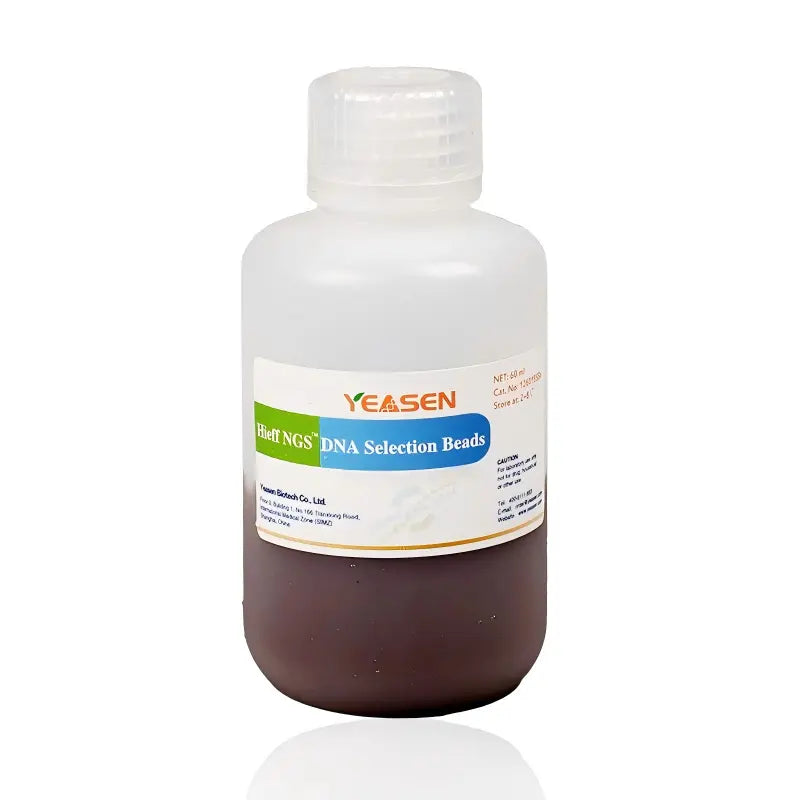



Hieff NGS™ DNA Selection Beads werden auf Basis des SPRI-Prinzips (Solid Phase Reverse Immobilization) hergestellt und eignen sich zur DNA-Reinigung und Größenauswahl bei der Vorbereitung von Next Generation Sequencing (NGS)-Bibliotheken. Hieff NGS™ DNA Selection Beads sind mit verschiedenen DNA- und RNA-Bibliotheksvorbereitungskits kompatibel und stellen eine gute Alternative zu AMPure Perlen.
Komponenten
| Komponenten Nr. | Name | 12601ES08 | 12601ES56 | 12601ES75 |
| 12601 | Hieff NGS™ DNA-Selektionsperlen | 5 ml | 60 ml | 450 ml |
Technische Daten
| Produktlinie | DNA-Reinigung und Auswahlperlen |
| Ausgangsmaterial | DNA |
| Kompatibilität | DNA |
| Isolationstechnologie | Magnetische Perle |
| Endprodukttyp | DNA |
| Zur Verwendung mit (Anwendung) | DNA-Analyse, DNA-Größenauswahl |
Versand und Lagerung
Die Perlen werden mit Kühlakkus versendet und können ein Jahr lang bei 2°C–8°C gelagert werden.
Anweisungen
- 1. Vorbereitung
Äquilibrieren Sie die Selektionskügelchen vor der Verwendung mindestens 30 Minuten lang bei Raumtemperatur.
- 2. Auswahl der DNA-Größe
Der Vorgangsablauf zur Größenauswahl ist in Abbildung 1 dargestellt und das Protokoll lautet wie folgt.
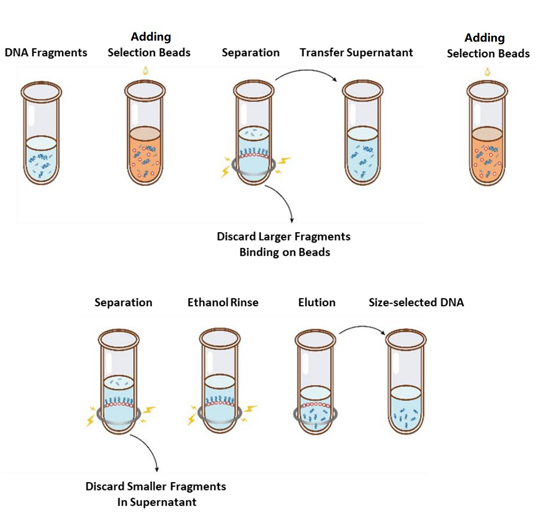
Abbildung 1. Das Flussdiagramm der DNA-Größenauswahl
2.1 Mischen Sie die Perlen vor jedem Gebrauch gründlich durch Vortexen oder Auf- und Abpipettieren.
2.2 Fügen Sie der Probe die erste Runde Selektionsperlen hinzu (siehe Tabelle 1). Mischen Sie gründlich, indem Sie die Probe mindestens 10 Mal auf dem Vortex-Rührer oder durch Auf- und Abpipettieren auf- und abpumpen.
2.3 5 Minuten bei Raumtemperatur inkubieren.
2.4 Zentrifugieren Sie das Röhrchen kurz und stellen Sie es auf einen Magnetständer. Wenn die Lösung klar ist (ca. 5 min), geben Sie den Überstand in ein neues PCR-Röhrchen.
2.5 Fügen Sie der Probe aus Schritt 2.4 gemäß Tabelle 1 die zweite Runde Selektionskügelchen hinzu. Mischen Sie gründlich, indem Sie mindestens 10 Mal auf und ab verwirbeln oder pipettieren.
2.6 5 Minuten bei Raumtemperatur inkubieren.
2.7 Zentrifugieren Sie das Röhrchen kurz und stellen Sie es auf einen Magnetständer. Wenn die Lösung klar ist (ca. 5 min), saugen Sie den Überstand ab und entsorgen Sie ihn.
2.8 Belassen Sie das Röhrchen im Magnetständer und geben Sie 200 μl frisch zubereiteten 80%igen Ethanol hinzu, ohne die Perlen zu beschädigen. Inkubieren Sie es 30 Sekunden lang bei Raumtemperatur. Saugen Sie das Ethanol ab und entsorgen Sie es.
2.9 Wiederholen Sie Schritt 2.8 einmal für insgesamt zwei Waschvorgänge.
2.10 Restliches Ethanol mit 10-µL-Pipettenspitzen entfernen. Das Röhrchen im Magnetständer lassen und die Selektionsperlen bei geöffnetem Deckel lufttrocknen, bis Risse sichtbar werden (ca. 5 Min.).
Hinweis: Trocknen Sie die Selektionsperlen nicht zu stark. Dies kann zu einer geringeren DNA-Zielausbeute führen.
2.11 Entfernen Sie das Röhrchen vom Magnetständer. Fügen Sie eine entsprechende Menge ddH2O (≥20 µL) hinzu und mischen Sie gründlich durch Vortexen oder mindestens 10-maliges Auf- und Abpipettieren.
2.12 5 Minuten bei Raumtemperatur inkubieren.
Zentrifugieren Sie das Röhrchen kurz und stellen Sie es auf den Magnetständer. Wenn die Lösung klar ist (ca. 5 Minuten), geben Sie 20 μL des Überstands in ein neues Röhrchen.
- 3. Empfohlene Bedingungen für die Auswahl der DNA-Größe
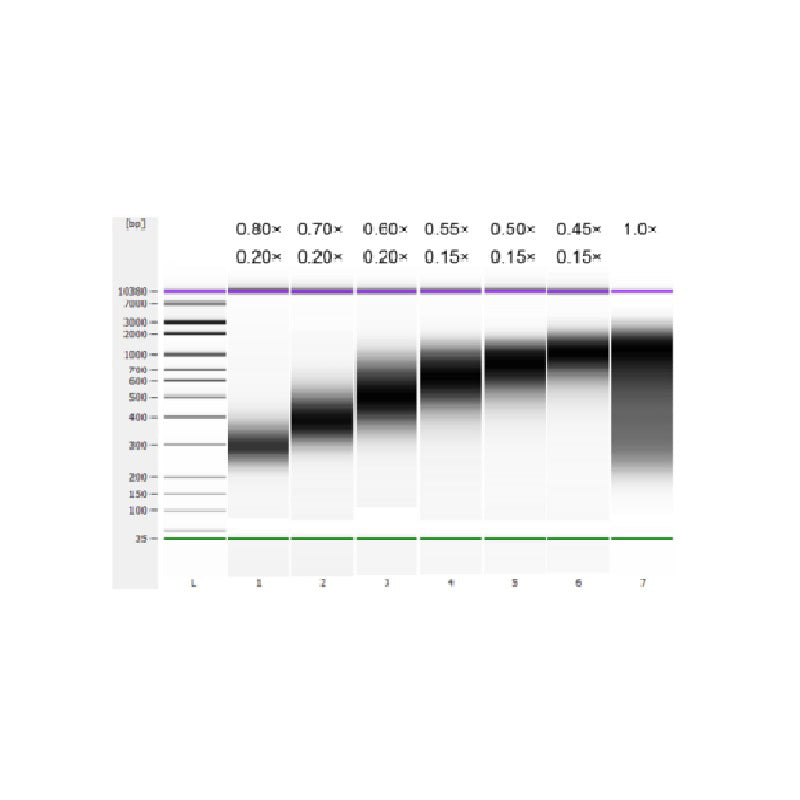
Die Kalbsthymus-DNA wurde durch Ultraschallbehandlung fragmentiert, um ein Fragment von 100–1.000 bp herzustellen, und es wurden zwei Runden der Größenauswahl gemäß Tabelle 1 durchgeführt. Die Ergebnisse wurden mit einem Agilent 2100 Bioanalyzer analysiert (Abbildung 2).
Tabelle 1. Empfohlene Bedingungen für die Auswahl der DNA-Größe
| Länge des DNA-Fragments | 250-350 bp | 320-420 bp | 450–550 bp | 550-700 bp | 700-900 bp | 800–1.000 Basispunkte |
| Perlenverhältnis: DNA für die 1. Runde | 0,80× | 0,70× | 0,60× | 0,55× | 0,50× | 0,45× |
| Perlenverhältnis: DNA für die 2. Runden | 0,20× | 0,20× | 0,20× | 0,15× | 0,15× | 0,15× |
Hinweis: „ד in der Tabelle gibt das Volumen der DNA-Probe an. Wenn beispielsweise die Insertlänge der Bibliothek 250 bp beträgt und das DNA-Probenvolumen 100 μL beträgt, beträgt das Volumen der in der ersten Sortierrunde verwendeten Magnetkügelchen 0,80 × 100 μL = 80 μL; das Volumen der in der zweiten Sortierrunde verwendeten Magnetkügelchen beträgt 0,20 × 100 μL = 20 μL.
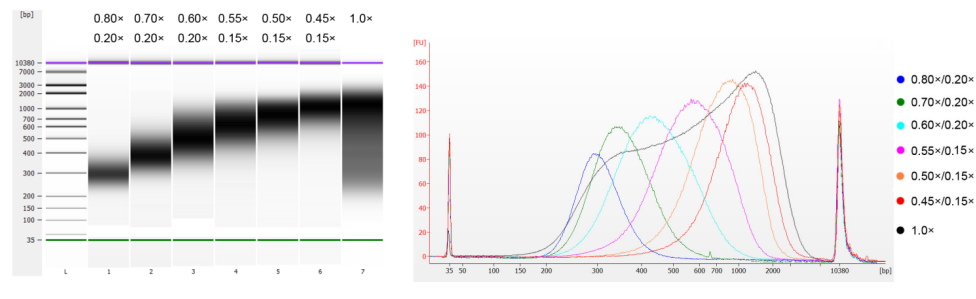
Abbildung 2. Agilent 2100 hochempfindliches DNA-Chip-Elektropherogramm
Hinweise:
1. Tragen Sie zu Ihrer Sicherheit und Gesundheit bei Operationen bitte Laborkittel und Einweghandschuhe.
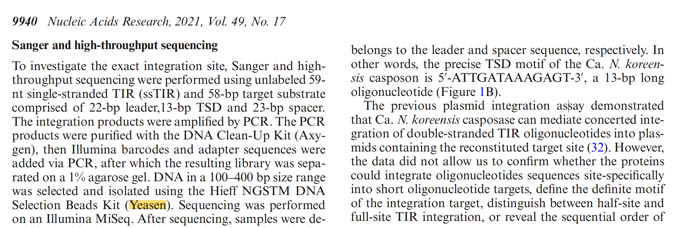
Zitiert aus „Sequenzspezifische Integration durch die Casposase der Familie 1 aus Candidatus Nitrosopumilus koreensis Nucleic Acids Res. 2021;49(17):9938-9952. doi:10.1093/nar/gkab725"
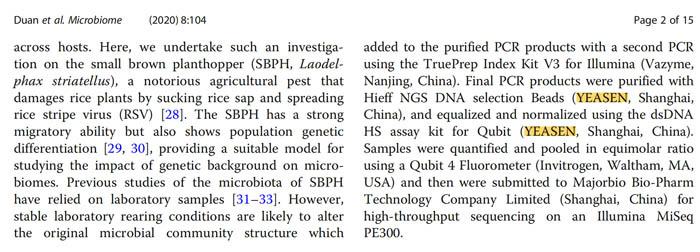
Zitiert aus „Recent infections by Wolbachia alters microbial communities in wild Laodelphax striatellus populations. Microbiome. 2020;8(1):104. Veröffentlicht 2020 Jul 2. doi:10.1186/s40168-020-00878-x“
[1] Wang X, Yuan Q, Zhang W, et al. Sequenzspezifische Integration durch die Casposase der Familie 1 aus Candidatus Nitrosopumilus koreensis Nucleic Acids Res. 2021;49(17):9938-9952. doi:10.1093/nar/gkab725(IF:16.971)
[2] Duan XZ, Sun JT, Wang LT, et al. Jüngste Infektion durch Wolbachia verändert mikrobielle Gemeinschaften in wilden Laodelphax striatellus-Populationen. Microbiome. 2020;8(1):104. Veröffentlicht am 2. Juli 2020. doi:10.1186/s40168-020-00878-x(IF:11.607)
[3] Song B, Almatrafi E, Sang F, et al.Umgang mit Fenton-behandeltem Sediment mit Biokohle und Schafmistkompost: Auswirkungen auf die evolutionären Eigenschaften der Bakteriengemeinschaft. J Environ Manage. 2022;316:115218. doi:10.1016/j.jenvman.2022.115218(IF:6.789)
[4] Huang C, Mei Q, Lou L, et al. Colitis ulcerosa als Reaktion auf eine fäkale Mikrobiota-Transplantation durch Modulation der Darmmikrobiota und des Th17/Treg-Zellgleichgewichts. Cells. 2022;11(11):1851. Veröffentlicht am 5. Juni 2022. doi:10.3390/cells11111851(IF:6.600)
[5] Ghosh S, Yang X, Wang L, Zhang C, Zhao L. Aktive Phase der präbiotischen Fütterung verändert die Darmmikrobiota und bewirkt eine gewichtsunabhängige Linderung der Leberverfettung und des Serumcholesterins bei Mäusen, die mit fettreicher Ernährung gefüttert wurden. Comput Struct Biotechnol J. 2020;19:448-458. Veröffentlicht am 24. Dezember 2020. doi:10.1016/j.csbj.2020.12.011(IF:6.018)
[6] Gao X, Yu B, Yu J, et al. Entwicklungsprofilierung der Verdauung von Nahrungskohlenhydraten bei Ferkeln. Front Microbiol. 2022;13:896660. Veröffentlicht am 29. April 2022. doi:10.3389/fmicb.2022.896660(IF:5.640)
[7] Li P, Zhang Y, Yan F, Zhou X. Eigenschaften eines Bakteriophagen, vB_Kox_ZX8, isoliert aus klinischem Klebsiella oxytoca und seine therapeutische Wirkung auf Mäusebakteriämie. Front Microbiol. 2021;12:763136. Veröffentlicht am 3. Dezember 2021. doi:10.3389/fmicb.2021.763136(IF:5.640)
[8] Lin Z, Luo P, Huang D, Wu Y, Li F, Liu H. Multi-Omics-basierte Strategie zur Toxizitätsanalyse von Acrylamid im Saccharomyces cerevisiae-Modell. Chem Biol Interact. 2021;349:109682. doi:10.1016/j.cbi.2021.109682(IF:5.194)
[9] Sun X, Lv W, Wang Y, et al. Das Mrgprb2-Gen spielt eine Rolle bei den anaphylaktoiden Reaktionen, die durch die Injektion von Houttuynia cordata hervorgerufen werden. J Ethnopharmacol. 2022;289:115053. doi:10.1016/j.jep.2022.115053(IF:4.360)
[10] Ma H, Lai B, Zan C, Di X, Zhu X, Wang K. GLO1 trägt zur Arzneimittelresistenz von Escherichia coli bei, indem es den PER-Typ von β-Lactamasen mit erweitertem Spektrum induziert. Infect Drug Resist. 2022;15:1573-1586. Veröffentlicht am 5. April 2022. doi:10.2147/IDR.S358578(IF:4.003)
[11] Zhong Y, Zhao W, Tang Z, et al. Vergleichende transkriptomische Analyse der verschiedenen Entwicklungsstadien des Eierstocks beim roten Sumpfkrebs Procambarus clarkii. BMC Genomics. 2021;22(1):199. Veröffentlicht am 21. März 2021. doi:10.1186/s12864-021-07537-x(IF:3.969)
[12] Lian C, Yang H, Lan J, et al. Vergleichende Analyse von Chloroplastengenomen enthüllt phylogenetische Beziehungen und intraspezifische Variation in der Heilpflanze Isodon rubescens. PLoS One. 2022;17(4):e0266546. Veröffentlicht am 6. April 2022. doi:10.1371/journal.pone.0266546(IF:3.240)
[13] Diao G, Huang J, Zheng X, et al. Prostaglandin E2 spielt eine Doppelrolle bei der Regulierung der Migration dendritischer Zellen. Int J Mol Med. 2021;47(1):207-218. doi:10.3892/ijmm.2020.4801(IF:3.098)
[14] Bing XL, Zhao DS, Peng CW, Huang HJ, Hong XY. Ähnlichkeiten und räumliche Variationen von Bakterien- und Pilzgemeinschaften in Populationen von Feldreiszikaden (Hemiptera: Delphacidae). Insect Sci. 2020;27(5):947-963. doi:10.1111/1744-7917.12782(IF:2.791)
[15] Li X, Zhou S, Zhang J, Zhou Z, Xiong Q. Richtungsänderungen in der intestinalen Bakteriengemeinschaft bei Larven der Schwarzen Soldatenfliege (Hermetia illucens). Animals (Basel). 2021;11(12):3475. Veröffentlicht am 6. Dezember 2021. doi:10.3390/ani11123475(IF:2.752)
[16] Yang J, Peng Y, Kong W. Identifizierung und vollständige Genomsequenz des Mulberry Cryptic Virus 1. Arch Virol. 2022;167(2):687-690. doi:10.1007/s00705-021-05350-1(IF:2.574)
[17] Chang Y, Xia X, Sui L, et al. Die endophytische Besiedlung durch entomopathogene Pilze erhöht die Krankheitsresistenz von Pflanzen durch Veränderung der endophytischen Bakteriengemeinschaft. J Basic Microbiol. 2021;61(12):1098-1112. doi:10.1002/jobm.202100494(IF:2.281)
[18] Ding CY, Ma YM, Li B, et al. Identifizierung und Funktionsanalyse von differentiell exprimierten Genen in Myzus persicae (Hemiptera: Aphididae) als Reaktion auf Trans-Anethol. J Insect Sci. 2022;22(1):3. doi:10.1093/jisesa/ieab094(IF:1.857)
Storage
FAQ
2) The proportion of magnetic beads is incorrect. It is recommended to select the appropriate proportion according to the instructions.
3) The incubation time is insufficient. Ensure that the incubation time is at least 5 minutes.
4) During magnetic bead separation, when the two wheels perform magnetic bead adsorption, the magnetic beads are collected. A 10 μL pipette can be connected in series before the 200 μL pipette for liquid transfer, which can prevent the collection of magnetic beads.
5) During the magnetic bead washing process, the ethanol solution was not prepared freshly, resulting in an insufficiently high ethanol concentration. It is recommended that the ethanol concentration be no less than 70%, and for small fragments, it should be no less than 80%.
6) Excessive drying: If the magnetic beads are dried for too long, the surface will crack, making it difficult to elute the DNA and resulting in a decrease in yield. It is recommended that the drying time should not be too long; the moment the surface begins to crack, drying should be stopped.
7) Insufficient volume of elution solution: The final elution solution should completely cover the magnetic beads within the tube.
8) Sample reasons: The sample purity is low and contains impurities. When there are a large amount of impurities in the sample, it may cause the magnetic beads to aggregate and harden, resulting in insufficient elution. Using a pipette, try to blow the magnetic beads apart as much as possible, extend the elution time, and increase the product recovery rate. If there are many large fragments in the sample, the large fragments will cause the magnetic beads to aggregate. During elution, you can prolong the time or, if necessary, incubate at 37 degrees to improve the yield.
Citations
Documents
| Brochure |
|---|
| Magnetic_Beads_for_DNA_RNA_and_mRNA_Enrichment.pdf |
Applications
Sie können auch mögen
Anfrage
FAQ
Das Produkt ist nur für Forschungszwecke bestimmt und nicht für die therapeutische oder diagnostische Anwendung bei Menschen oder Tieren. Produkte und Inhalte sind durch Patente, Marken und Urheberrechte von
Für bestimmte Anwendungen sind möglicherweise zusätzliche geistige Eigentumsrechte Dritter erforderlich.