
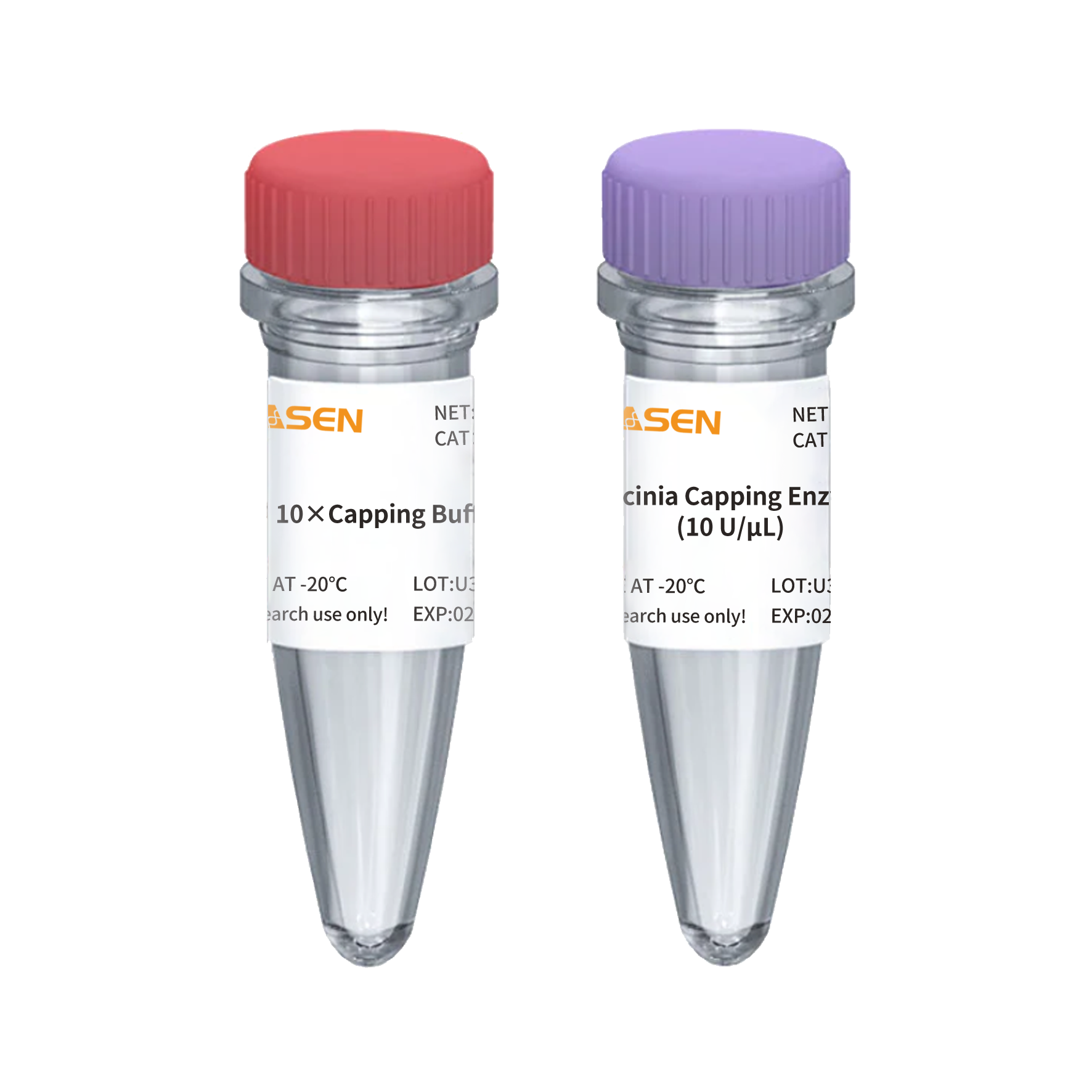
mRNA -Vaccinia Capping -Enzym (10 u/μl) _ 10615es

YeasenSKU: 10615ES84

Größe: 2 Ku
Preis:
Verkaufspreis$365.00
Aktie:
Auf Lager

Eukaryoten-mRNA bildet nach der Transkription am 5'-Ende eine spezielle Struktur, die sogenannte Cap-Struktur. Die Cap-Struktur spielt eine wichtige Rolle bei der Stabilität, dem Transport und der Translation von mRNA. Das Capping-Enzym des Vacciniavirus ist ein wirksames Enzym, das die Bildung der Cap-Struktur katalysieren kann. Es besteht aus zwei Untereinheiten, D1 und D12. Es besitzt außerdem RNA-Triphosphatase-Aktivität, Guanylat-Acyltransferase-Aktivität und Guanin-Methyltransferase-Aktivität, die die 7-Methylguanin-Cap-Struktur (m7Gppp) mit dem 5'-Ende der RNA (m7Gppp5'N) verbinden können. Das Capping-Enzym des Vacciniavirus kann die RNA innerhalb einer Stunde in die richtige Richtung cappen, wenn eine geeignete Konzentration an Capping-Puffer, Guanosintriphosphat (GTP), S-Adenosylmethionin (SAM) usw. vorhanden ist.

Besonderheit

  • Aus einer rekombinanten Quelle isoliert
  • Getestet auf Abwesenheit von Endonukleasen, Exonukleasen, RNasen

Anwendung

  • Capping von mRNA vor Translationsassays/In-vitro-Translation
  • Markierung des 5'-Endes der mRNA

Spezifikation

Quelle Rekombinant Escherichia coli mit Vacciniavirus-Capping-Enzym-Gen
Optimale Temperatur 37℃
Speicherpuffer 20 mM Tris-HCl pH 8,0, 100 mM NaCl, 1 mM DTT, 0,1 mM EDTA, 0,1 % Triton X-100, 50 % Glycerin
Einheitendefinition 1 Einheit: Die Enzymmenge, die erforderlich ist, um 10 pmol GTP (α- 32P) innerhalb einer Stunde bei 37℃ in ein Transkript mit 80 Nukleotiden (80 nt) einzubauen.

Komponenten

Komponenten Nr. Name 10615ES84 (2.000 HE) 10615ES92 (10.000 HE) 10615ES96 (100.000 Einheiten) 10615ES99 (5 ME)
10615 mRNA-Vaccinia-Capping-Enzym (10 Einheiten/µl) 200 μl 1 ml 10 ml 500 ml


Versand und Lagerung

mRNA-Vaccinia-Capping-Enzym-Produkte in GMP-Qualität werden mit Trockeneis versendet und können ein Jahr lang bei -15 °C bis -25 °C gelagert werden.

Zahlen
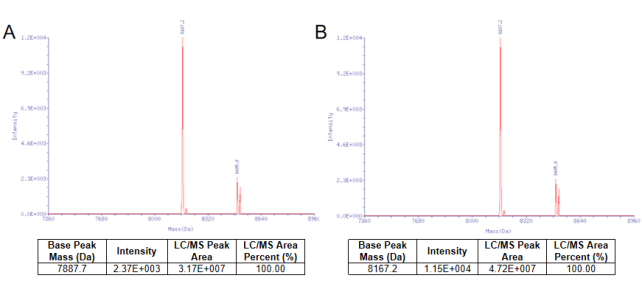
Abbildung 1. Die Capping-Effizienz des Vaccinia-Capping-Systems von YEASEN erreichte nahezu 100 %. Abbildung 1A zeigt die Nukleinsäure-Massenspektrometrie vor der Cap-Reaktion. Abbildung 1B zeigt die Nukleinsäure-Massenspektrometrie nach der Cap-Reaktion.

Unterlagen:


Storage

mRNA Vaccinia Capping Enzyme GMP-grade products are shipped with dry ice and can be stored at -15℃ ~ -25℃ for one year.

FAQ

The purpose of preheating is to unfold the secondary structure of RNA and bring it to a single-stranded state. If this step is not carried out, it will affect the efficiency of capping. This part is indeed a current technical challenge in production. Some companies now directly predict the secondary structure of RNA when determining the template sequence. The capping enzyme only recognizes the first few nucleotides of mRNA. If it is determined that this structure will not result in the secondary structure of RNA, then heating can be omitted.
In industry, the most commonly used method for enzymatic cap addition is to treat IVT products with vaccinia virus cap-adding enzyme, which can modify them into Cap 0 mRNA. The Cap 0 structure can be further modified into Cap 1 (m7GpppmN) under the action of 2'O-methyltransferase. With enzymatic cap addition, the cap addition efficiency can reach over 95%. The co-transcription cap addition method is simple to operate, but because GTP competes with the cap dimer, the cap addition rate of this method is a little lower; both methods have their own advantages and disadvantages.
By increasing the amount of VCE, for example, adding 10 ul of 100 U of enzyme activity to a 100 ul system, the main purpose is to enhance the methyltransferase activity of VCE. It can also be achieved by increasing SAM (0.5 mmol) to enhance the guanine transfer activity and increase the cap formation rate. For instance, our new single-strand cap enzyme has a significantly improved cap formation rate. This is because its guanine transfer activity is better than that of traditional VCE. For traditional VCE, the small subunit D12 is prone to precipitation and polymer formation, which makes purification difficult and leads to loss, thus resulting in higher costs and inability to control batches.
Currently, the industry has not specifically targeted this aspect. In the industry, the main focus is on the efficiency of the cap application. The current best cap application rate is above 80%. Of course, the higher the better. There is still no absolute standard for this. For the synthesized mRNA, purification methods can be employed, such as the one-step membrane encapsulation method by Kang*. This significantly reduces the purification process. The traditional method uses Oligo d(T) columns for purification, with good results achieving a recovery rate of 70-80%; poor results have a recovery rate of 40-50%. An additional step of a hydrophobic column can also be added after the Oligo d(T) column.
The co-transcription requirement stipulates that the starting position of the template must begin with AGG*. The two-step method does not have any specific requirements for the position. However, our current products have the highest yield for the AGGG starting position, mainly due to the preference of the T7 enzyme.

Citations

Applications

Sie können auch mögen

Anfrage

FAQ

Das Produkt ist nur für Forschungszwecke bestimmt und nicht für die therapeutische oder diagnostische Anwendung bei Menschen oder Tieren. Produkte und Inhalte sind durch Patente, Marken und Urheberrechte von Yeasen Biotechnology geschützt. Markensymbole geben das Herkunftsland an, nicht unbedingt die Registrierung in allen Regionen.

Für bestimmte Anwendungen sind möglicherweise zusätzliche geistige Eigentumsrechte Dritter erforderlich.

Yeasen engagiert sich für ethische Wissenschaften und ist davon überzeugt, dass unsere Forschung kritische Fragen ansprechen und gleichzeitig Sicherheit und ethische Standards gewährleisten sollte.