Description
Dextran sulfate sodium salt (DSS) is a polyanionic derivative of dextran produced by the esterification of Dextran with chlorosulphonic acid. The sulfur content is approximately 17% which corresponds to an average of 1.9 sulfate groups per glucosyl residue of the dextran molecule. DSS has several characteristics: 1) polyanionic complex, soluble in water, forming a colorless aqueous solution; 2) high purity and good stability; 3) can be degraded naturally. Inflammatory bowel disease (IBD) is a chronic, relapsing gastrointestinal infection that increases the risk of intestinal tumors, mainly including UC and Crohn disease (CD). In 1985, after the hamster ulcerative colitis model was first prepared by using DSS, a large number of studies have proved that the DSS colitis model is similar to human ulcerative colitis. The histological features, clinical manifestations, disease site, and cytokine proliferation of the DSS colitis model are very similar to human ulcerative colitis (UC). The modeling conditions and operation methods of this model are simple, the expenditure is very cheap, the repeatability is good, and it is easy to master and popularize. The DSS concentration and dosing time can be adjusted according to the experimental purpose to establish acute, chronic, and acute-chronic alternation models.
Features
High purity, water-soluble, and stable – forms a clear aqueous solution with reliable quality.
Biodegradable – naturally degradable, safe for long-term studies.
Easy to use – simple protocols with high repeatability.
Versatile UC model induction – dose-dependent UC symptoms, closely resembling human UC.
Multi-species applicability – effective in mice, rats, zebrafish, pigs, fruit flies, etc.
Widely used in IBD/CAC research – especially suitable for colitis and colitis-associated cancer models (with AOM).
Applications
- For modeling colitis
Specifications
| English synonym | Dextran Sulfate Sodium Salt, DSS; Dextran Sodium Sulfate |
| CAS NO. | 9011-18-1 |
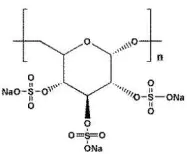
| Formula | (C6H7Na3O14S3)n |
| Appearance | White or off-white powder |
| Solubility | Soluble in water, slightly soluble in ethanol. |
| Structure | ![]() |
Components
| Components No. | Name | 60316ES25 | 60316ES60 | 60316ES76 | 60316ES80 |
| 60316 | Dextran Sulfate Sodium Salt (DSS) MW:36000~50000 | 25 g | 100 g | 500 g | 1 kg |
Shipping and Storage
The product is shipped and stored at room temperature, valid for 2 years.
Figure

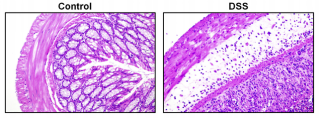
Figure 1 H&E staining results of DSS acute colitis sections[1]
Animal: BALB/c mice, female, 6-8 weeks, 25 g; Method: 3.5% DSS for 7 days
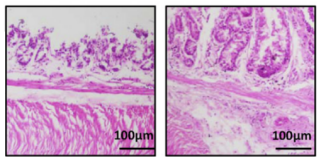
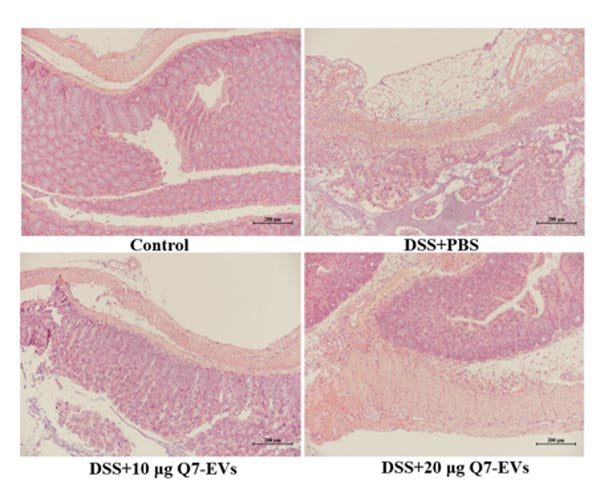
Figure 2 H&E staining results of colitis-associated cancer sections[2]
Animal: BALB/c mice, male,7 weeks old;; DSS concentration: 2.5%; AOM concentration:10 mg/kg; Experiment period:10 weeks
*Links to this resource:
[1]Gao X, Fan W, Tan L, et al. Soy isoflavones ameliorate experimental colitis by targeting ERα/NLRP3 inflammasome pathways[J]. The Journal of Nutritional Biochemistry, 2020, 83.
[2]Jia-Rong Huang, et al. Piperlongumine Alleviates Mouse Colitis and Colitis-Associated Colorectal Cancer[J]. Frontiers in Pharmacology. 2020.586885
FAQ
Q: Regarding the establishment of colitis models, what is the volume of water given to rats and mice per day (including both acute and chronic models)?
A: For mice (20-25g), 7-10 mL per mouse per day. For rats (100g), 10-11 mL per rat per day.
Q: What is the concentration of DSS used for the acute and chronic mouse modeling? And how long is the modeling period?
A: Acute model: 3% - 5%, duration: approximately 7 days; Chronic model: 1% - 3%, duration: approximately 9 weeks. The dosage concentration and the type, strain, weight of the animals, as well as the administration method all have an impact. Customers are required to refer to relevant literature and conduct preliminary experiments to explore the optimal concentration. Additionally, the batches of DSS used in the pre-experiment and the formal experiment should be as consistent as possible to minimize the interference caused by batches in the experiments.
Q: 3% DSS was administered to the mice for three days. Was there no significant weight loss observed?
A: This is a normal phenomenon. Due to individual differences among mice, some animals have a slower response in the modeling process. Even for some, the weight loss symptom didn't appear until the 5th day after drinking DSS. If no obvious symptoms are observed by the 7th day, it is recommended that the customer increase the DSS concentration to 3.5% to 5%.
Q: How to perform the model establishment by intragastric feeding for the colon?
A: Administer 2% DSS solution by gavage at 10:00, 14:00, and 18:00 every day, with 30mL/kg each time. No additional fluid supplementation is required. After each administration, provide an adequate amount of mixed formulated granular feed at the end, and collect the feed at 8:00 the next day. The model can be established continuously for 9 days. Reference: Comparative Study on the Use of Free Drinking of Sodium Dextran Sulfate for Quantitative Gavage to Induce Acute Colitis Model in Mice, Gastroenterology, 2009, 14(1), 27-30.
Q: What are the possible reasons for the failure of colitis model establishment?
A: The DSS model establishment is influenced by various factors, including the type of mice, the molecular weight of DSS, the concentration of DSS, and the administration period. Among these, the concentration of DSS is the most significant factor affecting the success of the model establishment. Possible reasons for model failure: too low DSS concentration, short administration period, and the mice not consuming DSS.
Solution:
1. Increase the concentration of DSS (there are reports indicating that the maximum dose of DSS that can be administered is 10%).
2. Extend the dosing period to a duration of 7-10 days. 3. Observe for any leakage or clogging at the bottle opening. Q: Why is it that only reagents with this specific molecular weight can be used for modeling?
A: DSS is a chemical substance commonly used to induce colitis models. However, different molecular weights of DSS may have different effects, so only DSS within a specific molecular weight range is suitable for colitis models. The key factors affecting the applicability of DSS are its solubility and intestinal permeability. Lower molecular weight DSS has a higher solubility and is more likely to penetrate through the intestinal mucosa, thus better simulating the pathological process of colitis. Higher molecular weight DSS has a lower solubility and poorer permeability, and it is difficult to enter the intestinal wall through the intestinal mucosa, so its effect for inducing colitis models is poorer. Therefore, when choosing DSS suitable for colitis models, the molecular weight needs to be considered to ensure that its solubility and intestinal permeability match the required pathological model. The suitable molecular weight of DSS for colitis models may vary depending on specific research needs, and the appropriate DSS should be selected based on relevant literature.
Q: Why was the product 60316ES chosen for the modeling process, and why can't other dextran sodium sulfate products be used?
A: Usually, the molecular weight used for intestinal inflammation modeling is 36-50KD. Small molecular weight DSS has poor inflammatory effect, while large molecular weight DSS cannot be absorbed by the intestines.
Q: When extracting DNA from the fecal samples of mice induced by DSS, there will be residual DSS in the RNA extracted from the colon tissues, which may inhibit the downstream PCR and RT-PCR experiments. How should this be handled?
A: Spermidine can eliminate the inhibitory effect of DSS on PCR. Reference: Journal of Microbiological Methods, 2018 Jan, 144: 1-7.
Q: Regarding the establishment of colitis models, for the acute colitis model, why did the colon not shorten and the cecum become larger?
A: During the process of establishing animal colitis models, it is clearly observed that the colon of chronic colitis becomes shorter. For acute colitis models, the colon is not as obvious, but there will be phenomena such as the colon becoming relatively brittle, transparent, and congested. It is recommended that customers evaluate through the results of HE section experiments. Acute colitis is an acute inflammatory reaction of the colonic mucosa. The enlargement of the cecum may be caused by congestion and edema due to the inflammation.
Documents
Related Blog
Establishment of Dextran sodium sulfate (DSS) Ulcerative Colitis Model
How to evaluate the success of a DSS-induced colitis model
Ulcerative Colitis Zebrafish Modeling using Dextran sodium sulfate (DSS)
Ulcerative Colitis Drosophila Modeling using Dextran sodium sulfate(DSS)
Ulcerative Colitis Piglet Modeling using Dextran sodium sulfate (DSS)
Ulcerative Colitis Rat Modeling using Dextran sodium sulfate (DSS)
FAQs
Q1: What are the key factors that affect the success of DSS modeling?
A1: DSS concentration, molecular weight, administration time, animal species and rearing environment.
Q2: What is the daily volume of drinking water for rats and mice (including acute and chronic modeling)?
A2: 7-10 mL per day for mice (20~25 g) and 10~11 mL per day for rats (100 g).
Q3: Both DSS and TNBS are models of colitis. What is the difference between the two?
A3: DSS induces ulcerative colitis and TNBS induces Crohn's colitis.
Q4: What is the difference between GAPDH and actin for primer selection?
A4: The difference is not big. GAPDH is used more. It is recommended to use GAPDH as an internal reference for mice.
Q5: Mice have a high lethality rate
A5: Reason: DSS concentration is too high. Recommendation: Appropriately reduce the concentration of DSS administered
Q6: Mice have no symptoms of enteritis or low symptoms of enteritis
A6: Reason: DSS concentration is too low, suggestion: appropriately increase DSS administration concentration; or reduce cycle interval (10-14 days)
Q7: In the same group of mice, the symptoms of enteritis vary greatly
A7: Reasons: 1. The bottle cap was blocked; 2. Some mice did not drink/a small amount of DSS. Suggestions: 1. Check the mouse drinking bottle every day; 2. Each mouse is isolated and cultured separately, and the water intake of the mice is checked every day or the mice are pre-raised for 1-2 weeks after arrival, and the mice with abnormal water intake are excluded.
Q8: Which part of the colon is more reliable for HE staining?
A8: The mouse anus goes up 1-2 cm.
Q9: DSS treatment of NCM460, the recommended concentration for cell modeling
A9: It is recommended to incubate with 3% DSS for 24h.
Citations & References
[1] Ma, X., Chen, J., Wang, F. et al. High fructose consumption aggravates inflammation by promoting effector T cell generation via inducing metabolic reprogramming. Sig Transduct Target Ther 10, 271 (2025). doi: 10.1038/s41392-025-02359-9. IF=52.7
[2] Zhong D, Jin K, Wang R, Chen B, Zhang J, Ren C, Chen X, Lu J, Zhou M. Microalgae-Based Hydrogel for Inflammatory Bowel Disease and Its Associated Anxiety and Depression. Adv Mater. 2024 Jan 26: e2312275.doi:10.1002/adma.202312275. Epub ahead of print. PMID: 38277492. IF=29.4
[3] Li Zhao, Fei Wang,Zhengwei Cai,et al.Improving drug utilization platform with injectable mucoadhesive hydrogel for treating ulcerative colitis[J].chemical engineering journal.424(2021)130464.IF=16.744
[4] Lingjun Tong, Haining Hao, Zhe Zhang,et al.Milk-derived extracellular vesicles alleviate ulcerative colitis by regulating the gut immunity and reshaping the gut microbiota[J].Theranostics.2021; 11(17): 8570-8586 IF=11.556
[5] Li, Y., Dong, J., Xiao, H., Zhang, S., Wang, B., Cui, M., & Fan, S. Gut commensal derived-valeric acid protects against radiation injuries. Gut Microbes,.2020 .1–18.IF=10.245
[6] Jingjing Gan, Yuxiao Liu, Lingyu Sun,et al.Orally administrated nucleotide-delivery particles from microfluidics for inflammatory bowel disease treatment[J].Applied Materials Today.2021 Dec;25:101231 IF=10.041
[7] JialiDong,YuanLi,HuiwenXiao,et al.Oral microbiota affects the efficacy and prognosis of radiotherapy for colorectal cancer in mouse models[J].Cell reports.2021, 109886.IF=9.423
[8] Hao H, Zhang X, Tong L, Liu Q,et al.Lactobacillus plantarumEffect of Extracellular Vesicles Derived From Q7 on Gut Microbiota and Ulcerative Colitis in Mice[J].Frontiers in Immunology.2021.777147 .IF=7.561
[9] Yaohua Fan,Yanqun Fan,Kunfeng Liu,et al.Edible Bird’s Nest Ameliorates Dextran Sulfate Sodium-Induced Ulcerative Colitis in C57BL/6J Mice by Restoring the Th17/Treg Cell Balance[J].Frontiers in Pharmacology.2021.632602.IF=7.561
Payment & Security
Your payment information is processed securely. We do not store credit card details nor have access to your credit card information.
Inquiry
You may also like
FAQ
The product is for research purposes only and is not intended for therapeutic or diagnostic use in humans or animals. Products and content are protected by patents, trademarks, and copyrights owned by Yeasen Biotechnology. Trademark symbols indicate the country of origin, not necessarily registration in all regions.
Certain applications may require additional third-party intellectual property rights.
Yeasen is dedicated to ethical science, believing our research should address critical questions while ensuring safety and ethical standards.