
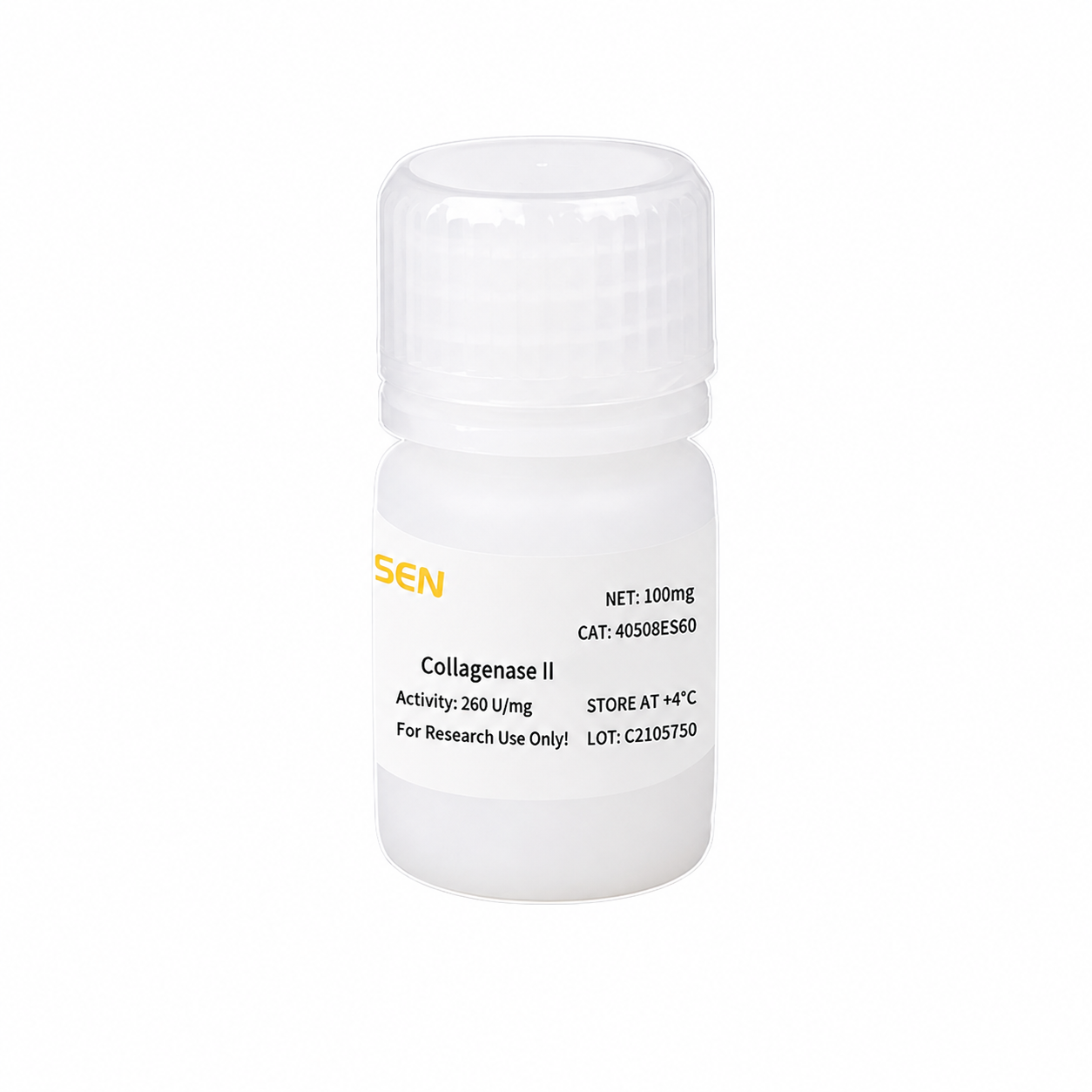

Description
Collagenase is a protease and an endopeptidase that specifically recognizes the Pro-X-Gly-Pro sequence—highly abundant in collagen but rarely found in other proteins—and cleaves the peptide bond between the neutral amino acid (X) and glycine (Gly). While many proteases can hydrolyze single-stranded, denatured collagen peptides, collagenase is the only enzyme capable of degrading native collagen fibers with their characteristic triple-helical structure, which are widely present in connective tissues.
This product is derived from Clostridium histolyticum and is a crude enzymatic extract. It contains collagenase (more accurately termed clostridiopeptidase A), which degrades native collagen and reticular fibers, as well as additional proteases, polysaccharidases, and lipases. These auxiliary enzymes effectively hydrolyze other proteins, polysaccharides, and lipids in the extracellular matrix of both connective and epithelial tissues, making this preparation highly suitable for tissue dissociation.
Commercially available bacterial collagenases are classified into four types—Type I, II, III, and IV—primarily based on differences in enzymatic activity profiles, each with distinct application preferences:
- Type I Collagenase: Contains balanced activities of collagenase, caseinase, clostripain, and trypsin-like enzymes. Commonly used for the isolation of epithelial cells and cells from liver, lung, adipose tissue, and adrenal glands.
- Type II Collagenase: Exhibits higher clostripain activity. Typically used for preparing cells from heart, bone, skeletal muscle, thymus, and cartilage.
- Type III Collagenase: Features lower overall protease activity. Often used for mammary cell isolation.
- Type IV Collagenase: Contains low trypsin-like activity. Preferred for pancreatic islet cell isolation or any application requiring preservation of cell surface receptor integrity.
This product is Type II Collagenase, with an activity of ≥125 U/mg solid, and is suitable for dissociation of tissues and cells from heart, thyroid, salivary gland, liver, bone, and cartilage.
Specifications
|
Cat NO. |
40508ES60 / 40508ES76 |
|
Size |
100 mg / 1 g |
|
Definition of Enzyme Unit |
One unit (U) of collagenase activity is defined as the amount of enzyme that produces 1 µM of L-leucine equivalents from collagen in 5 hours at 37 °C and pH 7.5. |
Components
|
Name |
40508ES60 |
40508ES76 |
|
Collagenase II |
100 mg |
1 g |
Storage
Store at 4 °C protected from light; stable for 2 years. Stock solutions should be aliquoted and stored at –20 °C protected from light.
Documents:
Safety Data Sheet
Manuals
40508_Manual_Ver.EN20251222.pdf
Reference
[1] Sun X, He X, Zhang Y, et al. Inflammatory cell-derived CXCL3 promotes pancreatic cancer metastasis through a novel myofibroblast-hijacked cancer escape mechanism. Gut. 2022;71(1):129-147. doi:10.1136/gutjnl-2020-322744(IF:23.059)
[2] Wu B, Qiang L, Zhang Y, et al. The deubiquitinase OTUD1 inhibits colonic inflammation by suppressing RIPK1-mediated NF-κB signaling. Cell Mol Immunol. 2022;19(2):276-289. doi:10.1038/s41423-021-00810-9(IF:11.530)
[3] Yu Q, Han F, Yuan Z, et al. Fucoidan-loaded nanofibrous scaffolds promote annulus fibrosus repair by ameliorating the inflammatory and oxidative microenvironments in degenerative intervertebral discs. Acta Biomater. 2022;148:73-89. doi:10.1016/j.actbio.2022.05.054(IF:8.947)
[4] Feng C, Xiong Z, Wang C, et al. Folic acid-modified Exosome-PH20 enhances the efficiency of therapy via modulation of the tumor microenvironment and directly inhibits tumor cell metastasis. Bioact Mater. 2020;6(4):963-974. Published 2020 Oct 9. doi:10.1016/j.bioactmat.2020.09.014(IF:8.724)
[5] Wang Y, Sun Q, Ye Y, et al. FGF-2 signaling in nasopharyngeal carcinoma modulates pericyte-macrophage crosstalk and metastasis. JCI Insight. 2022;7(10):e157874. Published 2022 May 23. doi:10.1172/jci.insight.157874(IF:8.315)
[6] Zheng Q, Liu P, Gao G, et al. Mitochondrion-processed TERC regulates senescence without affecting telomerase activities. Protein Cell. 2019;10(9):631-648. doi:10.1007/s13238-019-0612-5(IF:7.575)
[7] Guo H, Yin W, Zou Z, et al. Quercitrin alleviates cartilage extracellular matrix degradation and delays ACLT rat osteoarthritis development: An in vivo and in vitro study. J Adv Res. 2020;28:255-267. Published 2020 Jun 24. doi:10.1016/j.jare.2020.06.020(IF:6.992)
[8] Wang Y, Zhao M, Li W, et al. BMSC-Derived Small Extracellular Vesicles Induce Cartilage Reconstruction of Temporomandibular Joint Osteoarthritis via Autotaxin-YAP Signaling Axis. Front Cell Dev Biol. 2021;9:656153. Published 2021 Apr 1. doi:10.3389/fcell.2021.656153(IF:6.684)
[9] Zhang W, Wang H, Yuan Z, et al. Moderate mechanical stimulation rescues degenerative annulus fibrosus by suppressing caveolin-1 mediated pro-inflammatory signaling pathway. Int J Biol Sci. 2021;17(5):1395-1412. Published 2021 Apr 3. doi:10.7150/ijbs.57774(IF:6.582)
[10] Zhu L, Yang Y, Yan Z, et al. Controlled Release of TGF-β3 for Effective Local Endogenous Repair in IDD Using Rat Model. Int J Nanomedicine. 2022;17:2079-2096. Published 2022 May 9. doi:10.2147/IJN.S358396(IF:6.400)
[11] Zhou T, Xiang DK, Li SN, Yang LH, Gao LF, Feng C. MicroRNA-495 Ameliorates Cardiac Microvascular Endothelial Cell Injury and Inflammatory Reaction by Suppressing the NLRP3 Inflammasome Signaling Pathway. Cell Physiol Biochem. 2018;49(2):798-815. doi:10.1159/000493042(IF:5.500)
[12] Zheng Y, Chen Y, Lu X, et al. Inhibition of Histone Deacetylase 6 by Tubastatin A Attenuates the Progress of Osteoarthritis via Improving Mitochondrial Function. Am J Pathol. 2020;190(12):2376-2386. doi:10.1016/j.ajpath.2020.08.013(IF:4.307)
[13] Wang C, Wang Y, Wang C, et al. Therapeutic application of 3B-PEG injectable hydrogel/Nell-1 composite system to temporomandibular joint osteoarthritis. Biomed Mater. 2021;17(1):10.1088/1748-605X/ac367f. Published 2021 Nov 19. doi:10.1088/1748-605X/ac367f(IF:3.715)
[14] Hu H, Luo SJ, Cao ZR, et al. Depressive Disorder promotes Hepatocellular Carcinoma metastasis via upregulation of ABCG2 gene expression and maintenance of self-renewal. J Cancer. 2020;11(18):5309-5317. Published 2020 Jul 9. doi:10.7150/jca.45712(IF:3.565)
[15] Du Y, Chen X, Yang H, et al. Expression of Oocyte Vitellogenesis Receptor Was Regulated by C/EBPα in Developing Follicle of Wanxi White Goose. Animals (Basel). 2022;12(7):874. Published 2022 Mar 30. doi:10.3390/ani12070874(IF:2.752)
Payment & Security
Your payment information is processed securely. We do not store credit card details nor have access to your credit card information.
You may also like
Inquiry
FAQ
The product is for research purposes only and is not intended for therapeutic or diagnostic use in humans or animals. Products and content are protected by patents, trademarks, and copyrights owned by Yeasen Biotechnology. Trademark symbols indicate the country of origin, not necessarily registration in all regions.
Certain applications may require additional third-party intellectual property rights.
Yeasen is dedicated to ethical science, believing our research should address critical questions while ensuring safety and ethical standards.