
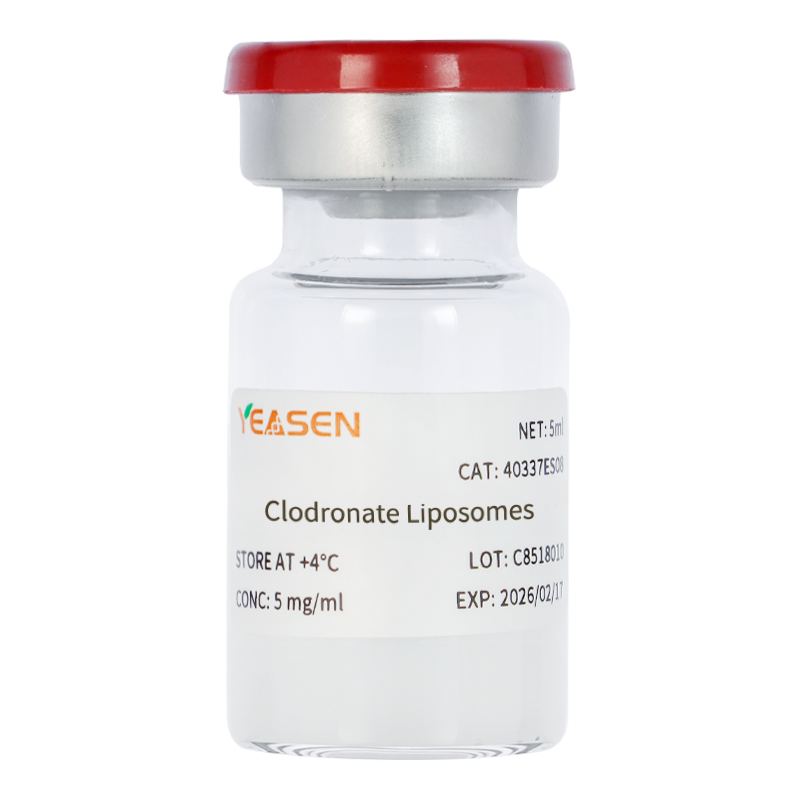

Description
Clodronate Liposomes utilize the endocytosis mechanism of macrophages to carry membrane-impermeable clodronate (clodronate) into the cell. In the presence of macrophage lysosomal phosphatase, clodronate dissolved in the aqueous phase of liposomes is released and accumulates inside the cell. When it reaches a certain concentration it can induce the macrophage to enter the apoptotic process, thus functioning as a macrophage scavenger.
Applications
Macrophages depletion
Clodronate Liposomes are suitable for a variety of injection methods, such as intravenous, intraperitoneal, subcutaneous, intranasal and testicular. The injection volume is related to the body weight of the mice, the injection cycle, the injection method and the purpose of the experiment.
Specifications
|
Solution |
10 mM Na2HPO4,10 mM NaH2PO4,140 mM NaCl |
|
Concentration |
5 mg/mL |
|
Lipid composition |
Phosphatidylcholine and cholesterol |
Components
|
Components No. |
Name |
40337ES05 |
40337ES08 |
40337ES10 |
|
40337 |
Clodronate Liposomes |
2 mL |
5 mL |
10 mL |
Shipping and Storage
The product is stored at 4℃. Transported in ice packs. Cannot be frozen! Shelf life 6 months.
FAQ
Q: For liver macrophage clearance, perfusion is required. Do you have any suggestions regarding flow cytometry?
A: Without perfusion, flow cytometry is meaningless because the macrophages haven't been separated. How can we observe the differences? Flow cytometry suggests detecting F4/80 and CD11b. It is recommended to inject via the tail vein, and then take the liver 24 hours later for immunohistochemistry. Immunohistochemistry does not require perfusion.
Q: The control group of the intracellular macrophage clearance agent, the blank lipid particles, is this a single-vesicle lipid particle or a multi-vesicle lipid particle?
A: Multi-room type.
Q: What is the concentration of the macrophage depleting agent?
A: 5 milligrams per milliliter.
Q: What is the particle size of the liposomes in the Clodronate Liposomes (from Vrije Universiteit Amsterdam) product, which is an intracellular macrophage clearance agent?
A: 150nm to 3um.
Q: How should the Clodronate liposomes be stored and handled after receiving them?
A: After receiving the chlorophosphate liposomes, if they cannot be used immediately, they should be stored in a refrigerator at 4℃. Do not freeze! Use them as the original solution and do not dilute. The liposomes are prone to precipitation. It is recommended to gently mix them before use. Also, the chlorophosphate liposomes at 4℃ cannot be used immediately; they need to be returned to room temperature before injection.
Q: Can Clodronate liposomes be used for the removal of macrophages in vitro?
A: The product can be used for the removal of macrophages in vitro, but this method is more suitable for in vivo experiments. This is mainly because during in vitro culture, the chlorine phosphate released from dead cells or the chlorine phosphate "leaking" from liposomes will remain in the culture medium continuously. However, in vivo, the half-life of chlorine phosphate is very short and it will be quickly cleared by the kidneys. Although free chlorine phosphate will not enter the cells or liposomes, once they accumulate in the culture medium, they will gradually enter the cells.
Q: After intravenous injection of Clodronate liposomes, the animals died very quickly. What was the reason?
A: On one hand, it is possible that the animals were injected with an uneven lipid suspension. It is recommended to gently shake and mix it before use. Liposomes will settle over time outside the body. If multiple animals need to be injected with one dose over a long period of time, the liposomes will precipitate in the syringe, forming an uneven suspension. As a result, the dosage injected into the first animal will be significantly different from that injected into the last animal. On the other hand, it is also possible that the liposomes have not yet returned to room temperature after being taken out of the refrigerator.
Q: For the removal of macrophages in different organs or tissues, where should the injection be performed, what should be the injection dose, and how should the injection time and cycle be determined?
A: This involves the design of a specific experimental plan. We suggest that the client design the experimental plan themselves. We can provide them with some reference materials or help them find relevant literature that aligns with their experimental goals.
Q: How many days after the injection of Clodronate liposomes did the animals die?
A: This might be due to bacterial contamination during the operation. After the macrophages in the body are removed, the chances of infection with viruses, bacteria or yeast increase.
Q: After intravenous injection of Clodronate liposomes, the ED1+ cells in the spleen and liver of the rats did not completely disappear?
A: In rats, mature macrophages show double positivity for ED1 and ED2. However, there are some precursor cells without or with weak phagocytic function that are also ED1+, but present as ED2-. Therefore, all cells positive for ED2 can be completely eliminated, but cells positive for ED1 can only be partially eliminated. The rate of elimination depends on the ratio of precursor/mature macrophages.
Q: The clodronate liposomes failed to achieve the expected results?
A: The chlorophosphate liposomes are produced in large quantities. For each batch, the concentration of chlorophosphate and some possible contaminants are tested to ensure accuracy before they are sold to customers. Additionally, liposomes are susceptible to extreme temperatures. The correct transportation and storage method is at 4 to 8 degrees Celsius. The suspension should neither be frozen nor heated above 30 degrees Celsius. Once the goods are received, they need to be used within 3 months; otherwise, the usage effect may be affected.
Q: During intravenous injection, can the volume of the injection be increased?
A: When performing intravenous injection, the dosage should be based on the animal's weight and cannot exceed 0.1 mL per 10 mg. However, for intraperitoneal injection, the volume of the injection can be appropriately increased. For subcutaneous injection, the dosage should be determined based on the volume of the injection site.
Q: The macrophage deactivator product got frozen during transportation. Can it still be used?
A: It cannot be used.
Q: Are macrophage degraders anions?
A: Yes, an anion.
Q: Regarding the macrophage clearance agent, does the 5 mg/mL mentioned in the instructions refer to the concentration of the drug?
A: Yes, it refers to the concentration of the drug.
Documents:
Safety Data Sheet
Manuals
Related Blog
Clodronate Liposomes | Lesson 1: Injection Methods and Administration Strategies
Clodronate Liposomes | Lesson 2: Liver
Clodronate Liposomes | Lesson 3: Lung Macrophages
Clodronate Liposomes | Lesson 4: Intestine
Clodronate Liposomes | Lesson 5: Brain
Clodronate Liposomes | Lesson 6: Applications in C57BL/6 Mice
Clodronate Liposomes | Lesson 7: Peripheral Blood
Clodronate Liposomes | Lesson 8: Applications in Splenic Macrophage Depletion
Clodronate Liposomes | Lesson 9: Testicular Macrophage Depletion
Simplifying In Vivo Macrophage Depletion: A Practical Guide with Clodronate Liposomes
Macrophage Depletion Made Simple: A Comprehensive FAQ on Clodronate Liposomes
Macrophages and In Vitro/In Vivo Research Strategies
Clodronate Liposomes for Macrophage Depletion
Macrophage Depletion Case Studies
Citations & References:
- Xiong X, Chen S, Shen J, et al. Cannabis suppresses antitumor immunity by inhibiting JAK/STAT signaling in T cells through CNR2. Signal Transduct Target Ther. 2022;7(1):99. Published 2022 Apr 6. doi:10.1038/s41392-022-00918-y(IF:52.7)
- Jiang Z, Wang Y, Gong J, et al. An Aeromonas variant that produces aerolysin promotes susceptibility to ulcerative colitis. Science. 2025;390(6775):eadz4712. doi:10.1126/science.adz4712(IF:45.8)
- Wang Y, Chai Y, Liu Y, et al. Inhibition of tumor cell macropinocytosis driver DHODH reverses immunosuppression and overcomes anti-PD1 resistance. Immunity. 2025;58(10):2456-2471.e6. doi:10.1016/j.immuni.2025.07.013(IF:26.3)
- Chen S, Zhang P, Zhu G, et al. Targeting GSDME-mediated macrophage polarization for enhanced antitumor immunity in hepatocellular carcinoma. Cell Mol Immunol. 2024;21(12):1505-1521. doi:10.1038/s41423-024-01231-0(IF:19.8)
- Zhang Z, Chen C, Yang F, et al. Itaconate is a lysosomal inducer that promotes antibacterial innate immunity [published online ahead of print, 2022 May 25]. Mol Cell. 2022;S1097-2765(22)00443-9. doi:10.1016/j.molcel.2022.05.009(IF:17.970)
- Cai J, Peng J, Zang X, et al. Mammary Leukocyte-Assisted Nanoparticle Transport Enhances Targeted Milk Trace Mineral Delivery [published online ahead of print, 2022 Jun 30]. Adv Sci (Weinh). 2022;e2200841. doi:10.1002/advs.202200841(IF:17.521)
- Liu S, Zhang Z, Wang Z, et al. SPP1 Drives Colorectal Cancer Liver Metastasis and Immunotherapy Resistance by Stimulating CXCL12 Production in Cancer-Associated Fibroblasts. Cancer Res. 2026;86(1):58-79. doi:10.1158/0008-5472.CAN-24-4916(IF:16.6)
- Dai P, Sun Y, Huang Z, et al. USP2 inhibition unleashes CD47-restrained phagocytosis and enhances anti-tumor immunity. Nat Commun. 2025;16(1):4564. Published 2025 May 16. doi:10.1038/s41467-025-59621-5(IF:15.7)
- Jin H, Liu K, Tang J, et al. Genetic fate-mapping reveals surface accumulation but not deep organ invasion of pleural and peritoneal cavity macrophages following injury. Nat Commun. 2021;12(1):2863. Published 2021 May 17. doi:10.1038/s41467-021-23197-7(IF:14.919)
- Sheng D, Ma W, Zhang R, et al. Ccl3 enhances docetaxel chemosensitivity in breast cancer by triggering proinflammatory macrophage polarization [published correction appears in J Immunother Cancer. 2022 Jun;10(6):]. J Immunother Cancer. 2022;10(5):e003793. doi:10.1136/jitc-2021-003793(IF:13.751)
- Pan J, Zhang M, Rao D, et al. CAD manipulates tumor intrinsic DHO/UBE4B/NF-κB pathway and fuels macrophage cross-talk, promoting HCC metastasis. Hepatology. Published online March 12, 2025. doi:10.1097/HEP.0000000000001304(IF:13)
- Jia J, Ji W, Xiong N, Lin J, Yang Q. Trained immunity using probiotics and inactivated pathogens enhances resistance to Salmonella enterica serovar Typhimurium infection by activating the cGAS-STING signal pathway in mice and chickens. J Adv Res. 2026;79:491-504. doi:10.1016/j.jare.2025.03.011(IF:13)
- Lv Q, Yang H, Xie Y, et al. Prunus mume derived extracellular vesicle-like particles alleviate experimental colitis via disrupting NEK7-NLRP3 interaction and inflammasome activation. J Nanobiotechnology. 2025;23(1):532. Published 2025 Jul 21. doi:10.1186/s12951-025-03567-9(IF:12.6)
- Zhao L, Zhang H, Liu X, et al. TGR5 deficiency activates antitumor immunity in non-small cell lung cancer via restraining M2 macrophage polarization. Acta Pharm Sin B. 2022;12(2):787-800. doi:10.1016/j.apsb.2021.07.011(IF:11.614)
- Xia L, Zhang C, Lv N, et al. AdMSC-derived exosomes alleviate acute lung injury via transferring mitochondrial component to improve homeostasis of alveolar macrophages. Theranostics. 2022;12(6):2928-2947. Published 2022 Mar 21. doi:10.7150/thno.69533(IF:11.556)
- Zhang X, Hou L, Li F, et al. Piezo1-mediated mechanosensation in bone marrow macrophages promotes vascular niche regeneration after irradiation injury. Theranostics. 2022;12(4):1621-1638. Published 2022 Jan 16. doi:10.7150/thno.64963(IF:11.556)
- Wang H, Li L, Li Y, et al. Intravital imaging of interactions between iNKT and kupffer cells to clear free lipids during steatohepatitis. Theranostics. 2021;11(5):2149-2169. Published 2021 Jan 1. doi:10.7150/thno.51369(IF:11.556)
- Xun J, Du L, Gao R, et al. Cancer-derived exosomal miR-138-5p modulates polarization of tumor-associated macrophages through inhibition of KDM6B. Theranostics. 2021;11(14):6847-6859. Published 2021 May 3. doi:10.7150/thno.51864(IF:11.556)
- Zuo L, Li J, Zhang X, et al. Aberrant mesenteric adipose extracellular matrix remodeling is involved in adipocyte dysfunction in Crohn's disease: The role of TLR-4-mediated macrophages [published online ahead of print, 2022 Jun 16]. J Crohns Colitis. 2022;jjac087. doi:10.1093/ecco-jcc/jjac087(IF:9.071)
- Huang C, Wang J, Liu H, et al. Ketone body β-hydroxybutyrate ameliorates colitis by promoting M2 macrophage polarization through the STAT6-dependent signaling pathway. BMC Med. 2022;20(1):148. Published 2022 Apr 15. doi:10.1186/s12916-022-02352-x(IF:8.775)
Payment & Security
Your payment information is processed securely. We do not store credit card details nor have access to your credit card information.
You may also like
Inquiry
FAQ
The product is for research purposes only and is not intended for therapeutic or diagnostic use in humans or animals. Products and content are protected by patents, trademarks, and copyrights owned by Yeasen Biotechnology. Trademark symbols indicate the country of origin, not necessarily registration in all regions.
Certain applications may require additional third-party intellectual property rights.
Yeasen is dedicated to ethical science, believing our research should address critical questions while ensuring safety and ethical standards.