
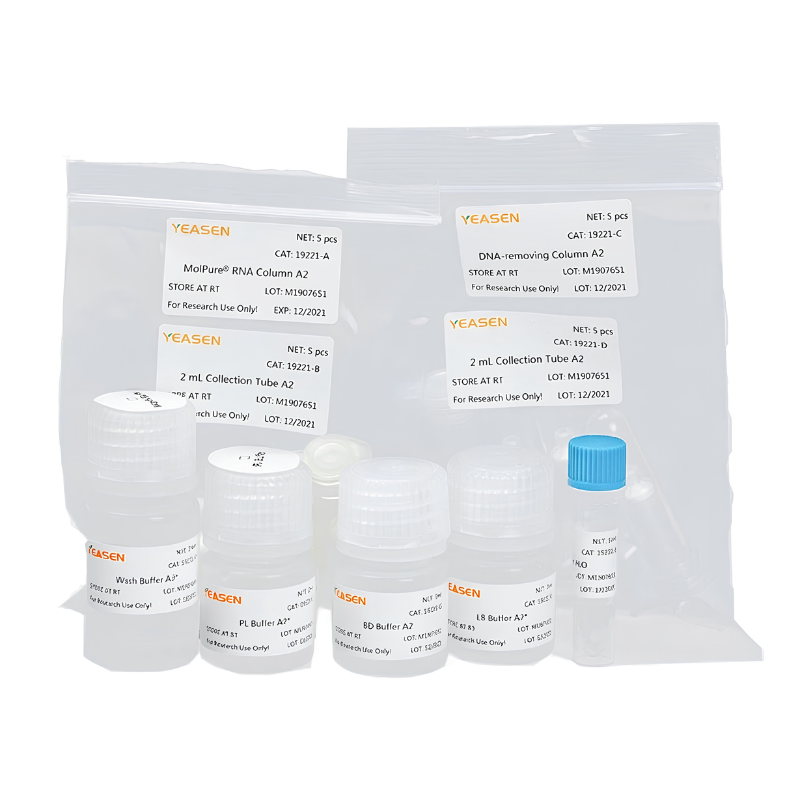
Description
Hieff Cell /Tissue Total RNA Kit was performed by using Hieff DNA removing / RNA binding column technology and new solution systems suitable for extracting high purity and quality total RNA from a variety of fresh or frozen animal tissues or cultured cells. The extraction process does not require toxic phenol, chloroform, β -mercaptoethanol, or precipitation of isopropanol and ethanol. Easy to operate, 15 min to complete the animal tissue or cells (10-30 mg animal tissue or (1-10) ×106 Animal cells) of total RNA extraction. The total RNA is of high purity and can be used in various molecular biology experiments including RT-PCR, qPCR, molecular cloning and RNase protection analysis.
Features
- Ultra-Fast: RNA extraction in under 15 minutes per sample.
- High RNA Integrity: Proprietary buffer formulation preserves full-length RNA throughout the workflow.
- Broad Sample Compatibility: Works efficiently with challenging samples, including primary cells, protein-rich muscle tissue, lipid-rich brain tissue, and aquatic species (e.g., fish and shrimp).
- Effective gDNA Removal: Integrated DNA-removal/RNA-binding spin column eliminates genomic DNA contamination in just 30 seconds—no DNase treatment required.
Components
| No. | Name | 19221ES50 (50 T) |
| 19221-A | Hieff DNA removing/RNA binding Column A | 100 |
| 19221-B | 2 mL Collection Tube A2 | 100 |
| 19221-C | Lysate buffer LB(LB Buffer A2) | 30 mL |
| 19221-D | Deproteinized buffer PL (PL Buffer A 2) | 40 mL |
| 19221-E | Wash Buffer W*(Wash Buffer A 2*) | 13 mL |
| 19221-F | RNase-free H2O | 5 mL |
Shipping and Storage
This product should be Store at room temperature, protected from light, for 24 months. 2-8℃lasts longer.
Figures

Figure 1. High RNA integrity across diverse tissues with Yeasen Kit (Cat. No. 19221).
RNA was extracted from liver (P-1, P-2), muscle (H-1, H-2), kidney (H-3, H-4), spleen (H-5), brain (H-6), skin (fH-4), shrimp, loach, and crab meat. All samples show clear 28S and 18S rRNA bands with a ~2:1 ratio, indicating excellent RNA integrity.
FAQ
Q: The ratio of 260 to 280 is only approximately 1.6, right?
A: If OD260/OD280 < 1.6: There might be residual proteins. The benzene rings in the amino acid residues absorb at 280nm, resulting in a lower ratio. Of course, it could also be caused by other benzene ring substances (phenols). Proteinase K can be used for treatment; add denaturants to denature the protein. Or use chloroform for extraction.
Q: Can 19221 be used to extract fat?
A: Fat is difficult to extract. You can first perform centrifugation and then pass through the column. Do not use too much sample. Fat tissue is not easy to be ground. Moreover, the concentration or purity of the extracted material will not be good. The traditional method is recommended.
Q: The sample has been lysed using Trizol. Can we use this?
A: Yes, just replace our lysis solution with trizol, and all the other steps remain the same.
Q: The SPL protein solution has crystals precipitated. Does it have any impact?
A: There is no impact. This is a problem related to the precipitation of guanidine and evaporation. The presence of precipitation indicates saturation, but it doesn't affect anything.
Q: Why are the concentrations of the wash buffer in the trial kit and the official kit different when it comes to the amount of absolute ethanol added? Will this affect the extraction concentration?
A: Ethanol is used to precipitate nucleic acids. When there is a lot of ethanol, more nucleic acids will be precipitated onto the membrane, resulting in a higher extraction concentration. However, correspondingly, the amount of the wash buffer is relatively small. This component is used to wash away impurities. If it is lacking, the purity of the extraction will be poor.
Q: The samples are stored in Trizol. Can we still use this kit for extraction?
A: Yes, trizol can be used as the lysis solution, and the other steps remain the same.
Q: Crystalline precipitates have formed in LB buffer A2 and BD buffer A2.
A: These two reagents contain disodium salts. Place them at 37℃, let the crystals dissolve, then mix well before using.
Q: The manual states that β-mercaptoethanol can be added. What is the purpose of adding this? Can it be omitted?
A: It is used for degrading RNase and breaking disulfide bonds to prevent RNA degradation. If the extracted RNA is of good quality, it can be omitted.
Q: Does this extraction product have any tissue types that it is not applicable to?
A: Samples containing high levels of lipids, proteins, polysaccharides, and fibers are not recommended for extraction using this product. For example, fat tissues, brain tissues, heart tissues, and cartilage tissues.
Q: What are the differences between 19221 and 19211?
A: 19211 is based on the principle of Trizol lysis and centrifugal column purification, and is suitable for various types of samples. 19221 is a column-based extraction kit, and is only used for extracting cells and tissues.
Q: What are the differences between 19221 and 19231?
A: 19221 is for cells and tissues, while 19231 is specifically for extracting nucleic acids from cells. Moreover, the amount of cells targeted is different. 19231 is suitable for situations where the number of cells is less than 1×10^6, while 19221 is appropriate for (5-10)×10^6 cells.
Documents:
Safety Data Sheet
Publication
[2] Wang T, Yang J, Lin G, et al. Effects of Dietary Mannan Oligosaccharides on Non-Specific Immunity, Intestinal Health, and Antibiotic Resistance Genes in Pacific White Shrimp Litopenaeus vannamei. Front Immunol. 2021;12:772570. Published 2021 Nov 24. doi:10.3389/fimmu.2021.772570(IF:7.561)
[3] Wang S, Huang J, Liu F, et al. Isosteviol Sodium Exerts Anti-Colitic Effects on BALB/c Mice with Dextran Sodium Sulfate-Induced Colitis Through Metabolic Reprogramming and Immune Response Modulation. J Inflamm Res. 2021;14:7107-7130. Published 2021 Dec 20. doi:10.2147/JIR.S344990(IF:6.922)
[4] Wang S, Huang J, Liu F, et al. Isosteviol Sodium Exerts Anti-Colitic Effects on BALB/c Mice with Dextran Sodium Sulfate-Induced Colitis Through Metabolic Reprogramming and Immune Response Modulation. J Inflamm Res. 2021;14:7107-7130. Published 2021 Dec 20. doi:10.2147/JIR.S344990(IF:6.922)
[5] Xu M, Yao J, Shi Y, et al. The SRCAP chromatin remodeling complex promotes oxidative metabolism during prenatal heart development. Development. 2021;148(8):dev199026. doi:10.1242/dev.199026(IF:6.868)
[6] Zhang J, Wang H, Yuan C, et al. ITGAL as a Prognostic Biomarker Correlated With Immune Infiltrates in Gastric Cancer. Front Cell Dev Biol. 2022;10:808212. Published 2022 Mar 24. doi:10.3389/fcell.2022.808212(IF:6.684)
[7] Wang S, Huang J, Tan KS, Deng L, Liu F, Tan W. Isosteviol Sodium Ameliorates Dextran Sodium Sulfate-Induced Chronic Colitis through the Regulation of Metabolic Profiling, Macrophage Polarization, and NF-κB Pathway. Oxid Med Cell Longev. 2022;2022:4636618. Published 2022 Jan 27. doi:10.1155/2022/4636618(IF:6.543)
[8] Luo Y, Tao T, Tao R, Huang G, Wu S. Single-Cell Transcriptome Comparison of Bladder Cancer Reveals Its Ecosystem. Front Oncol. 2022;12:818147. Published 2022 Feb 21. doi:10.3389/fonc.2022.818147(IF:6.244)
[9] Zhan Z, Liu W, Pan L, Bao Y, Yan Z, Hong L. Overabundance of Veillonella parvula promotes intestinal inflammation by activating macrophages via LPS-TLR4 pathway. Cell Death Discov. 2022;8(1):251. Published 2022 May 6. doi:10.1038/s41420-022-01015-3(IF:5.241)
[10] Feng M, Wang D, Wang X, Yang Y, Zhang S. Bai-Hu-Tang regulates endothelin-1 and its signalling pathway in vascular endothelial cells. J Ethnopharmacol. 2022;284:114812. doi:10.1016/j.jep.2021.114812(IF:4.360)
[11] Zhan Z, Wang Z, Bao Y, Liu W, Hong L. OI inhibits development of ovarian cancer by blocking crosstalk between cancer cells and macrophages via HIF-1α pathway. Biochem Biophys Res Commun. 2022;606:142-148. doi:10.1016/j.bbrc.2022.03.106(IF:3.575)
Payment & Security
Your payment information is processed securely. We do not store credit card details nor have access to your credit card information.
Inquiry
You may also like
FAQ
The product is for research purposes only and is not intended for therapeutic or diagnostic use in humans or animals. Products and content are protected by patents, trademarks, and copyrights owned by Yeasen Biotechnology. Trademark symbols indicate the country of origin, not necessarily registration in all regions.
Certain applications may require additional third-party intellectual property rights.
Yeasen is dedicated to ethical science, believing our research should address critical questions while ensuring safety and ethical standards.

