
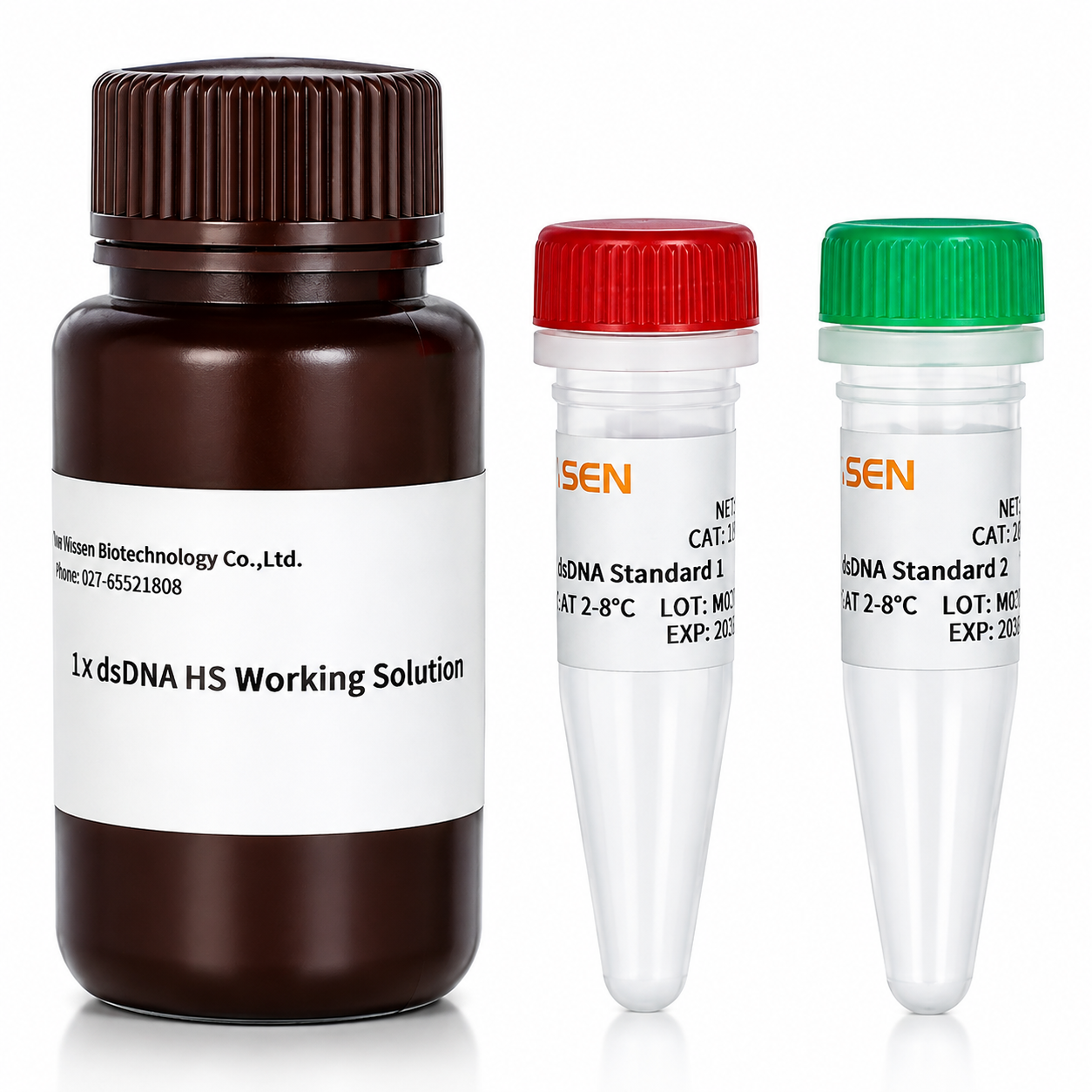


1×dsDNA HS Assay Kit is a rapid, highly sensitive and accurate fluorescent quantitative detection kit for double-stranded DNA (dsDNA). This kit is highly selective for dsDNA and has good linearity in the range of 0.2 ng-100 ng, the quantitation range is between 10 pg/μL to 100 ng/μL. This kit is easy to operate, providing a ready-to-use working solution that enables simple dsDNA sample quantification on Qubit Fluorometer or Fluorescence Microplate Reader. It is ideal choice for NGS large-scale DNA sample quantification (such as input DNA quantification, DNA library quantification, etc.). This kit is well tolerated to common contaminants such as proteins and salts.
Features
Fast: Ready-to-use premixed solution for easy handling; results available in just 5 minutes.
Sensitive: Accurately quantifies samples ranging from 0.2 to 100 ng.
Accurate: Minimal deviation compared to competing products, with all errors controlled within 10% and low batch-to-batch variation.
Stable: Consistent performance across different production batches.
Components
|
Components No. |
Name |
Concentration |
12642ES60 (100 T) |
12642ES76 (500 T) |
|
12642-A |
1×dsDNA HS Working Solution |
1×Concentrate in DMSO |
50 mL |
250 mL |
|
12642-B |
dsDNA Standard 1 |
0 ng/μL in TE buffer |
1 mL |
|
|
12642-C |
dsDNA Standard 2 |
10 ng/μL in TE buffer |
1 mL |
5×1 mL |
Application
dsDNA quantification; DNA concentration determination
Figures
1. Easy-to-use and streamlined quantification workflow

Figure 1. DNA Quantification Workflow
2. Good linearity: 12642 has good linearity in the range of 0.2-100 ng.

Figure 2. Linear Relationship Test
Linear quantification of 11 dsDNA concentrations (0.5–10 ng/μL) using 12642. Fluorescence was measured with Qubit Fluorometer 3.0. Results show good linearity across 0.2–100 ng total dsDNA.
3. Dye binding specificity

Figure 3. Specificity test
Test Scheme: DNA standard S2 (1–100 ng gradient: 1, 5, 10, 20, 40, 60, 80, 100 ng), along with equal-mass samples of ssDNA, RNA, dsDNA+ssDNA mix, and dsDNA+RNA mix were tested.
Conclusion: Adding equal amounts of ssDNA slightly increases the 12642 reading; error <10%(left). Adding equal amounts of RNA also increases the 12642 reading; error <10%(right).
4. Efficient dye binding and stable fluorescence signal

Figure 4. Dye binding efficiency and fluorescence signal persistence
Test Scheme: Two RNA libraries of different concentrations were measured using 12642 on the Qubit 3.0 with a 2 μL sample volume.
Conclusion: The fluorescence signal saturated within 2 minutes and remained stable for up to 5 h.
5. Strong tolerance to common contaminants

6. Ultra-high stability

Figure 5. Stability comparison of Yeasen's (Cat#12642ES) and competitor T brand
Test Scheme: Two dsDNA concentrations were measured over time using supplier T* (4°C), Yeasen#12642 (4°C), and Yeasen#12642 (room temperature, ~25°C). Deviation from the initial value (Day 0) was calculated.
Conclusion: Yeasen#12642 remained stable at room temperature for 2 weeks, with deviations <10%.
Storage
FAQ
Citations
Documents
| Brochure |
|---|
| Instructions_for_Using_the_Qubit_Quantitation_Series_with_a_Microplate_Reader.pdf |
| Library_Quantitation_Solution.pdf |
| MSDS |
|---|
| EN-12642-A-MSDS-HB220420.pdf |
| EN-12642-B-MSDS-HB220420.pdf |
| EN-12642-C-MSDS-HB220420.pdf |
Applications
You may also like
Inquiry
FAQ
The product is for research purposes only and is not intended for therapeutic or diagnostic use in humans or animals. Products and content are protected by patents, trademarks, and copyrights owned by Yeasen Biotechnology. Trademark symbols indicate the country of origin, not necessarily registration in all regions.
Certain applications may require additional third-party intellectual property rights.
Yeasen is dedicated to ethical science, believing our research should address critical questions while ensuring safety and ethical standards.