
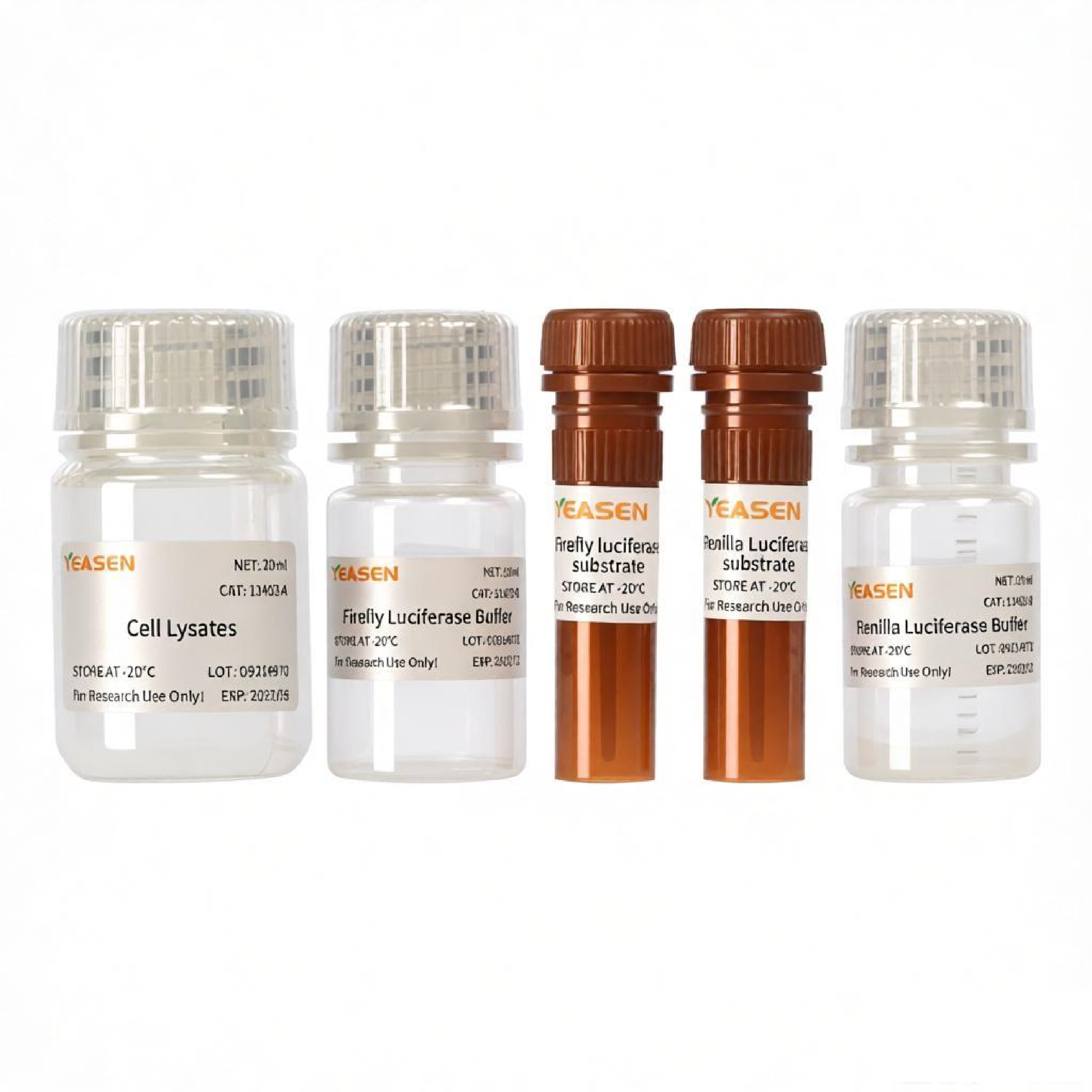

Frequently Bought Together
Firefly luciferase is a protein with a molecular weight of about 61 kDa, which can catalyze the oxidation of luciferin to oxyluciferin in the presence of ATP, magnesium ions and oxygen. It emits bioluminescence with a wavelength of around 560 nm. Renilla luciferase is a protein with a molecular weight of about 36 kDa, which can catalyze the oxidation of coelenterazine to coelenteramide in the presence of oxygen, and emits a wavelength of 480 nm during the oxidation process. about bioluminescence. Both bioluminescence can be measured by chemiluminescence. The detection principle is shown in the figure 1:

Figure 1. Firefly and Renilla luciferase assay schematic
Usually, the 5´UTR or promoter of the target gene is cloned upstream of Firefly Luciferase, or the 3´UTR is cloned downstream of Firefly Luciferase, and the transcriptional regulation effect of the promoter or regulatory element is detected by detecting the amount of firefly luciferase. Renilla Luciferase was used as an internal control to eliminate differences in cell number, transfection efficiency, etc. The Dual Luciferase Reporter Gene Assay Kit uses luciferin as a substrate to detect the activity of the firefly luciferase reporter gene, and then uses coelenterazine as a substrate to detect Renilla luciferin while quenching the fluorescence reaction. Enzyme reporter gene activity. The kit has the characteristics of high sensitivity.
Features
Enhanced Lysis Capability: Capable of completely lysing the vast majority of cell types.
Stronger Signal: Precise detection of weak promoter expression.
Higher Sensitivity: Detectable down to 10-20 picomoles of luciferase molecules.
Broader Linear Range: Linear detection range exceeds 8 orders of magnitude of enzyme concentration.
Applications
Verification of miRNA interactions with target gene 3'UTRs
Verification of lncRNA-miRNA interactions
Verification of transcription factor regulation in the promoter region
Signaling pathway analysis
SNP activity analysis
Specifications
|
Form |
liquid |
|
Luciferase |
Firefly and Renilla |
|
Signal Half-life |
30 min |
|
Number of Product Components |
5 |
|
Workflow |
Two Step |
Components
|
Components No. |
Name |
11402ES60 |
11402ES80 |
|
11402-A |
Cell Lysates |
20 mL |
10×20 mL |
|
11402-B |
Firefly Luciferase Buffer |
10 mL |
10×10 mL |
|
11402-C |
Firefly luciferase substrate (50 ×) |
200 μL |
10×200 μL |
|
11402-D |
Renilla Luciferase Buffer |
10 mL |
10×10 mL |
|
11402-E |
Renilla Luciferase substrate (50 ×) |
200 μL |
10×200 μL |
Figures
1. Product Performance Is Consistent with Imported Products

Figure 1 shows the comparison of Firefly luciferase luminescence intensity, quenching efficiency, and Renilla luciferase luminescence intensity.
Yeasen 11402 Dual-Luciferase Reporter Assay product performs comparably to Brand P in terms of luminescence intensity. Meanwhile, Yeasen 11402 is also on par with Brand P in Firefly luciferase quenching efficiency. Additionally, the residual fluorescence of Yeasen 11402 is extremely low and negligible, ensuring no cross-interference with subsequent Renilla luciferase signal generation, thereby guaranteeing the accuracy and reliability of experimental results.
2. Superior Signal Stability

Figure 2 shows the kinetic testing results for the Firefly luciferase luminescence signal stability of Yeasen 11402 Dual-Luciferase Reporter Assay product. Tracking the Firefly luciferase luminescence signal continuously for up to 30 minutes from the start of the reaction revealed almost no signal decay in Yeasen 11402. This exceptional signal stability far exceeds the time required for standard microplate reader operations, fully meeting practical detection requirements.
3. Five Freeze-Thaw Cycles Have Minimal Impact on Signal

Figure 3 displays the luminescence signals of Firefly luciferase and Renilla luciferase after subjecting the Yeasen 11402 Dual-Luciferase Reporter Assay product to 5 freeze-thaw cycles. Results indicate that signal intensity remains virtually unaffected with extremely high stability. This feature enhances its practicality in laboratory settings to better satisfy daily operational needs.
Storage
FAQ
2. In vitro reporter assays require cell lysis to homogenize samples, overcoming transfection heterogeneity, uneven substrate permeability, and signal variation. In vitro reporter assays are highly quantitative and sensitive, requiring ATP and oxygen. Cell lysis fully releases expressed luciferase to optimize the reaction; since intracellular oxygen is limited, omitting lysis leads to signal reduction (some lysis buffers include optimized additives like ATP to boost signal). Therefore, cell lysis ensures superior signal in in vitro assays. 3. In vivo imaging instruments possess high sensitivity and power capable of penetrating skin and tissue, enabling strong signal detection without cell lysis.
Citations
Documents
Applications
You may also like
Inquiry
FAQ
The product is for research purposes only and is not intended for therapeutic or diagnostic use in humans or animals. Products and content are protected by patents, trademarks, and copyrights owned by Yeasen Biotechnology. Trademark symbols indicate the country of origin, not necessarily registration in all regions.
Certain applications may require additional third-party intellectual property rights.
Yeasen is dedicated to ethical science, believing our research should address critical questions while ensuring safety and ethical standards.