
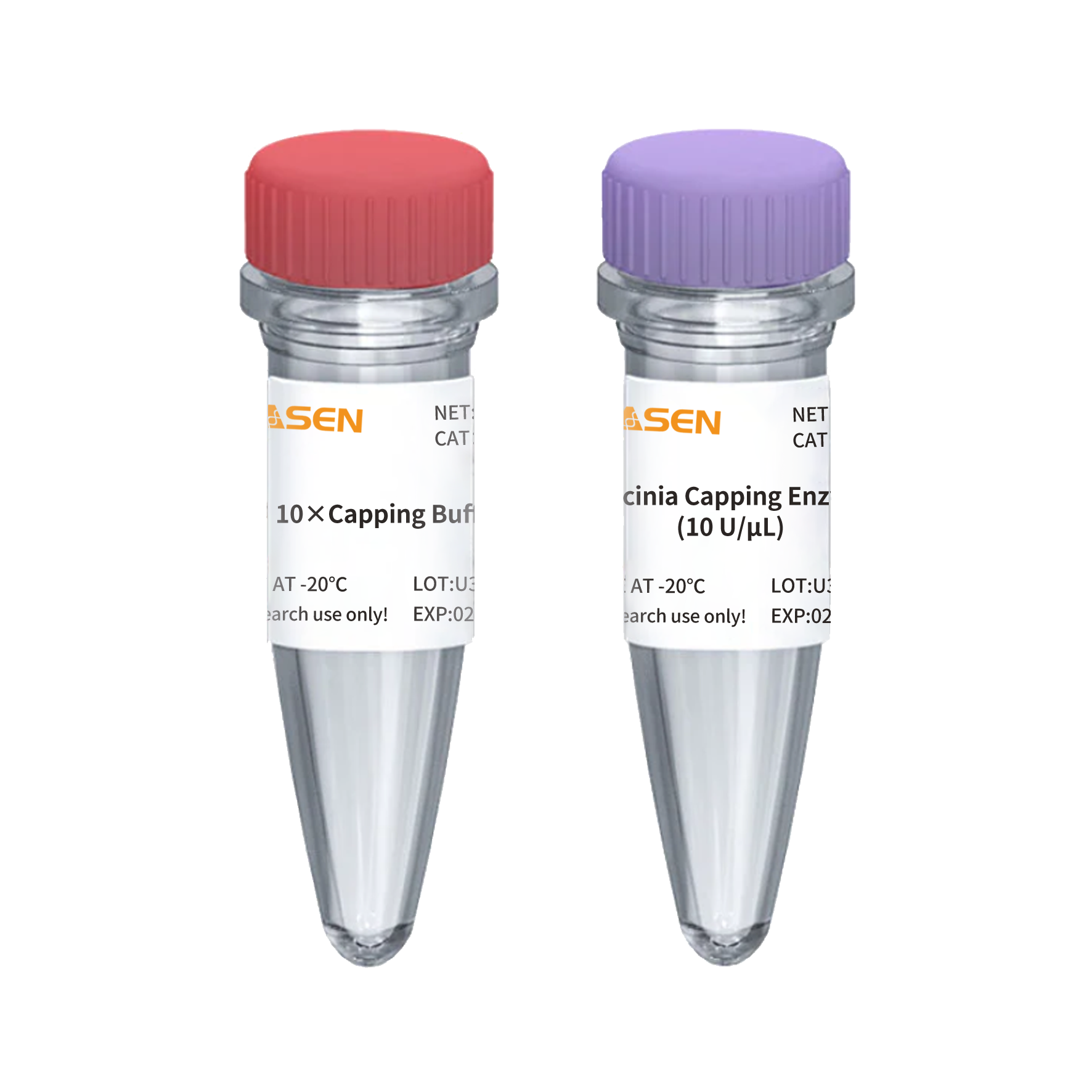
mRNA 백신 캡핑 효소(10 U/μL) _ 10615ES

Yeasen제품번호: 10615ES84

크기: 2 쿠
가격:
판매 가격$365.00
재고:
재고 있음

진핵생물 mRNA는 전사 후 5' 말단에 캡 구조라는 특수한 구조를 형성합니다. 캡 구조는 mRNA의 안정성, 수송 및 번역에 중요한 역할을 합니다. 바시니아 바이러스 캡핑 효소는 캡 구조의 형성을 촉진할 수 있는 효과적인 효소입니다. 그것은 두 개의 서브유닛 D1과 D12로 구성되어 있습니다. 그것은 또한 RNA 트리포스파타제 활성, 구아닐레이트 아실트랜스퍼라제 활성, 구아닌 메틸트랜스퍼라제 활성을 가지고 있어 7-메틸구아닌 캡 구조(m7Gppp)를 RNA의 5' 말단(m7Gppp5'N)에 연결할 수 있습니다. 바시니아 바이러스 캡핑 효소는 캡핑 완충액, 구아노신 삼인산(GTP), S-아데노실메티오닌(SAM) 등의 적절한 농도로 존재할 경우 1시간 이내에 RNA를 올바른 방향으로 캡핑할 수 있습니다.

특징

  • 재조합 소스로부터 분리됨
  • 엔도뉴클레아제, 엑소뉴클레아제, RNase의 부재 여부를 테스트했습니다.

애플리케이션

  • 번역 분석/시험관 내 번역 전 mRNA 캡핑
  • mRNA의 5´ 끝 라벨링

사양

원천 백신바이러스 캡핑효소 유전자를 갖는 재조합 대장균
최적의 온도 37℃
저장 버퍼 20 mM Tris-HCl pH 8.0, 100 mM NaCl, 1 mM DTT, 0.1 mM EDTA, 0.1% Triton X-100, 50% 글리세린
단위 정의 1 단위: 37℃에서 1시간 이내에 80개 뉴클레오티드(80nt)의 전사체에 10 pmol GTP(α-32P)를 통합하는 데 필요한 효소의 양.

구성 요소

구성품 번호 이름 10615ES84(2,000유로) 10615ES92(10,000U) 10615ES96(100,000U) 10615ES99(5MU)
10615 mRNA 백신 캡핑 효소(10 U/μL) 200 μL 1ml(1ml) 10ml(10ml) 500ml (500ml)


배송 및 보관

mRNA 백신 캡핑 효소 GMP 등급 제품은 건조 얼음과 함께 배송되며 -15℃ ~ -25℃에서 1년 동안 보관할 수 있습니다.

그림
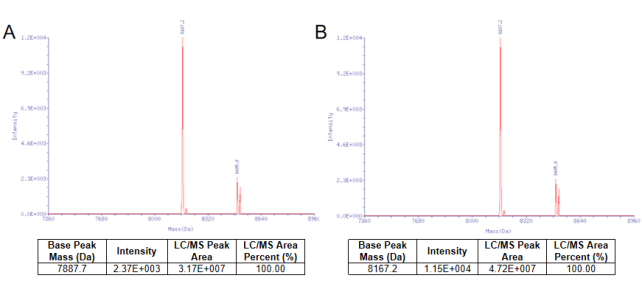
그림 1. YEASEN의 백신 캡핑 시스템으로 캡핑 효율이 거의 100%에 도달했습니다. 캡 반응 전 핵산 질량 분석은 그림 1A에 표시되어 있습니다. 캡 반응 후 핵산 질량 분석은 그림 1B에 표시되어 있습니다.

서류:


Storage

mRNA Vaccinia Capping Enzyme GMP-grade products are shipped with dry ice and can be stored at -15℃ ~ -25℃ for one year.

FAQ

The purpose of preheating is to unfold the secondary structure of RNA and bring it to a single-stranded state. If this step is not carried out, it will affect the efficiency of capping. This part is indeed a current technical challenge in production. Some companies now directly predict the secondary structure of RNA when determining the template sequence. The capping enzyme only recognizes the first few nucleotides of mRNA. If it is determined that this structure will not result in the secondary structure of RNA, then heating can be omitted.
In industry, the most commonly used method for enzymatic cap addition is to treat IVT products with vaccinia virus cap-adding enzyme, which can modify them into Cap 0 mRNA. The Cap 0 structure can be further modified into Cap 1 (m7GpppmN) under the action of 2'O-methyltransferase. With enzymatic cap addition, the cap addition efficiency can reach over 95%. The co-transcription cap addition method is simple to operate, but because GTP competes with the cap dimer, the cap addition rate of this method is a little lower; both methods have their own advantages and disadvantages.
By increasing the amount of VCE, for example, adding 10 ul of 100 U of enzyme activity to a 100 ul system, the main purpose is to enhance the methyltransferase activity of VCE. It can also be achieved by increasing SAM (0.5 mmol) to enhance the guanine transfer activity and increase the cap formation rate. For instance, our new single-strand cap enzyme has a significantly improved cap formation rate. This is because its guanine transfer activity is better than that of traditional VCE. For traditional VCE, the small subunit D12 is prone to precipitation and polymer formation, which makes purification difficult and leads to loss, thus resulting in higher costs and inability to control batches.
Currently, the industry has not specifically targeted this aspect. In the industry, the main focus is on the efficiency of the cap application. The current best cap application rate is above 80%. Of course, the higher the better. There is still no absolute standard for this. For the synthesized mRNA, purification methods can be employed, such as the one-step membrane encapsulation method by Kang*. This significantly reduces the purification process. The traditional method uses Oligo d(T) columns for purification, with good results achieving a recovery rate of 70-80%; poor results have a recovery rate of 40-50%. An additional step of a hydrophobic column can also be added after the Oligo d(T) column.
The co-transcription requirement stipulates that the starting position of the template must begin with AGG*. The two-step method does not have any specific requirements for the position. However, our current products have the highest yield for the AGGG starting position, mainly due to the preference of the T7 enzyme.

Citations

Applications

당신은 또한 좋아할 수 있습니다

문의

자주 묻는 질문

이 제품은 연구 목적으로만 사용되며 인간이나 동물의 치료 또는 진단용으로 의도되지 않았습니다. 제품과 콘텐츠는 Yeasen Biotechnology가 소유한 특허, 상표 및 저작권으로 보호됩니다. 상표 기호는 모든 지역에서 반드시 등록되는 것은 아니지만 원산지를 나타냅니다.

특정 애플리케이션에는 추가적인 제3자 지적 재산권이 필요할 수 있습니다.

예슨은 윤리적 과학에 헌신하며, 우리의 연구가 안전과 윤리적 기준을 보장하는 동시에 중요한 문제를 해결해야 한다고 믿습니다.