
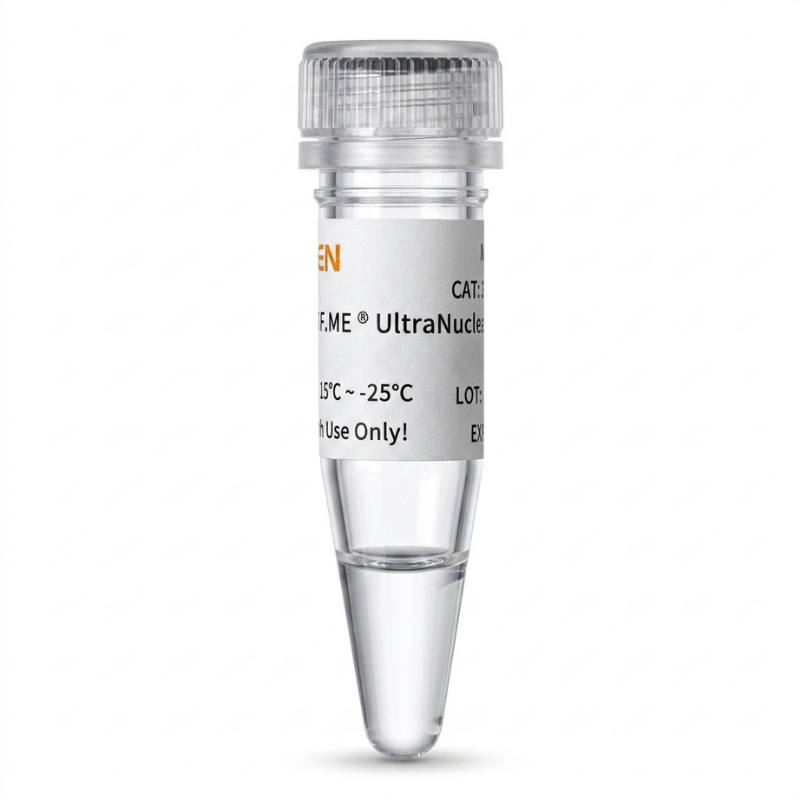
UCF.ME™ UltraNuclease _ 20156ES

YeasenSKU: 20156ES25

Size: 25 KU
価格:
販売価格$155.00

送料計算済み チェックアウト時

在庫:
在庫あり

説明

UltraNuclease, also known as non-specific nuclease or broad-spectrum nuclease, is a non-specific endonuclease derived from Serratia Marcescen. It can cleave at any nucleotide within the chain, completely digesting nucleic acids into 5'-monophosphate oligonucleotides of 2-5 bases in length. UltraNuclease is capable of degrading various forms (double-stranded, single-stranded, linear, circular, native, or denatured) of DNA and RNA under a wide range of conditions (6 M Urea, 0.1 M Guanidine HCl, 0.4% Triton X-100, 0.1% SDS, 1 mM EDTA, 1 mM PMSF). It is widely used for removing nucleic acids from biological products.

This product is genetically engineered and expressed in Escherichia coli (E. coli), with a purity ≥99%. It is used to reduce the viscosity of cell supernatants and cell lysates, improve protein purification efficiency and functionality studies, and effectively prevent the clumping of human peripheral blood mononuclear cells (PBMCs) in cell therapy and vaccine research.

It is provided as a sterile liquid enzyme stored in buffer (20 mM Tris-HCl pH 8.0, 2 mM MgCl2, 20 mM NaCl, 50% Glycerol), appearing as a clear, colorless liquid.

Features

Wide range of applications: degrade all forms of DNA and RNA

High purity and activity: purity ≥ 99%; specific activity ≥ 1.5×10⁶ U/mg

Specification

Source

E. coli

Molecular Weight

26.5 kDa

Isoelectric Point

6.85

Purity

≥ 99%(HPLC)

Enzyme Activity

250-300 U/μL

Specific Activity

≥1.5×10⁶ U/mg protein

Optimum pH

8.0 (pH range 6-10)

Optimum Temperature

37°C (temperature range 0-42°C)

Cofactor

1-10 mM Mg2+

Storage Buffer

20 mM Tris-HCl pH8.0,2 mM MgCl2,20 mM NaCl,50% Glycerol

Unit Definition

One unit (U) of enzyme activity is defined as the amount of enzyme required to cause an increase in absorbance (ΔA260) of 1.0 in 30 minutes under reaction conditions of 37°C, pH 8.0 in a total reaction volume of 2.625 mL, equivalent to the complete digestion of 37 μg of salmon sperm DNA into oligonucleotides.


Components

Name

20156ES25

20156ES50

20156ES60

UCF.METM UltraNuclease

25 KU

50 KU

100 KU

Storage

Store Part I components at -25°C ~ -15°C; store Part II components at 2~8°C;

store Part III components at room temperature. The product is valid for 1 year.

Application

  • Purification of viral vaccines, viral vectors for the vaccine, and oncolytic viruses;
  • Protein purification-Efficient removal of contaminating DNA and RNA from proteins and other biologics;
  • Reduction of viscosity caused by nucleic acids;
  • Sample preparation in electrophoresis and chromatography;
  • Prevention of cell clumping.

Figures

1. High Purity

Figure 1. Purity analysis of the enzyme. (A) SDSPAGE showing ≥ 99% purity; (B) HPLC profile showing ≥ 99% purity.

 Figure 1. Purity analysis of the enzyme. (A) SDSPAGE showing ≥ 99% purity; (B) HPLC profile showing ≥ 99% purity.

2. Enzymatic activity testing under different conditions

Figure 2. Single‑factor comparison of Universal Nuclease activity.

Figure 2. Single‑factor comparison of Universal Nuclease activity.

No significant difference was observed between this product and Supplier M under identical test conditions.

3. Application Examples

FAQ

Q: How much should be used each time after dilution, and how to test the gradient? How much should be added initially?

A: Depending on the specific requirements of the experiments, the addition amount can range from 1/100 to 1/10,000.

Q: What are the reaction-inhibiting factors?

A: The activity of Benzonase will decrease by 50% or more when the following substances are present: > 150 mM monovalent cations, > 100 mM phosphate, > 100 mM ammonium sulfate, > 100 mM guanidine hydrochloride, > 0.1% SDS, > 1% Triton X-100, > 1% Tween 20.

Q: Which solutions can be used as reaction buffers?

A: Common biological buffers, such as TBS, MOPS (pH 6-8), etc.

Q: How to inactivate the Benzonase nucleic acid enzyme? And how to remove it?

A: The use of EDTA to chelate metal ions (concentration greater than 6 mM) can reversibly inhibit the activity of Benzonase nucleases. Extreme conditions can cause irreversible inactivation, such as 100 mM NaOH treatment for 30 minutes, etc. Benzonase nucleases can be separated from the target product using an anion exchange column or gas chromatography. Due to the stability of this nucleolytic enzyme, it is recommended not to use Benzonase nucleases in applications where the exclusion of nucleases is required in the final product.

Q: Can the all-in-one nucleases be added to whole blood? Subsequently, the customer will use them to directly extract nucleic acids. However, some whole blood may have the phenomenon of clumping and stringing, and the A260/230 ratio is too high?

A: So far, we haven't had any customers do this. If it's for dealing with cell clumping, you can add it to the reaction and then remove the total nucleases by changing the solution. In industrial virus purification, column filtration can also remove the total nucleases. When you add this and then perform nucleic acid extraction, there's no guarantee that the total nucleases will be completely removed. Once there is any residue, the extracted nucleic acids will be cut and degraded. 70℃ for 30 minutes can inactivate them. It's uncertain if this will have an impact on your blood sample. According to the instructions, 1 ul of total nucleases is equivalent to being able to handle 10 to the power of 9 cells. 200 ul of whole blood doesn't know how many cells haven't undergone whole blood processing. We can't recommend it. You can conduct a gradient test to see.

Documents:

Safety Data Sheet

20156_MSDS_HB250925_EN.PDF

Manuals

20156_Manual_Ver.EN20250806.pdf

Related Blog:

Unlocking Cleaner Bioprocesses: A Deep Dive into UltraNuclease Applications

UltraNuclease (Benzonase Nuclease) – The total Solution for Nucleic Acid Residue removing in Biologics

YEASEN UCF. ME ™ UltraNuclease — Your BEST choice for degrading nucleic acids

Residual Nucleic Acid Removal in Biologics: UCF.ME™ UltraNuclease & Nuclease Residual Detection Kit

Citations & References:

[1] Lin J, Chen Z, Yang L, et al. Cas9/AAV9-Mediated Somatic Mutagenesis Uncovered the Cell-Autonomous Role of Sarcoplasmic/Endoplasmic Reticulum Calcium ATPase 2 in Murine Cardiomyocyte Maturation. Front Cell Dev Biol. 2022;10:864516. Published 2022 Apr 1. doi:10.3389/fcell.2022.864516(IF:6.684)


[2] Kang D, Liu Y, Song Y, Fang B, Zhang Q, Hu L. Triptolide Shows High Sensitivity and Low Toxicity Against Acute Myeloid Leukemia Cell Lines Through Inhibiting WSTF-RNAPII Complex. Front Oncol. 2022;12:811850. Published 2022 Feb 16. doi:10.3389/fonc.2022.811850(IF:6.244)

支払いとセキュリティ

American Express Apple Pay Diners Club Discover Google Pay Mastercard Visa

お支払い情報は安全に処理されます。 クレジットカードの詳細を保存したり、クレジットカード情報にアクセスすることはありません

あなたも好きかもしれません

問い合わせ

よくある質問

この製品は研究目的のみに使用され、人間や動物の治療や診断に使用することを意図したものではありません。製品とコンテンツは、Yeasen Biotechnology が所有する特許、商標、著作権によって保護されています。商標記号は原産国を示しますが、必ずしもすべての地域で登録されているわけではありません。

特定のアプリケーションでは、追加のサードパーティの知的財産権が必要になる場合があります。

Yeasen は倫理的な科学に専念しており、私たちの研究は安全性と倫理基準を確保しながら重要な問題に取り組むべきだと考えています。