

Frequently Bought Together
Bộ tổng hợp RNA năng suất cao T7 tối ưu hóa hệ thống phản ứng phiên mã. Bộ này có thể tổng hợp RNA mạch đơn hiệu quả bằng cách sử dụng T7 RNA polymerase, DNA mạch đôi tuyến tính với trình tự khởi động T7 làm khuôn mẫu, NTP làm chất nền để kiểm soát trình tự DNA hạ lưu của trình tự khởi động. Trong quá trình phiên mã, các nucleotide đã biến đổi có thể được thêm vào chất nền để chuẩn bị biotin hoặc RNA được gắn nhãn thuốc nhuộm.
Bộ dụng cụ này có thể tổng hợp các bản sao dài và bản sao ngắn, RNA có thể được sản xuất 100-200 μg với 1 μg đầu vào khuôn mẫu DNA. RNA được tổng hợp bằng phiên mã có thể được sử dụng cho nhiều ứng dụng hạ nguồn khác nhau, chẳng hạn như nghiên cứu cấu trúc và chức năng của RNA, bảo vệ RNase, lai hóa đầu dò, RNAi, tiêm vi mô và trong ống nghiệm bản dịch.
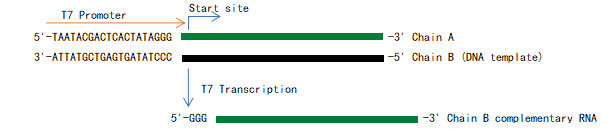
Hình 1: Trong ống nghiệm Quá trình phiên mã RNA
Tính năng
- Lên đến 180 μg RNA cho mỗi phản ứng từ 1 μg mẫu kiểm soát
- Hệ thống phản ứng tối ưu cho quá trình IVT
- Giảm sản xuất dsRNA
- Độ toàn vẹn và độ tinh khiết của RNA cao hơn
Ứng dụng
- Trong ống nghiệm Tổng hợp RNA
Thành phần
| Số thành phần | Tên | 10623ES50 (50 tấn) | 10623ES60 (100 tấn) | 10623ES70 (500 tấn) |
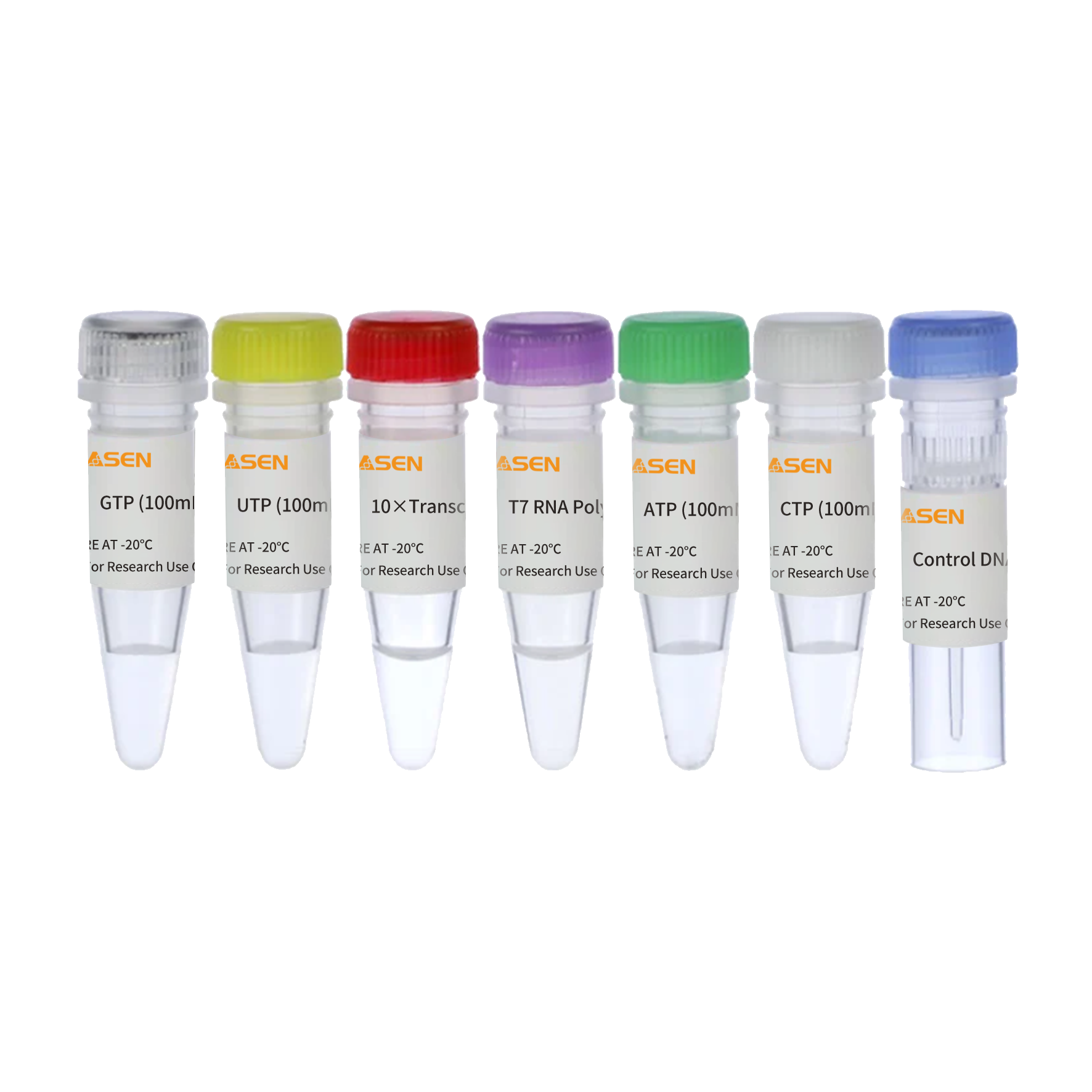
| 10623-A | Hỗn hợp RNA Polymerase T7 | 100 μL | 200 μL | 1mL |
| 10623-B | 10×Bộ đệm phiên mã | 100 μL | 200 μL | 1mL |
| 10623-C | ATP (100mM) | 100 μL | 200 μL | 1mL |
| 10623-D | CTP (100mM) | 100 μL | 200 μL | 1mL |
| 10623-E | GTP (100mM) | 100 μL | 200 μL | 1mL |
| 10623-F | UTP (100mM) | 100 μL | 200 μL | 1mL |
| 10623-G | Mẫu DNA kiểm soát (500ng/μL) | 10 μL | 20 μL | 100 μL |
Vận chuyển và lưu trữ
Vận chuyển đá khô. Bảo quản ở nhiệt độ -15℃ ~ -25℃, thời hạn sử dụng là hai năm.
Các con số
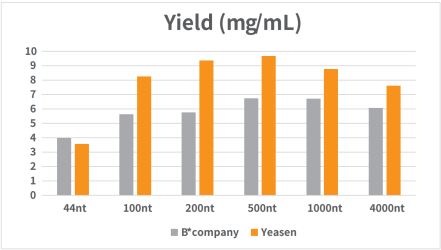
Hình 1. RNA chuẩn được tổng hợp trong ống nghiệm bằng bộ dụng cụ tổng hợp RNA T7.
Phản ứng được ủ trong thiết bị PCR ở 37℃ trong 2 giờ và sau đó được tinh chế bằng hạt từ tính (Cat#12602). Kết quả sản lượng được phân tích bằng máy quang phổ NanoDrop như thể hiện trong Hình 1.
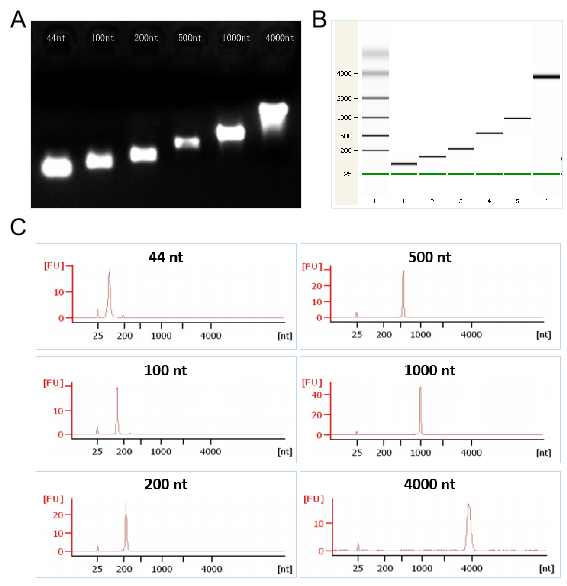
Hình 2. Minh họa phiên mã các chiều dài khác nhau của RNA bằng bộ dụng cụ T7 tương ứng trong điện di đồ (Hình 2A), sơ đồ điện di mao quản (Hình 2B) và sắc ký đồ (Hình 2C)
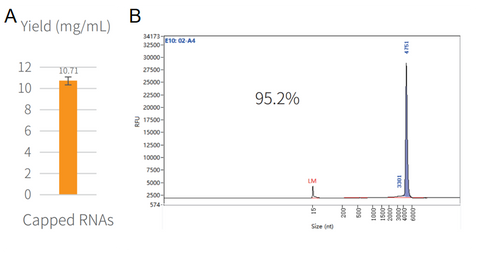
Hình 3. Tổng hợp RNA có mũ trong ống nghiệm.
Phản ứng được ủ trong thiết bị PCR ở 37℃ trong 2 giờ, sau đó được tinh chế bằng hạt từ tính (Cat#12602). Kết quả sản lượng được thử nghiệm bằng máy quang phổ NanoDrop như thể hiện trong Hình 3A. Kết quả tính toàn vẹn được phân tích bằng phương pháp điện di mao quản như thể hiện trong Hình 3B.
1. Năng suất bản sao thấp
Chất lượng của mẫu có liên quan chặt chẽ đến năng suất. Nếu năng suất của nhóm thử nghiệm thấp hơn đáng kể so với nhóm đối chứng, thì những lý do có thể là:
① mẫu thử nghiệm chứa các thành phần ức chế;
② Mẫu có lỗi.
Gợi ý:
① Làm sạch lại mẫu;
② Xác định số lượng mẫu và tính toàn vẹn của nó;
③ Kéo dài thời gian phản ứng;
④ Tăng lượng mẫu nhập vào;
⑤ Hãy thử các chất xúc tiến và RNA polymerase khác.
2. Năng suất thấp của bản sao ngắn
Một đoạn khởi đầu phiên mã ngắn sẽ ức chế phản ứng. Khi sản phẩm phiên mã nhỏ hơn 100 nt, kéo dài thời gian phản ứng lên 4-8 giờ hoặc tăng lượng khuôn mẫu lên 2 μg sẽ làm tăng sản lượng RNA.
3. Chiều dài phiên mã RNA dài hơn dự kiến
Nếu kết quả điện di cho thấy dải sản phẩm lớn hơn kích thước dự kiến thì có thể có những lý do sau:
① Khuôn mẫu plasmid có thể không được tuyến tính hóa hoàn toàn;
②Đầu 3' của sợi cảm ứng có cấu trúc nổi bật;
③RNA có cấu trúc bậc 2 không bị biến tính hoàn toàn.
Gợi ý:
①Kiểm tra xem mẫu đã được tuyến tính hóa hoàn toàn chưa và nếu cần, hãy thực hiện tuyến tính hóa bổ sung;
②Chọn một enzyme hạn chế thích hợp để tránh phần nhô ra ở đầu 3' hoặc sử dụng DNA polymerase Klenow Fragment/T4 để hoàn tất quá trình phiên mã trước khi tiến hành;
③Sử dụng gel biến tính để phát hiện sản phẩm RNA.
4. Chiều dài phiên mã RNA ngắn hơn dự kiến
Nếu kết quả điện di cho thấy dải sản phẩm nhỏ hơn kích thước mong đợi thì có thể có những lý do sau:
① Khuôn mẫu chứa trình tự kết thúc tương tự như RNA polymerase T7;
②Hàm lượng GC trong mẫu cao.
Gợi ý:
①Giảm nhiệt độ phản ứng (ví dụ: 30°C). Đôi khi việc giảm nhiệt độ có thể làm tăng độ dài phiên mã, nhưng sẽ làm giảm năng suất. Hoặc thử các loại RNA polymerase khác nhau để phiên mã;
②Nếu hàm lượng GC mẫu cao thì sử dụng 42℃ để phiên mã hoặc thêm SSB để tăng sản lượng và độ dài phiên mã.
5. Điện di đuôi sản phẩm phiên mã
Có hiện tượng đuôi xuất hiện trong quá trình điện di.
Những lý do có thể:
①Bị nhiễm RNase trong quá trình vận hành thử nghiệm;
②Mẫu DNA bị nhiễm bẩn bởi RNase.
Gợi ý:
①Sử dụng đầu pipet không chứa RNase và ống EP, đeo găng tay cao su và khẩu trang dùng một lần, và tất cả thuốc thử đều được chuẩn bị bằng H2O không chứa RNase.
②Tái tinh chế DNA khuôn mẫu.
[1] Dong Z, Zheng N, Hu C, và cộng sự.Nosema bombycis microRNA-like RNA 8 (Nb-milR8) làm tăng khả năng gây bệnh của nấm bằng cách điều chỉnh biểu hiện gen BmPEX16 ở vật chủ của nó, Bombyx mori. Microbiol Spectr. 2021;9(2):e0104821. doi:10.1128/Spectrum.01048-21(IF:7.171)
[2] Wang X, Tang S, Ye S, et al. Định lượng siêu nhạy miR-195-5p tuần hoàn với chuỗi khuếch đại dịch chuyển ba sợi. Talanta. 2022;242:123300. doi:10.1016/j.talanta.2022.123300(IF:6.057)
Storage
FAQ
The optimization of the IVT system can be achieved by adjusting the template, the amount of T7 enzyme used, and if it is co-transcription with cap addition, the ratio between the cap and NTP can be considered; for enzymatic cap addition, the conditions can be optimized in terms of the dosage of the cap-adding enzyme, 2-O-methyltransferase, and SAM. Regarding the template, apart from the requirement of complete linearization, there is another point, which is sequence design. For example, in the 5'UTR region, pay attention to uAUG and Kozak sequence; for CDS, consider the codon preference, GC3 content, and dinucleotide preference, etc.; 3'UTR: RBP and miRNA binding sites: and another point is the secondary structure of RNA. The stable secondary structure of the 5'UTR pre-sequence will reduce the expression of mRNA; the stable secondary structure of 3'UTR will increase the stability of mRNA and promote the expression of the encoded protein. For the recommended IVT system and more detailed tips, please refer to the mRNA in vitro synthesis experiment manual of Vivian Biotechnology.
The average yield is between 120-220 ug/ul (the yield is highly dependent on the sequence design). In the co-transcription method, the mRNA yield is 8 g/L. With process optimization, the yield will increase. Currently, the quality parameters of the available processes include observing the fluorescence value of GFP and measuring the cap addition rate using LC-MS.
The T7 pol enzyme will use the product RNA as a template and continue to extend the RNA at its 3' end. The extended sequence will form complementary pairing with the 3' end sequence of the original RNA molecule, thereby creating a hairpin structure.
The T7 pol enzyme can use RNA as a template to replicate RNA molecules, and synthesize the complementary strand.
(At present, there is no effective method for removing dsRNA. However, there is a patent report suggesting that a fiber column (sigma) could be tried.)
1. Reduce the concentration of magnesium ions; however, reducing the concentration of magnesium ions will also lead to a decrease in the production of RNA, and a balance point needs to be reached.
2. Increase the reaction temperature of IVT to 50-56℃. This temperature can effectively reduce the content of dsRNA in the product; however, the requirements for equipment for high-temperature reactions will vary, and it may also increase the cost.
3. In the IVT reaction system, certain dispersants such as urea and formamide are added; our process research team has also conducted some experiments on this route, which can achieve the effect of inhibiting dsRNA. However, whether it is suitable for process scaling-up still needs further research.
This kind of precipitation occurs by chance and is also closely related to the sequence design.
Solution: (1) Reduce the concentration of magnesium ions, but this will result in a decrease in yield. The amount of T7 enzyme needs to be increased and the reaction time (from 2 hours to 3-4 hours) needs to be extended; (2) The form of NTP (the presence of magnesium ions at a high concentration, such as 46 mM, does not select NTP, but when the magnesium ion concentration decreases, the yield of NTP (Tris salt form) does not change much, and the yield of the triNa form of NTP decreases significantly.
Citations
Documents
| Manual |
|---|
| 10623_Manual_HB230115_EN.pdf |
Applications

Bạn cũng có thể thích
Cuộc điều tra
Câu hỏi thường gặp
Sản phẩm chỉ dành cho mục đích nghiên cứu và không dùng để điều trị hoặc chẩn đoán ở người hoặc động vật. Sản phẩm và nội dung được bảo vệ bởi các bằng sáng chế, nhãn hiệu và bản quyền thuộc sở hữu của
Một số ứng dụng có thể yêu cầu thêm quyền sở hữu trí tuệ của bên thứ ba.