
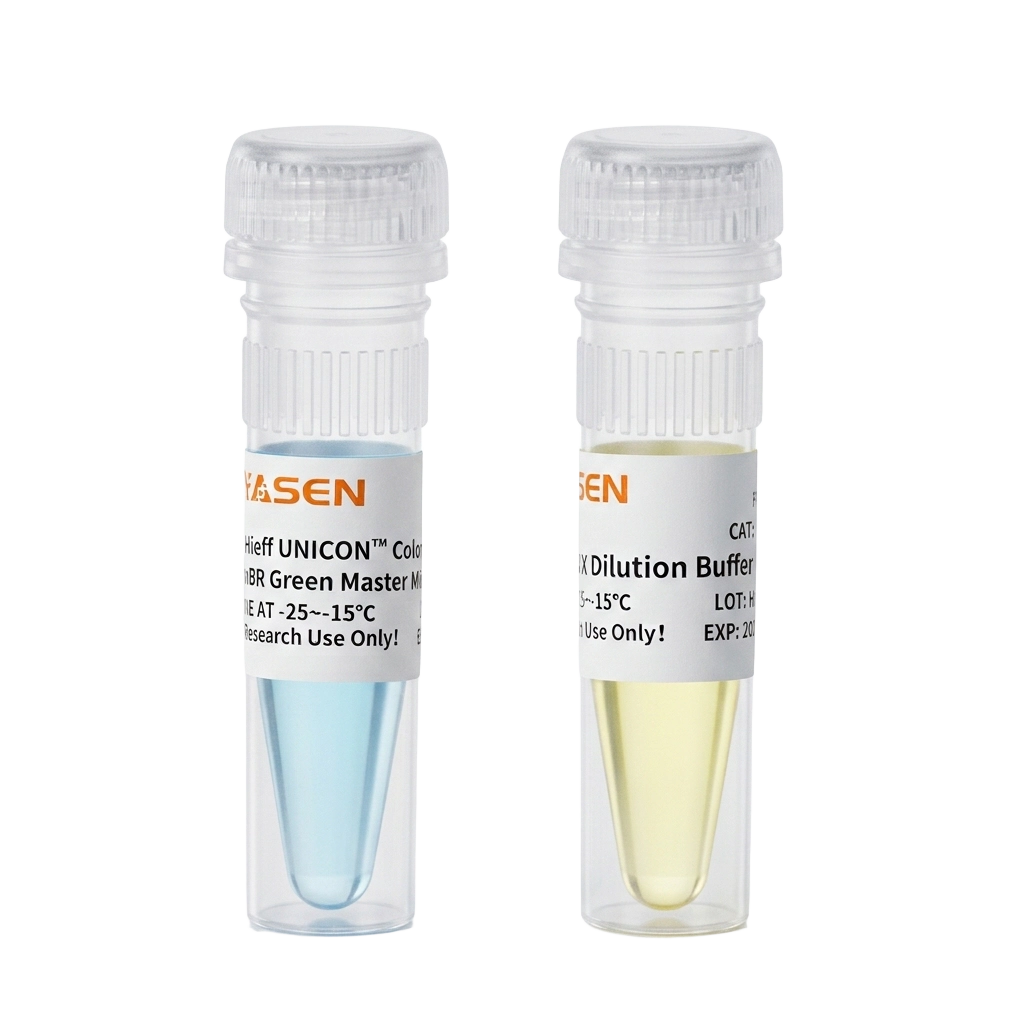


Hieff UNICON™ ColorGPS qPCR Master Mix (Low Rox) is a pre-solution for 2× real-time quantitative PCR amplification, featuring high fluorescence intensity, high sensitivity and specificity, and high amplification yield. The core component, Hieff UNICON™ Taq DNA Polymerase, is hot-started by antibody method, which can effectively inhibit non-specific amplification caused by primer annealing during sample preparation. At the same time, the formula adds factors to enhance the amplification efficiency of the PCR reaction and facilitators to equalize the amplification of genes with different GC contents (30~70%), so that the quantitative PCR can obtain a good linear relationship in a wide range of quantitative regions. The product utilizes the mixed color change reaction of different dyes to monitor the pipetting operation, which effectively reduces the occurrence of pipetting errors.
Features
Pipetting Tracking: Reduce the Risk of Missed/Addition Errors
Excellent Amplification: Good linearity across a wide linear range
High Precision: Can accurately distinguish templates with a 2-fold concentration difference
Good Repeatability: Small inter-well variability in replicate wells, resulting in better repeatability
Stable and Reliable: The reaction system can be stored at room temperature for 24 hours, and the product remains unaffected after 20 freeze-thaw cycles
Applications
Gene Expression Difference Analysis
Absolute Quantitative Analysis
Specifications
|
Concentration |
2 ×(qPCR Mix) |
|
Detection method |
Dye method |
|
PCR method |
qPCR |
|
Polymerase |
Taq DNA Polymerase |
|
Type of sample |
DNA |
|
Application equipment |
Applied Biosystems 7500, 7500 Fast, ViiA7;Stratagene MX4000, MX3005P, MX3000P and other fluorescence quantitative PCR instruments that require the addition of low concentrations of ROX Reference Dye |
|
Product Type |
Premix for real-time fluorescence quantitative PCR |
|
Apply to (application) |
Gene Expression |
Components
|
Components No. |
Name |
11189ES03 |
11189ES08 |
11189ES60 |
|
11189-A |
Hieff UNICON™ ColorGPS qPCR Master Mix (Low Rox) |
1 mL |
5×1 mL |
100×1 mL |
|
11189-B |
10×Dilution Buffer |
1 mL |
1 mL |
20×1 mL |
Figures

Figure1. Reliable results can be obtained within the dynamic range.
Using 2 µL of plasmid templates with a gradient of 10^1-10^7, the related genes were amplified. Hieff UNICON™ ColorGPS master mix can effectively detect a template amount range of 7 orders of magnitude, achieving good linearity within a broad linear range.

Figure2. Can accurately distinguish template concentration differences of 2-fold.
Using 2 µL of plasmid diluted in a 2-fold gradient as the template, the related genes were amplified. Hieff UNICON™ ColorGPS master mix can accurately resolve template concentration differences.

Figure3. Small inter-well variability is observed, showing better repeatability.
Using dozens of copies of plasmid as the template, amplification was performed with different fluorescent quantitative reagents according to the procedures specified in their respective instruction manuals. The SD values indicate that, compared to other reverse transcription reagents, the new product has smaller differences between replicate wells and better repeatability.

Figure4. More flexible, suitable for standard or rapid procedures.
In the standard procedure, the denaturation time and extension time are set to 10 seconds and 30 seconds, respectively, while in the rapid procedure, the denaturation time and extension time are set to 3 seconds and 10 seconds, respectively, to detect the Ct values corresponding to 10 target genes. The results show that the Ct values obtained with the new product in both standard and rapid procedures have a strong correlation, and the new product can achieve good results using the rapid procedure.

Figure5. After the reaction system is prepared, it can remain stable at room temperature for 24 hours.
Using different genes from mouse, human 293 cells, and Arabidopsis thaliana as targets, after preparing the reaction system, it was placed in the dark at different temperatures for 24 hours before detection. Compared to immediate processing, the detection difference for different genes does not exceed 0.5 Ct, indicating that stable results can also be obtained with long-duration operations.
Try it for free!
Get a free sample of ColorGPS qPCR Master Mix and validate its performance in your own lab.
👉 [Request Sample Now]
Storage
FAQ

1. The instrument has not been calibrated for a long time or it is aging. Usually, the instrument needs to be calibrated once a year. It is necessary to have an instrument engineer perform the calibration or replace the aging components.
2. A 10 μL reaction system was used. The normal system is a 20 μL system. Using half of the normal system would result in an excessively low total concentration of Rox, increasing the probability of BadRox occurrence. It is recommended to conduct the experiment using the 20 μL system.
2.Is the length of the product too long? If the length of the product is set to 500bp or more, this situation may occur. It is recommended that during primer design, the length of the product be controlled within the range of 80-300bp.
3. Are the primers inappropriate? If the primers are not designed correctly, they need to be redesigned. If the primers are correctly designed but seem to be degraded, PAGE electrophoresis can be used to check the integrity of the primers.
4. Template degradation: Prepare the template anew and repeat the experiment.
2. What if CT is ≥ 30 but the repeatability is very poor? At this point, due to the low abundance of the effective template, the randomness of collisions between the template and the primers increases, thereby causing a greater difference between the replicons. It is recommended to try adding 2-3 replicons, and then eliminate the data with large differences for data analysis.
Citations
Documents
Applications
You may also like
Inquiry
FAQ
The product is for research purposes only and is not intended for therapeutic or diagnostic use in humans or animals. Products and content are protected by patents, trademarks, and copyrights owned by Yeasen Biotechnology. Trademark symbols indicate the country of origin, not necessarily registration in all regions.
Certain applications may require additional third-party intellectual property rights.
Yeasen is dedicated to ethical science, believing our research should address critical questions while ensuring safety and ethical standards.