
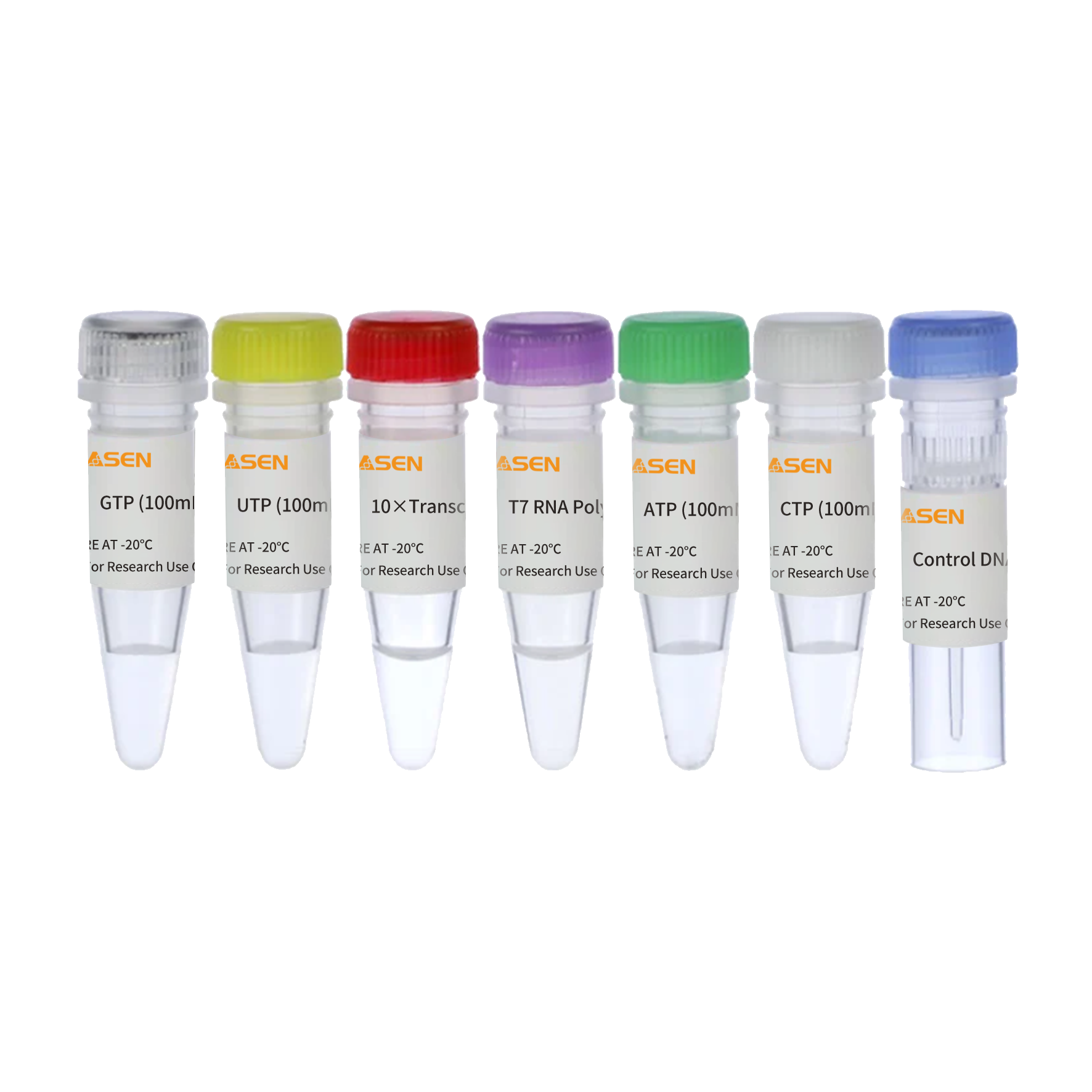

Frequently Bought Together
T7 High Yield RNA Synthesis Kitは、転写反応系を最適化します。T7 RNAポリメラーゼ、T7プロモーター配列を含む直鎖二本鎖DNAを鋳型とし、プロモーター下流のDNA配列を制御するためのNTPを基質として用いることで、一本鎖RNAを効率的に合成します。転写中に、修飾ヌクレオチドを基質に添加することで、ビオチン標識または色素標識RNAを調製できます。
このキットは長鎖転写産物と短鎖転写産物を合成でき、1μgのDNAテンプレートから100~200μgのRNAを合成できます。転写によって合成されたRNAは、RNAの構造と機能の研究、RNase保護、プローブハイブリダイゼーション、RNAi、マイクロインジェクション、in vitro翻訳など、様々な下流アプリケーションに使用できます。
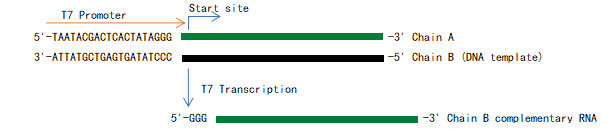
図1: in vitro RNA転写プロセス
特徴
- 1μgのコントロールテンプレートから反応あたり最大180μgのRNA
- IVTプロセスに最適化された反応システム
- dsRNAの産生を減らす
- RNAの完全性と純度の向上
応用
- 試験管内RNA合成
コンポーネント
| コンポーネント番号 | 名前 | 10623ES50 (50 T) | 10623ES60(100T) | 10623ES70(500T) |
| 10623-A | T7 RNAポリメラーゼミックス | 100μL | 200μL | 1mL |
| 10623-B | 10×転写バッファー | 100μL | 200μL | 1mL |
| 10623-C | ATP(100mM) | 100μL | 200μL | 1mL |
| 10623-D | CTP(100mM) | 100μL | 200μL | 1mL |
| 10623-E | GTP(100mM) | 100μL | 200μL | 1mL |
| 10623-F | UTP(100mM) | 100μL | 200μL | 1mL |
| 10623-G | コントロールDNAテンプレート(500ng/μL) | 10μL | 20μL | 100μL |
配送と保管
ドライアイス輸送。-15℃~-25℃で保管し、2年間有効です。
数字
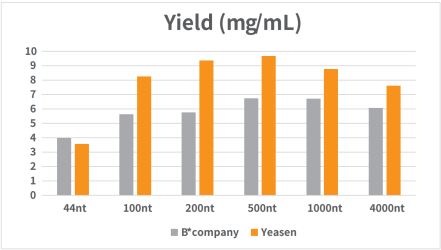
図 1. 標準 RNA は、T7 RNA 合成キットを使用して in vitro で合成されました。
反応液はPCR装置内で37℃で2時間インキュベートし、その後磁気ビーズ(Cat#12602)で精製した。収量はNanoDrop分光光度計で分析し、図1に示した。
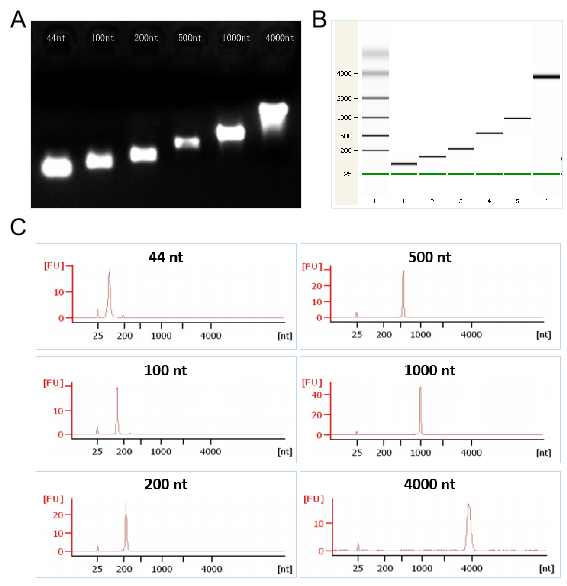
図2. T7キットによる異なる長さのRNAの転写の実証。それぞれ電気泳動図(図2A)、キャピラリー電気泳動図(図2B)、クロマトグラム(図2C)で示されている。
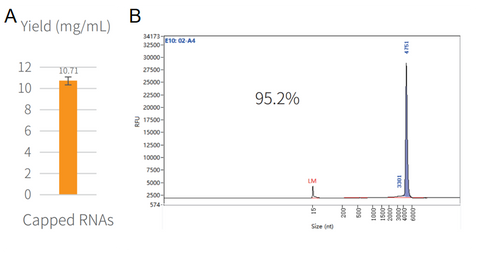
図 3. キャップされた RNA の in vitro 合成。
反応液はPCR装置内で37℃で2時間インキュベートし、その後磁気ビーズ(Cat#12602)で精製した。収量はNanoDrop分光光度計で測定した(図3A参照)。完全性はキャピラリー電気泳動で測定した(図3B参照)。
1. 転写産物の収量が低い
テンプレートの品質は収量と密接に関連しています。実験群の収量が対照群よりも著しく低い場合、考えられる原因は以下のとおりです。
① 実験テンプレートに阻害成分が含まれていること
② テンプレートに問題があります。
提案:
① テンプレートを再精製する。
② テンプレートの定量化と完全性を決定する。
③ 反応時間を延ばす
④ テンプレートの入力量を増やす
⑤ 他のプロモーターとRNAポリメラーゼを試してください。
2. 短いトランスクリプトの収量が少ない
短い転写開始断片は反応を阻害します。転写産物が100ヌクレオチド未満の場合は、反応時間を4~8時間に延長するか、テンプレート量を2μgに増やすことでRNA収量が増加します。
3. RNA転写長が予想よりも長い
電気泳動で生成物のバンドが予想よりも大きいことが示された場合、考えられる理由は次のとおりです。
①プラスミドテンプレートが完全に直線化されていない可能性があります。
②センス鎖の3’末端は突出した構造を有する。
③RNAは完全に変性していない二次構造を持っています。
提案:
①テンプレートが完全に線形化されているかどうかを確認し、必要に応じて追加の線形化を実行します。
②3'オーバーハングを避けるために適切な制限酵素を選択するか、Klenow Fragment /T4 DNAポリメラーゼを使用して転写を完了してから続行します。
③変性ゲルを用いてRNA産物を検出します。
4. RNA転写の長さが予想より短い
電気泳動の結果、生成物のバンドが予想よりも小さい場合、次のような理由が考えられます。
①テンプレートにはT7 RNAポリメラーゼに類似した終結配列が含まれています。
②テンプレート中のGC含有量が高い。
提案:
①反応温度を下げる(例えば30℃)。温度を下げると転写長が長くなる場合もありますが、収量は減少します。あるいは、転写に別のRNAポリメラーゼを試してみるのも良いでしょう。
②テンプレートのGC含量が高い場合は、42℃で転写するか、SSBを添加して収量と転写長を増加させます。
5. 転写産物の電気泳動テーリング
電気泳動時にテーリング現象が発生します。
考えられる理由:
①実験操作中にRNaseに汚染された
②RNaseによるDNAテンプレートの汚染。
提案:
①RNaseフリーのピペットチップとEPチューブを使用し、使い捨てのラテックス手袋とマスクを着用し、すべての試薬はRNaseフリーの水で調製します。
②鋳型DNAを再精製する。
[1] Dong Z, Zheng N, Hu C, et al. Nosema bombycis microRNA-like RNA 8 (Nb-milR8)は、宿主であるBombyx moriにおけるBmPEX16遺伝子発現を調節することにより真菌病原性を高める。Microbiol Spectr. 2021;9(2):e0104821. doi:10.1128/Spectrum.01048-21(IF:7.171)
[2] Wang X, Tang S, Ye S, et al. 三本鎖置換増幅カスケードによる循環miR-195-5pの超高感度定量. Talanta. 2022;242:123300. doi:10.1016/j.talanta.2022.123300(IF:6.057)
関連ブログ:
Storage
FAQ
The optimization of the IVT system can be achieved by adjusting the template, the amount of T7 enzyme used, and if it is co-transcription with cap addition, the ratio between the cap and NTP can be considered; for enzymatic cap addition, the conditions can be optimized in terms of the dosage of the cap-adding enzyme, 2-O-methyltransferase, and SAM. Regarding the template, apart from the requirement of complete linearization, there is another point, which is sequence design. For example, in the 5'UTR region, pay attention to uAUG and Kozak sequence; for CDS, consider the codon preference, GC3 content, and dinucleotide preference, etc.; 3'UTR: RBP and miRNA binding sites: and another point is the secondary structure of RNA. The stable secondary structure of the 5'UTR pre-sequence will reduce the expression of mRNA; the stable secondary structure of 3'UTR will increase the stability of mRNA and promote the expression of the encoded protein. For the recommended IVT system and more detailed tips, please refer to the mRNA in vitro synthesis experiment manual of Vivian Biotechnology.
The average yield is between 120-220 ug/ul (the yield is highly dependent on the sequence design). In the co-transcription method, the mRNA yield is 8 g/L. With process optimization, the yield will increase. Currently, the quality parameters of the available processes include observing the fluorescence value of GFP and measuring the cap addition rate using LC-MS.
The T7 pol enzyme will use the product RNA as a template and continue to extend the RNA at its 3' end. The extended sequence will form complementary pairing with the 3' end sequence of the original RNA molecule, thereby creating a hairpin structure.
The T7 pol enzyme can use RNA as a template to replicate RNA molecules, and synthesize the complementary strand.
(At present, there is no effective method for removing dsRNA. However, there is a patent report suggesting that a fiber column (sigma) could be tried.)
1. Reduce the concentration of magnesium ions; however, reducing the concentration of magnesium ions will also lead to a decrease in the production of RNA, and a balance point needs to be reached.
2. Increase the reaction temperature of IVT to 50-56℃. This temperature can effectively reduce the content of dsRNA in the product; however, the requirements for equipment for high-temperature reactions will vary, and it may also increase the cost.
3. In the IVT reaction system, certain dispersants such as urea and formamide are added; our process research team has also conducted some experiments on this route, which can achieve the effect of inhibiting dsRNA. However, whether it is suitable for process scaling-up still needs further research.
This kind of precipitation occurs by chance and is also closely related to the sequence design.
Solution: (1) Reduce the concentration of magnesium ions, but this will result in a decrease in yield. The amount of T7 enzyme needs to be increased and the reaction time (from 2 hours to 3-4 hours) needs to be extended; (2) The form of NTP (the presence of magnesium ions at a high concentration, such as 46 mM, does not select NTP, but when the magnesium ion concentration decreases, the yield of NTP (Tris salt form) does not change much, and the yield of the triNa form of NTP decreases significantly.
Citations
Documents
| Manual |
|---|
| 10623_Manual_HB230115_EN.pdf |
Applications

あなたも好きかもしれません
問い合わせ
よくある質問
この製品は研究目的のみに使用され、人間や動物の治療や診断に使用することを意図したものではありません。製品とコンテンツは、
特定のアプリケーションでは、追加のサードパーティの知的財産権が必要になる場合があります。