


Frequently Bought Together
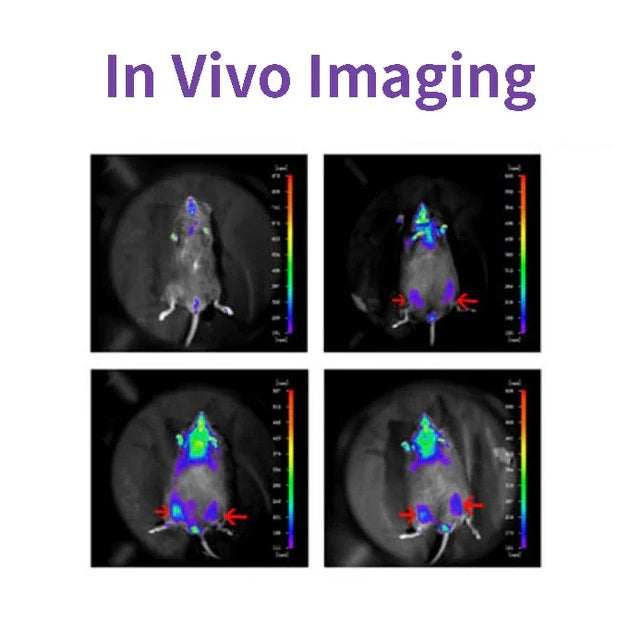
D-luciferin is a common substrate for Luciferase and is widely used throughout biotechnology, especially in vivo imaging Technology. The mechanism of action is that luciferin (substrate) can be oxidized to emit light in the presence of ATP and luciferase. When fluorescein is in excess, the quantum number of light produced is equal to Luciferase concentrations were positively correlated (see figure below). Plasmids carrying luciferase encoding gene (Luc) were transfected into cells and introduced into study animals such as rats and mice.

D-luciferin is also commonly used in in vitro studies, including luciferase and ATP levels analysis; Reporter gene analysis; High-throughput sequencing and various contamination tests. There are three Product form: D-luciferin (free acid), D-luciferin salt (sodium salt and potassium salt). The main difference lies in solubility: water solubility of the former and solubility of the buffer system. They are weakly soluble except in weak bases such as low concentrations of NaOH and KOH solutions. Soluble in methanol and DMSO; The latter can be easily dissolved in water or buffer, easy to use.
Features
No radiation, almost harmless to living organisms.
Bioluminescence, no excitation light source.
So sensitive, you can detect it in a few hundred cells.
Good penetration, 3-4cm tissue depth can still be detected.
High signal-to-noise ratio, strong fluorescence signal and good anti-interference.
Applications
1. In the tumorigenesis experiment in nude mice, the tumor growth was observed without invasion in real time, without tumor stripping measurement.
2. To test the effect of the administration on tumor growth or metastasis, the fluorescein substrate can be completely eliminated within 3 hours, without interference to the drug experiment.
3. The localization and distribution of foreign cells in animals were detected.
4. The target gene or promoter of the target gene is fused to the luciferase gene to detect changes in gene expression during drug treatment or disease progression.
5. Monitoring stem cell transplantation, survival and proliferation; Trace the distribution and migration of stem cells in vivo.
Specifications
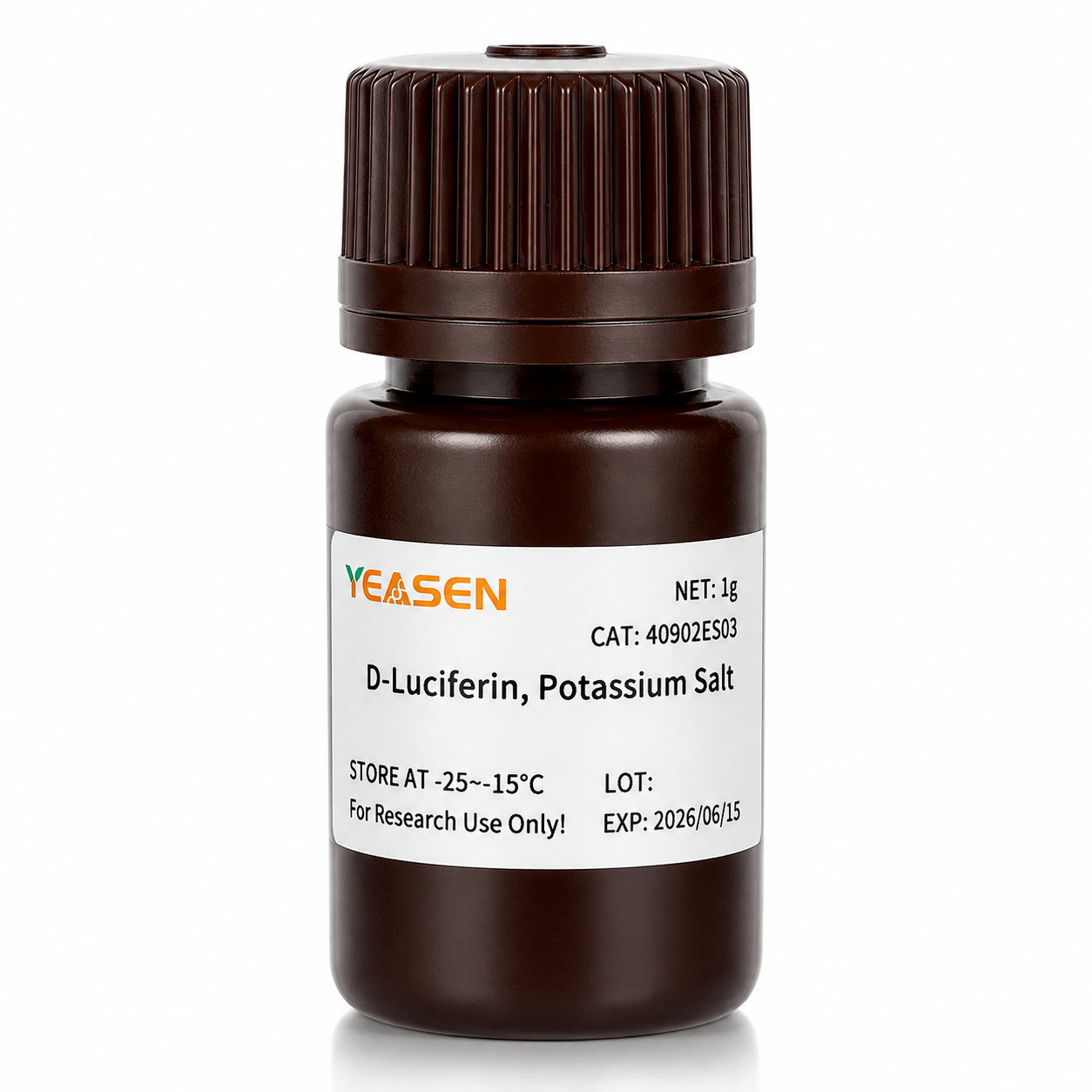
| English synonym | (S)-4,5-Dihydro-2-(6-hydroxy-2-benzothiazolyl)-4-thiazolecarboxylic acid potassium salt; D-Luciferin firefly, potassium salt |
| CAS NO. | 115144-35-9 |
| Formula | C₁₁H₇N₂O₃S₂K |
| Molecular weight | 318.42 g/mol |
| Appearance | Light yellow powder |
| Solubility | Soluble in water(60 mg/mL) |
Components
| Components No. | Name | 40902ES01 | 40902ES02 | 40902ES03 | 40902ES08 |
| 40902 | D-Luciferin, Potassium Salt | 100mg | 500 mg | 1g | 5g |
Figures
Cited from "A Novel Allosteric Inhibitor of Phosphoglycerate Mutase 1 Suppresses Growth and Metastasis of Non-Small-Cell Lung Cancer, Cell Metab. 2019;30(6):1107-1119
Storage
FAQ
1) Solubility: The salt form is easily soluble in water. The solubility of potassium salt is 60mg/ml, and that of sodium salt is 100mg/ml. Free acid is not easily soluble in water. It can be dissolved by a weak alkaline solution of sodium bicarbonate, and its solubility in methanol is 10mg/ml, and in DMSO is 50mg/ml.
2) Toxicity: The salt form is more convenient to use during the process, especially in in vivo imaging experiments, as it can dissolve in water and the reaction toxicity will be smaller (Fluorescein is a low-molecular-weight organic compound composed of phenylthiazole and thiazole carboxyl group, with low toxicity).
3) Usage effect: There is no significant difference. In in vivo experimental studies, the usage rate of potassium salt is higher.
2. Native coelenterazine is an action substrate for various luciferases such as sea kidney luciferase (Rluc) and Gaussia luciferase (Gluc).
1. Instruments with a biochemiluminescence detection module. The light produced by luciferin can be detected by a photometer or a scintillation counter. Common in vivo imaging instruments: such as the IVIS® Lumina small animal in vivo imaging system, the In-Vivo Xtreme multi-mode small animal in vivo imaging instrument from Bruker, Germany.
2. Multi-functional microplate readers: It is necessary to confirm with the instrument manufacturer whether it is a specific biochemiluminescence detection module (note: cannot use a fluorescence microscope).
2. The cells themselves also contain a certain amount of ATP and magnesium, which can promote the reaction. In most cases, the ATP and magnesium contained in the cells are sufficient for the reaction of D-fluorescein salt, but the content varies depending on the type of cells. You can first try using a culture medium without additional ATP and magnesium, and conduct the experiment normally to see the results.
1) Injection method: It can be done through intraperitoneal injection or tail vein injection.
2) Injection volume: The scientific approach is to evaluate the injection dose based on the kinetic curve. The initial attempted injection dose is: 150mg substrate/kg of mouse body weight. Therefore, the purchase quantity can be calculated according to the above method: If there are 10 mice, 22 - 25g, then 33 - 37.5mg of substrate is required.
Citations
Documents
| Brochure |
|---|
| In_vivo_imaging_Leaving_Tumor_Cells_Nowhere_to_Hide.pdf |


You may also like
Inquiry
FAQ
The product is for research purposes only and is not intended for therapeutic or diagnostic use in humans or animals. Products and content are protected by patents, trademarks, and copyrights owned by Yeasen Biotechnology. Trademark symbols indicate the country of origin, not necessarily registration in all regions.
Certain applications may require additional third-party intellectual property rights.
Yeasen is dedicated to ethical science, believing our research should address critical questions while ensuring safety and ethical standards.