
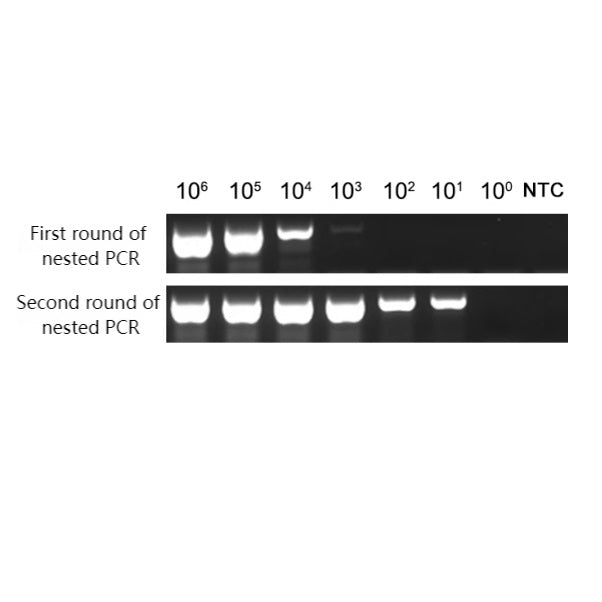
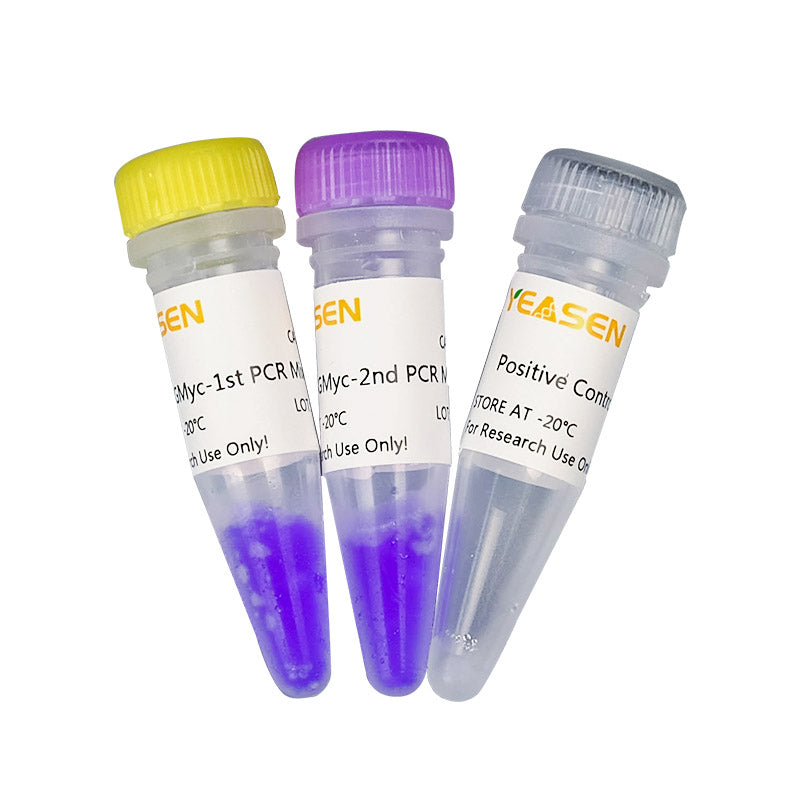


Mycoplasma PCR Detection Kit (Nested PCR) (2G) is based on the nested PCR method (Nested PCR) to detect mycoplasma infection in various biological materials (such as cell culture, experimental animal secretions and animal serum, etc.). The kit uses quantitative PCR technology, designs two sets of primers for the conservative region of the mycoplasma 16S-23S rRNA sequence, performs two rounds of PCR amplification, and judges the mycoplasma contamination based on the second round of amplification products. It can detect 34 types of mycoplasma, including oral mycoplasma (M.orale), pneumoniae (M.pneumoniae), hyorhinis (M.hyorhinis), arginine mycoplasma (M.arginini), gallisepticum (M.gallisepticum), synoviae (M.synoviae), fermentation mycoplasma (M.fermentans), citric spiroplasma (Spiroplasma citri), salivarium (M.salivarium), etc., with a sensitivity of up to 2.5 copies/uL. It can also amplify bands normally for 10 CFU/mL mycoplasma standard strains. It has the characteristics of strong specificity, high sensitivity, convenient and fast operation, and can be directly used for the detection of cell culture supernatant.
Compared with conventional PCR mycoplasma detection kits, this product can avoid the production of non-specific products due to non-specific pairing between primers and templates; it can also sensitively detect trace amounts of mycoplasma DNA in samples to avoid false negatives.
Features
Comprehensive Detection: Advanced nested PCR technology enables the detection of up to 34 mycoplasma species in a single assay.
Exceptional Specificity: Primers target the conserved 16S–23S rRNA region with no cross-reactivity to related species such as Clostridium or Lactobacillus.
Ultra-High Sensitivity: Achieves a detection limit as low as 2.5 copies/μL for early and reliable identification.
Fast & Convenient Workflow: Streamlined protocol allows for sample preparation and detection in under 2 hours.
Safe & Contamination-Free: The included non-infectious positive control ensures safety and eliminates the risk of cross-contamination.
Specifications
|
For Use With (Equipment) |
Conventional PCR instrument |
|
Sample Type |
Strains, cell supernatants, etc. |
|
Polymerase |
Taq DNA Polymerase |
|
Detection Method |
Nested PCR |
|
Detection of mycoplasma types |
34 types, including 9 types of mycoplasma covered by the pharmacopoeia |
|
Detection limit |
1st Round PCR:1x10³ copies/uL 2nd Round PCR: 2.5 copies/μL / 5CFU/mL |
|
Reaction time (fast PCR procedure) |
48 min |
Components
|
Components No. |
Name |
40614ES10 |
40614ES20 |
|
40614-A* |
GMyc-1st PCR Mix |
460 μL |
460 μL×2 tube |
|
40614-B* |
GMyc-2nd PCR Mix |
490 μL |
490 μL×2 tube |
|
40614-C** |
Positive Control Template |
20 μL |
40 μL |
【Note】: *PCR reaction is extremely sensitive. To prevent false positives, add the positive control last when adding samples.
**40614-C: Positive Control Template, positive control.
Application
mycoplasma contamination; mycoplasma testing; Cell Culture Quality Control
Figures
1.Workflow

2. Specificity

 Figure 1. Specificity and matrix tolerance of GMyc-PCR Mycoplasma Detection Kit (2G)
(A)/(B).Sample matrix interference: 14 common sample matrices and the positive control and its spiked content (2.5 copies/μL positive control) and negative control (PCR Mix) in the kit were selected for verification. No mycoplasma was detected in any of the 14 matrices.
(C).Detection Range: GMyc-PCR Mycoplasma Detection Kit (2G) is capable of detecting all 8 mycoplasma species required by both Chinese and international pharmacopoeias, with a sensitivity of 10 CFU/mL.
3. High detection sensitivity
 Figure 2. Sensitivity test
4. Stability

 Figure 3. Stability Test
(A)Freeze-thaw stability: The kit withstands 10 freeze-thaw cycles at -25 to -15°C without loss of performance.
(B)Heat-accelerated stability: The Mycoplasma 2G nested PCR kit remains stable after 14 days at 37°C.
Storage
FAQ
Citations
Documents


You may also like
Inquiry
FAQ
The product is for research purposes only and is not intended for therapeutic or diagnostic use in humans or animals. Products and content are protected by patents, trademarks, and copyrights owned by Yeasen Biotechnology. Trademark symbols indicate the country of origin, not necessarily registration in all regions.
Certain applications may require additional third-party intellectual property rights.
Yeasen is dedicated to ethical science, believing our research should address critical questions while ensuring safety and ethical standards.