Polyacrylamide gel (PAGE gel) is often used for protein electrophoresis to realize protein separation. This kind of gel is generally composed of concentrated gel and separation gel. The former plays the role of concentrating protein samples, while the latter separates proteins of different sizes according to the concentration of acrylamide monomer and N,N-methylenebisacrylamide (methyleneacrylamide) crosslinking agent used in the gel.
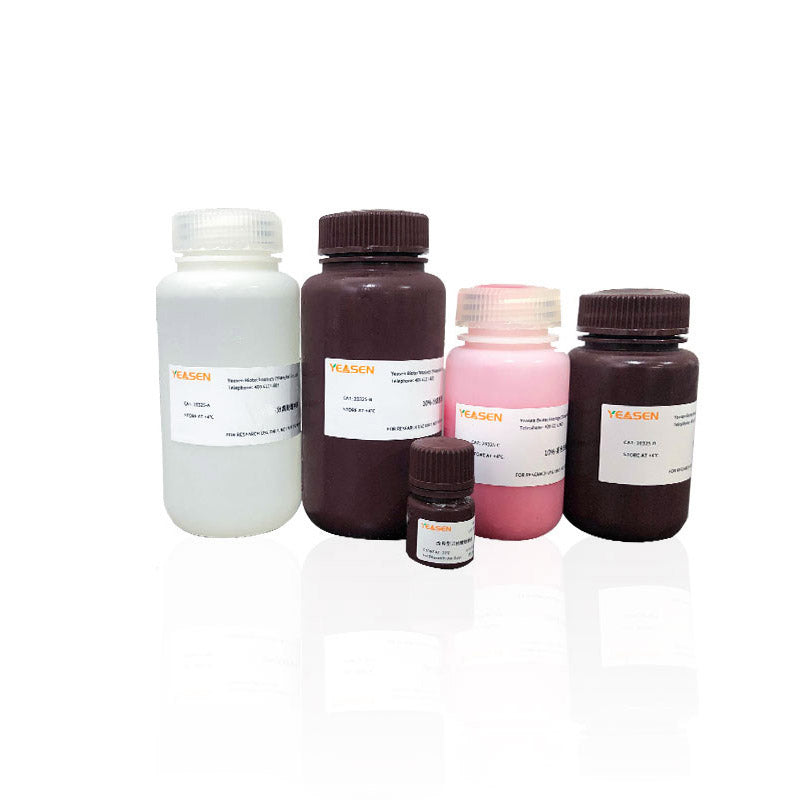
This kit provides a variety of reagents required for quick preparation of PAGE gel. Users only need to prepare their own gel preparation equipment to prepare gel, which greatly simplifies the gel preparation process. The gel prepared by this kit can only be used for denaturing PAGE gel electrophoresis. This specification can prepare about 125 pieces of mini gel (calculated by 0.75 mm thick gel).
Specifications
|
SDS-PAGE concentrated gel concentration
|
4.2%
|
|
SDS-PAGE separation gel concentration
|
15%
|
|
Separation range (kDa)
|
10-45
|
|
Gel System
|
Tris-glycine
|
|
SDS-PAGE concentrated gel concentration
|
4.2%
|
Components
|
Category
|
Cat. No.
|
Component Name
|
20327ES62 (125 mini gels)
|
Storage
|
|
Part I
|
20327-A
|
15% Resolving Gel Buffer
|
250 mL
|
2~8℃
|
|
20327-B
|
15% Resolving Gel Solution
|
250 mL
|
2~8℃
|
|
20327-C
|
15% Colored Stacking Gel Buffer
|
80 mL
|
2~8℃
|
|
20327-D
|
15% Stacking Gel Solution
|
80 mL
|
2~8℃
|
|
20327-E
|
Gel Casting Cups
|
3 units
|
2~8℃
|
|
Part II
|
20327-F
|
Improved Ammonium Persulfate Solution
|
--
|
-25~-15℃
|
[Note]:20325-F, Improved Ammonium Persulfate Solution(APS) is not included in this kit and must be supplied by the user.
The gel prepared with this kit is suitable for both denaturing and non-denaturing PAGE. This package size yields approximately 125 gels at 0.75 mm, 90 gels at 1.00 mm, or 60 gels at 1.50 mm thickness.
Features
Fast & Easy: Cast multiple gels in 2 min. No calculations or dilutions needed.
Colored Stacking Gel: Visual aid for easy loading; color does not interfere with downstream applications.
Safe & Odorless: Eliminates the need to handle TEMED.
One-Step Casting: Add stacking gel directly; no sealing of resolving gel needed.
Instructions:
It is recommended not to configure too many pieces of gel at one time to avoid adding the upper solution too late (2-3 pieces are recommended at most)
1.Select the appropriate gel concentration according to the molecular weight of the target protein (refer to table 1)
2.Gel making process (take a piece of 0.75/1.0/1.5 mm Mini gel as example)
2.1 Take an equal volume of separation gel buffer and separation gel solution and mix them, i.e. take 2.0/2.7/ 4.0 mL of the two solutions respectively.
2.2 Weigh out 0.1 g of ammonium persulfate and dissolve it in 1 mL of deionized water. The customer needs to purchase the ammonium persulfate themselves.
2.3 Add 35/45/70 μL APS to the mixed solution in step 1 (the amount of APS used can be reduced by half if the solidification is too fast) and fully mixed.
2.4 Inject the solution in step 2 into the gel making glass plate. Note that the concentrated gel shall be injected into the gel mold within 2 minutes after the separation gel is added, and the pouring of the concentrated gel shall be slow to prevent mixing of the concentrated gel and the separation gel. If the individual finds it difficult to configure, it can also be adapted to configure concentrated gel after sealing with ethanol.
2.5 Preparation of concentrated gel: take an equal volume of concentrated gel buffer and concentrated gel solution, i.e. take 0.5/0.75/ 1.0 mL of the two solutions respectively, and then add 10/13/18 μL APS and mixed well.
2.6 Inject it into the gel making glass plate and insert the comb teeth (do not use excessive force to insert the comb teeth gently).
2.7 After the concentrated gel is solidified for 15 min, the comb teeth can be removed and used for electrophoresis. Note: please try to use freshly prepared electrophoresis buffer.
Notes
1. It is suggested that the voltage during electrophoresis should be between 100-120 V. If it is necessary to accelerate the electrophoresis speed, it can be increased to 150 V.
2. Before gel filling, make sure to balance the gel solution to room temperature (for example, keep it for several minutes) to effectively avoid the formation of bubbles in gel.
3. The customer needs to purchase the ammonium persulfate themselves. We recommend using the product with Cat#A3678 from Sigma.
4. The amount of ammonium persulfate solution is only for reference, and the actual amount can be increased or decreased according to personal experimental habits and experience. Adding more ammonium persulfate can accelerate the gel speed, and vice versa. The coagulation rate of PAGE gel is closely related to the temperature and the amount of ammonium persulfate.
5. An appropriate amount of TEMED substitutes have been added to this product. If it is necessary to further accelerate the gel speed, an appropriate amount of TEMED can be added as required before dispensing.
6. There is a significant positive correlation between gel solidification and temperature. Under the same conditions, the higher the temperature, the faster the solidification speed.
7. Color concentrated gel may produce a small amount of precipitation during storage, which is a normal phenomenon. Please feel free to use it.
8. The APS was stored at -20℃. For convenience, the APS that has been opened and is in use can be stored at 4℃.
9. Please wear the necessary PPE, such lab coat and gloves, to ensure your health and safety!
10. For research use only!
Table 1. Reference separation range of SDS-PAGE gel with different concentration
|
SDS-PAGE gel concentration
|
Separation range (kDa)
|
|
8%
|
30-200
|
|
10%
|
20-80
|
|
12.5%
|
15-60
|
|
15%
|
10-45
|