
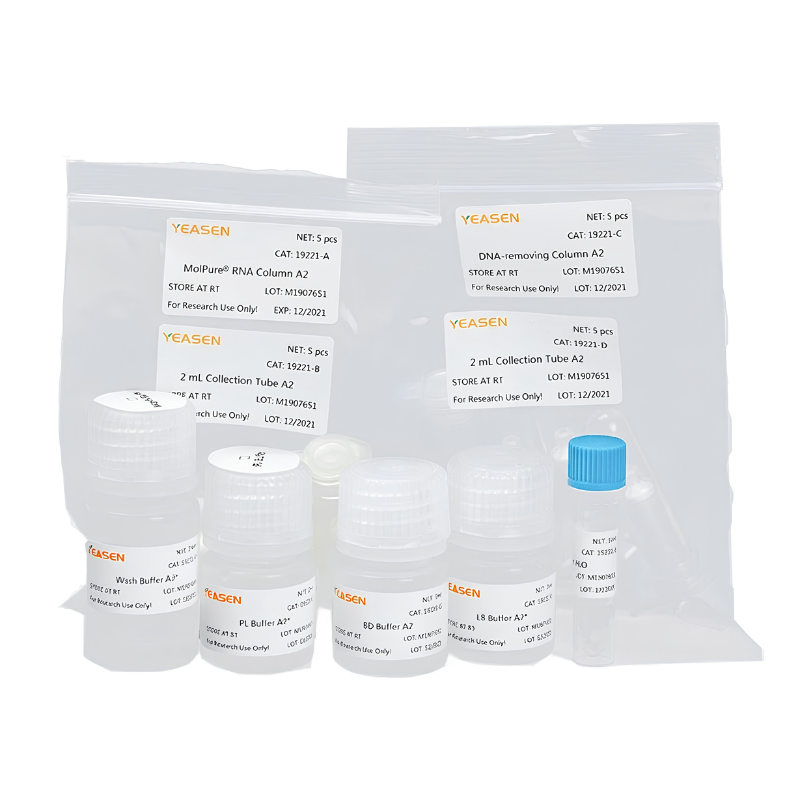


Hieff™ Flash Cell /Tissue Total RNA Kit was performed by using Hieff DNA removing / RNA binding column technology and new solution systems suitable for extracting high purity and quality total RNA from a variety of fresh or frozen animal tissues or cultured cells. The extraction process does not require toxic phenol, chloroform, β -mercaptoethanol, or precipitation of isopropanol and ethanol. Easy to operate, 15 min to complete the animal tissue or cells (10-30 mg animal tissue or (1-10) ×106 Animal cells) of total RNA extraction. The total RNA is of high purity and can be used in various molecular biology experiments including RT-PCR, qPCR, molecular cloning and RNase protection analysis.
Features
Ultra-Fast: RNA extraction in under 15 minutes per sample.
High RNA Integrity: Proprietary buffer formulation preserves full-length RNA throughout the workflow.
Broad Sample Compatibility: Works efficiently with challenging samples, including primary cells, protein-rich muscle tissue, lipid-rich brain tissue, and aquatic species (e.g., fish and shrimp).
Effective gDNA Removal: Integrated DNA-removal/RNA-binding spin column eliminates genomic DNA contamination in just 30 seconds—no DNase treatment required.
Components
| No. | Name | 19221ES50 (50 T) |
| 19221-A | Hieff DNA removing/RNA binding Column A | 100 |
| 19221-B | 2 mL Collection Tube A2 | 100 |
| 19221-C | Lysate buffer LB(LB Buffer A2) | 30 mL |
| 19221-D | Deproteinized buffer PL (PL Buffer A 2) | 40 mL |
| 19221-E | Wash Buffer W*(Wash Buffer A 2*) | 13 mL |
| 19221-F | RNase-free H2O | 5 mL |
Figures
 Figure 1. High RNA integrity across diverse tissues with Yeasen Kit (Cat. No. 19221).
RNA was extracted from liver (P-1, P-2), muscle (H-1, H-2), kidney (H-3, H-4), spleen (H-5), brain (H-6), skin (fH-4), shrimp, loach, and crab meat. All samples show clear 28S and 18S rRNA bands with a ~2:1 ratio, indicating excellent RNA integrity.
Storage
FAQ
Citations
Documents
| Files |
|---|
| 19221-C-MSDS-HB230228.pdf |
| 19221-D-MSDS-HB230228.pdf |
| 19221-E-MSDS-HB230228.pdf |
| 19221-F-MSDS-HB230228.pdf |
| 19221-G-MSDS-HB230228.pdf |
Applications
You may also like
Inquiry
FAQ
The product is for research purposes only and is not intended for therapeutic or diagnostic use in humans or animals. Products and content are protected by patents, trademarks, and copyrights owned by Yeasen Biotechnology. Trademark symbols indicate the country of origin, not necessarily registration in all regions.
Certain applications may require additional third-party intellectual property rights.
Yeasen is dedicated to ethical science, believing our research should address critical questions while ensuring safety and ethical standards.