

شرح
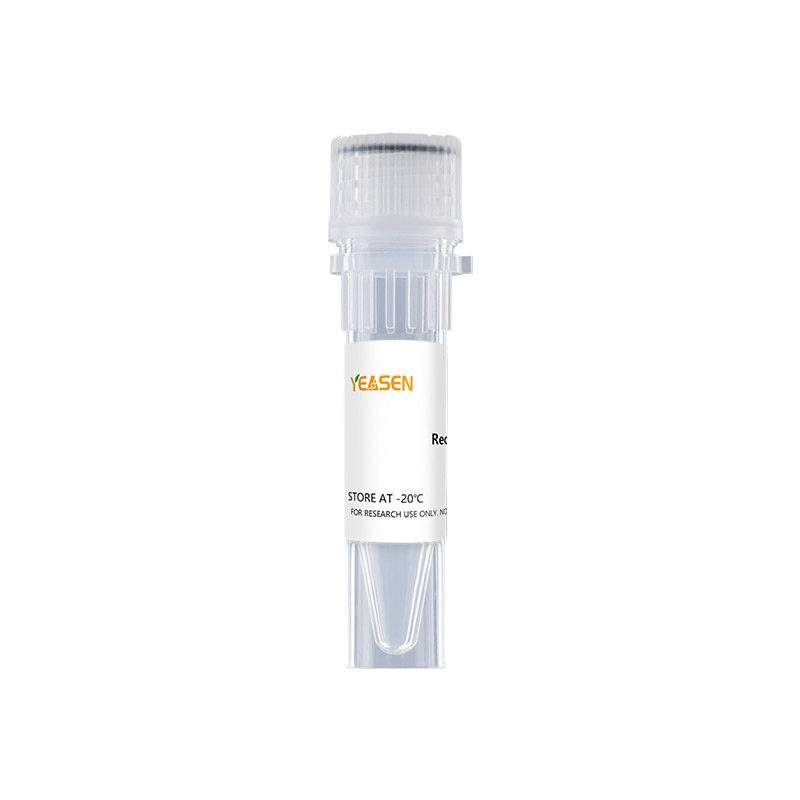
Hieff™ HC Fast Tagmentase (10 U/μL, 2.2 μg/μL) is a mutant form of the wild-type Tn5 transposase. It recognizes the inside end (IE), outside end (OE), and mosaic end (ME) sequences of the Tn5 transposon, and achieves the highest transposition efficiency on DNA fragments containing the ME sequence.
This product is a high-concentration naked Tn5 enzyme. After being pre-loaded with adapters, it can efficiently and randomly insert the Tn5 transposon into target sequences, and is widely used in fields such as in vitro transgenesis and next-generation sequencing (NGS) library preparation.
Product Information
|
Catalog No. |
Size |
|
12914ES50 / 12914ES76 |
10 µL / 50 µL |
Component Information
|
Component No. |
Component Name |
12914ES50 |
12914ES76 |
|
12914-A |
HC Fast Tagmentase (10 U/µL, 2.2 µg/µL) |
10 µL |
50 µL |
|
12914-B |
Assemble Buffer |
5 mL |
25 mL |
|
12914-C |
5 × Reaction Buffer |
5 mL |
25 mL |
|
12914-D |
6 × Terminate Solution |
5 mL |
25 mL |
Feature
• High enzyme activity concentration.
• Wild-type Tn5 enzyme.
• Compatible with different loading (pre-loaded) sequences.
• Application directions: DNA library construction, ATAC library construction, bacterial mutant library construction, methylation, single-cell genome, and third-generation genome sequencing methods.
Applications
Transposase applications include sequencing and microbial mutant library construction.
Protocol 1: High-throughput sequencing library construction (for example). Before use, please carefully read the instructions for use.
1. Adapter preparation
1) Reference primer names and sequences for the Illumina platform:
Primer A: 5′-phos-CTGTCTCTTATACACATCT-NH2-3′
Primer B: 5′-TCGTCGGCAGCGTCAGATGTGTATAAGAGACAG-3′
Primer C: 5′-GTCTCGTGGGCTCGGAGATGTGTATAAGAGACAG-3′
2) Dissolve Primer A, Primer B, and Primer C in Annealing Buffer to a concentration of 100 μM.
3) Prepare the following reaction systems separately:
|
Component |
Reaction 1 |
|
Primer A (100 μM) |
10 μL |
|
Primer B (100 μM) |
10 μL |
|
Total |
20 μL |
|
Component |
Reaction 2 |
|
Primer A (100 μM) |
10 μL |
|
Primer C (100 μM) |
10 μL |
|
Total |
20 μL |
4) Vortex Reaction 1 and Reaction 2 separately to mix thoroughly, and briefly centrifuge to collect the solution at the bottom of the tubes. Place in a PCR instrument and run the following program: heated lid 105°C ON; heat at 94°C for 2 min. Immediately stop the reaction program after the time is reached (be sure not to exceed the reaction time; it is best to set a timer as a reminder). Do not open the PCR instrument lid; let the reaction tubes cool naturally in the PCR instrument for 2 hours, then cool for 5 min at 4°C or on ice.
Alternatively, set the PCR program as follows: heated lid 105°C ON; 72°C 15 min; 60°C 10 min; 50°C 10 min; 40°C 10 min; 25°C 30 min.
5) After the reaction is complete, mix Reaction 1 and Reaction 2 in equal volumes and mix thoroughly. Name the mixture Adapter Mix and store at −25 to −15°C.
2. Transposome generation
1) Prepare the following reaction system:
|
Component |
Volume (μL) |
|
HC Fast Tagmentase (10 U/μL, 2.2 μg/μL) |
10 |
|
Adapter Mix (25 μM)* |
8 |
|
Assemble Buffer |
Up to 200 |
*The Adapter Mix is prepared by the user according to the experimental purpose and sequencing platform.
2) Reaction conditions: mix thoroughly by gentle pipetting with a pipette. Incubate at 25°C for 1 h (heated lid OFF). The reaction product is named Tn5 Mix and can be directly applied to library construction experiments or stored at −25 to −15°C.
3. DNA fragmentation test
1) Prepare the following reaction system:
|
Component |
Volume (μL) |
|
Input DNA (50 ng/μL) |
1* |
|
5 × Reaction Buffer |
4 |
|
Tn5 Mix |
2** |
|
ddH2O |
Up to 20 |
*The larger the amount of input DNA, the longer the average length of the fragmented product; conversely, the smaller the amount, the shorter the average length of the fragmented product.
**To increase the degree of fragmentation, increase the amount of Tn5 Mix; conversely, reduce the amount of enzyme used.
2) Fragmentation reaction program
Mix gently by pipetting or vortexing, and briefly centrifuge. Perform the fragmentation reaction according to the reaction program shown in the table below.
|
Temperature |
Time |
|
Heated lid 105°C |
ON |
|
55°C |
10 min |
|
4°C |
Hold |
3) Termination of DNA fragmentation
Prepare the following reaction system. Add the reaction components in the table below to the above fragmented product, and mix thoroughly by gently pipetting 20 times with a pipette.
|
Component |
Volume (μL) |
|
Fragmented product |
20 |
|
6 × Terminate Solution |
4 |
|
Total |
24 |
Perform the termination reaction according to the reaction program shown in the table below.
|
Temperature |
Time |
|
Heated lid 105°C |
ON |
|
55°C |
10 min |
|
4°C |
Hold |
After the sample temperature drops to 4°C, remove the PCR tube and purify the fragmented product. 1.2 × magnetic bead purification can be chosen; Hieff NGS™ DNA Selection Beads (Cat#12601ES) are recommended. Finally, elute the fragmented product with 21 μL ddH2O.
4) Quality control
a. Determine the concentration using a Qubit fluorometer.
b. Detect the length distribution using an Agilent Technologies 2100 Bioanalyzer.
5) Amplification of the fragmented product
Appropriate reagents can be selected for the amplification experiment according to the specific experimental purpose and sequencing platform.
Protocol 2: Microbial mutant library construction
Step 1: Transposon preparation
a. Design of the Tn5 transposon. The Tn5 transposon is a DNA fragment with 19 bp ME sequences at both ends, which can be synthesized by PCR using forward and reverse primers containing the ME sequence. To achieve the best transposition efficiency, a 5′ phosphate group needs to be added to the PCR primers at both ends. A typical Tn5 transposon is shown in Figure 1. ME sequence: 5′-[phos]CTGTCTCTTATACACATCT-3′
The sense-strand sequence of the resulting transposon: 5′-CTGTCTCTTATACACATCT + target gene (resistance marker) + AGATGTGTATAAGAGACAG-3′

Figure 1: Schematic diagram of the Tn5 transposon. The Tn5 transposon has 19 bp ME sequences at both ends, which can be specifically recognized by the Tn5 transposase.
b. Prepare the Tn5 transposome complex by sequentially adding the corresponding reagents according to the table below.
|
Component |
Amount |
|
Tn5 Transposon DNA (100 μg/mL in TE Buffer, Step 2a) |
2 μL |
|
Tn5 transposase (40 μM) |
4 μL |
|
Glycerol (100%, 714419ES) |
2 μL |
|
Total reaction volume |
8 μL |
· This reaction does not require Mg2+ catalysis; do not use 5 × Reaction Buffer.
· Referring to the Tn5 transposon design in (a), the Tn5 Transposon DNA is double-stranded DNA containing a selection marker (e.g., resistance marker), paired recognition sequences (e.g., ME sequences), and the target gene, and can be obtained by methods such as PCR.
· This reaction system can be scaled up or down according to actual needs.
c. After mixing, incubate at room temperature for 0.5–1 hour.
d. Transform 1 μL of the transposome complex into competent cells by electroporation, allowing insertion to occur in vivo, and screen for positive strains based on the resistance marker. Recommended electroporation conditions: 50 μL competent cells, 1 μL transposome complex, 2 mm electroporation cuvette, 2500 V, electroporation time 5 milliseconds. The transformation conditions can be optimized based on the transformation efficiency obtained under these conditions. The number of transposition clones depends mainly on the host cells transformed, the endogenous restriction-modification system, and the transformation efficiency of the competent cells.
e. The constructed transposome complex can be stored at −20°C for 1 year.
2 Supplementary notes on in vitro transposition (especially applicable to the DNA transformation method)
For certain bacteria with low transformation efficiency (such as the thermophilic bacterium Thermus thermophilus), the following alternative method can be considered: after mixing and incubating the Tn5 transposome with 1 μg of genomic DNA of the target bacterium, use a DNA polymerase to fill in the single-stranded gaps generated by transposition (this step is critical for certain bacteria). The treated DNA is then directly transformed (e.g., into naturally competent strains) or electroporated into the target bacterium.
Storage
Component A (HC Fast Tagmentase) should be stored at −85 to −65°C. Adapter assembly should be completed within one month after receipt of the goods, and the assembled product should be stored at −15 to −25°C.
The other components should be stored at −15 to −25°C.
Documents:
Safety Data Sheet
Manual
Payment & Security
اطلاعات پرداخت شما با اطمینان پردازش می شود. ما جزئیات کارت اعتباری را ذخیره نمی کنیم و به اطلاعات کارت اعتباری شما دسترسی نداریم.
You may also like
Inquiry
FAQ
The product is for research purposes only and is not intended for therapeutic or diagnostic use in humans or animals. Products and content are protected by patents, trademarks, and copyrights owned by Yeasen Biotechnology. Trademark symbols indicate the country of origin, not necessarily registration in all regions.
Certain applications may require additional third-party intellectual property rights.
Yeasen is dedicated to ethical science, believing our research should address critical questions while ensuring safety and ethical standards.