
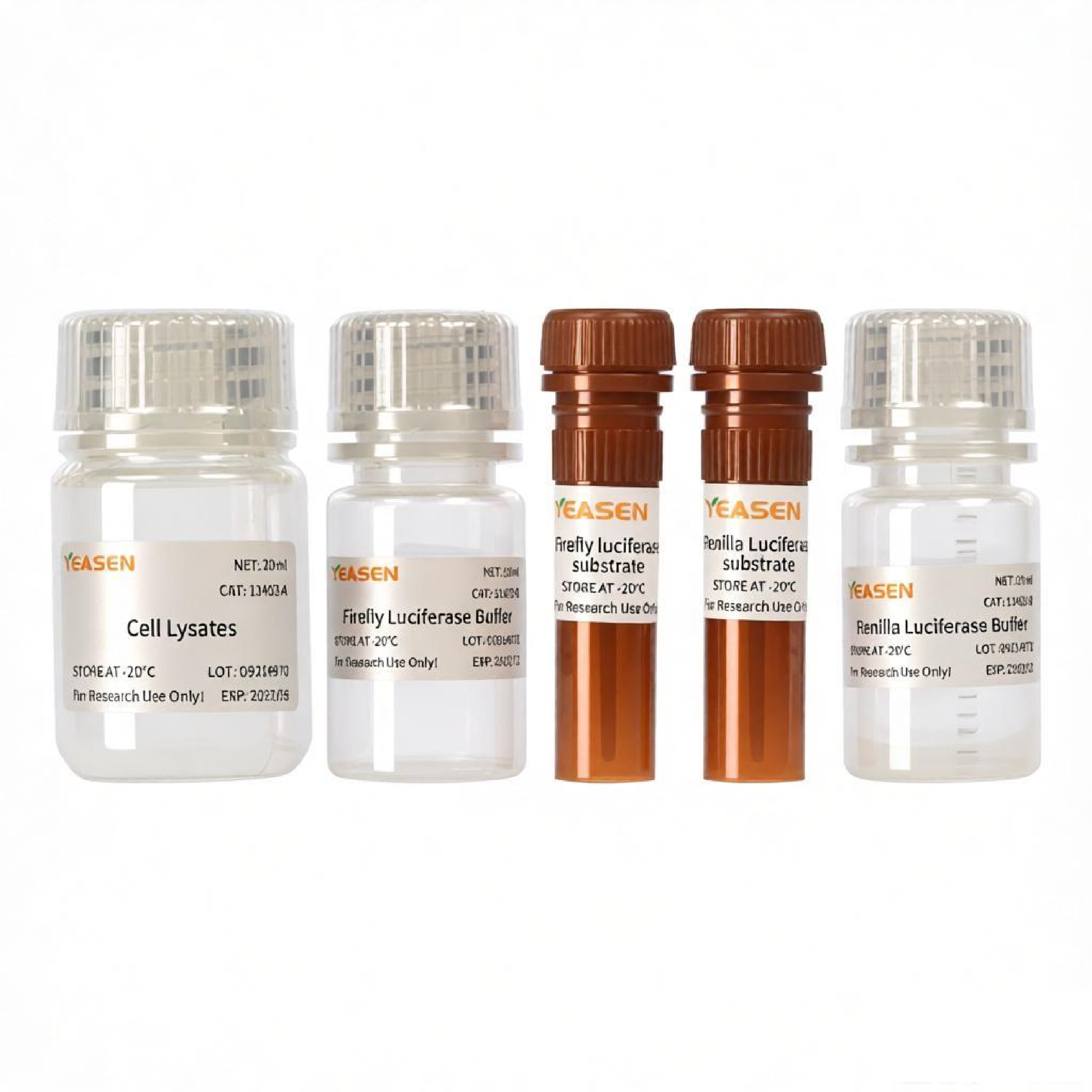
Dual Luciferase Reporter Gene Assay Kit _ 11402ES

YeasenSKU: 11402ES10

Size: 10 T
قیمت:
قیمت فروش$25.00

حمل و نقل محاسبه شده است در پرداخت

انبار:
در انبار

شرح

Firefly luciferase is a protein with a molecular weight of about 61 kDa, which can catalyze the oxidation of luciferin to oxyluciferin in the presence of ATP, magnesium ions and oxygen. It emits bioluminescence with a wavelength of around 560 nm. Renilla luciferase is a protein with a molecular weight of about 36 kDa, which can catalyze the oxidation of coelenterazine to coelenteramide in the presence of oxygen, and emits a wavelength of 480 nm during the oxidation process. about bioluminescence. Both bioluminescence can be measured by chemiluminescence. The detection principle is shown in the figure 1:


 Figure 1. Firefly and Renilla luciferase assay schematic

Usually, the 5´UTR or promoter of the target gene is cloned upstream of Firefly Luciferase, or the 3´UTR is cloned downstream of Firefly Luciferase, and the transcriptional regulation effect of the promoter or regulatory element is detected by detecting the amount of firefly luciferase. Renilla Luciferase was used as an internal control to eliminate differences in cell number, transfection efficiency, etc. The Dual Luciferase Reporter Gene Assay Kit uses luciferin as a substrate to detect the activity of the firefly luciferase reporter gene, and then uses coelenterazine as a substrate to detect Renilla luciferin while quenching the fluorescence reaction. Enzyme reporter gene activity. The kit has the characteristics of high sensitivity.

Features

Enhanced Lysis Capability: Capable of completely lysing the vast majority of cell types.

Stronger Signal: Precise detection of weak promoter expression.

Higher Sensitivity: Detectable down to 10-20 picomoles of luciferase molecules.

Broader Linear Range: Linear detection range exceeds 8 orders of magnitude of enzyme concentration.

Applications

 Verification of miRNA interactions with target gene 3'UTRs

Verification of lncRNA-miRNA interactions

Verification of transcription factor regulation in the promoter region

Signaling pathway analysis

SNP activity analysis

Specifications

Form

liquid

Luciferase

Firefly and Renilla

Signal Half-life

30 min

Number of Product Components

5

Workflow

Two Step

Components

Components No.

Name

11402ES60

11402ES80

11402-A

Cell Lysates

20 mL

10×20 mL

11402-B

Firefly Luciferase Buffer

10 mL

10×10 mL

11402-C

Firefly luciferase substrate (50 ×)

200 μL

10×200 μL

11402-D

Renilla Luciferase Buffer

10 mL

10×10 mL

11402-E

Renilla Luciferase substrate (50 ×)

200 μL

10×200 μL

Shipping and Storage

The Dual Luciferase Reporter Gene Assay Kit products should be stored at -15℃ ~ -25℃ for 1 year.

Figures

1. Product Performance Is Consistent with Imported Products

Figure 1 shows the comparison of Firefly luciferase luminescence intensity, quenching efficiency, and Renilla luciferase luminescence intensity. 
Yeasen 11402 Dual-Luciferase Reporter Assay product performs comparably to Brand P in terms of luminescence intensity. Meanwhile, Yeasen 11402 is also on par with Brand P in Firefly luciferase quenching efficiency. Additionally, the residual fluorescence of Yeasen 11402 is extremely low and negligible, ensuring no cross-interference with subsequent Renilla luciferase signal generation, thereby guaranteeing the accuracy and reliability of experimental results.

2. Superior Signal Stability

Figure 2 shows the kinetic testing results for the Firefly luciferase luminescence signal stability of Yeasen 11402 Dual-Luciferase Reporter Assay product. Tracking the Firefly luciferase luminescence signal continuously for up to 30 minutes from the start of the reaction revealed almost no signal decay in Yeasen 11402. This exceptional signal stability far exceeds the time required for standard microplate reader operations, fully meeting practical detection requirements.

3. Five Freeze-Thaw Cycles Have Minimal Impact on Signal

Figure 3 displays the luminescence signals of Firefly luciferase and Renilla luciferase after subjecting the Yeasen 11402 Dual-Luciferase Reporter Assay product to 5 freeze-thaw cycles. Results indicate that signal intensity remains virtually unaffected with extremely high stability. This feature enhances its practicality in laboratory settings to better satisfy daily operational needs.

FAQ

Q: Can cell lysates obtained with 11402ES be stored at -80°C?

A: Yes, they can be stored at -80°C, similar to standard protein storage protocols. Lysed samples can be stored at -80°C for up to 6 months and at -20°C for up to 1 month.

Q: Do the two substrates in the 11402ES Dual-Luciferase Reporter Assay Kit need to be protected from light?

A: Strict light protection is not required during operation. However, store them protected from light. Low temperature is a more critical storage condition—especially for coelenterazine (the Renilla substrate), which is recommended to be stored at -80°C.

Q: How should the vector ratio be optimized and adjusted during co-transfection for the 11402ES Dual-Luciferase Reporter Assay?

A: The ratio should be adjusted according to specific experimental conditions. Pilot experiments are recommended—for instance, testing Renilla vector to Firefly vector ratios at 1:10, 1:20, 1:50, and 1:100.

Q: Are Renilla and Firefly luciferases detected in the same well with 11402ES? Will Firefly luminescence interfere with Renilla luminescence? Can they be measured separately?

A: They are assayed in the same well. There is no mutual interference because the Renilla luciferase substrate reagent contains a compound that quenches Firefly luminescence. While separate assays are possible, sequential measurement in a single well is standard.

Q: Why is the background signal for Renilla significantly higher when using a Promega microplate reader with 11402ES?

A: Different microplate readers vary in sensitivity and parameter settings, which can lead to differences in background signal readings for the same sample.

Q: What type of plate should be used with the microplate reader when detecting Firefly luciferase using 11402ES?

A: Opaque white microplates.

Q: What should I do if I run out of 11402ES cell lysis buffer?

A: Add 0.3 mL of Triton X-100 to 10 mL of PBS to prepare a 3% Triton X-100 solution.

Q: How should I handle high background issues when determining protein concentration via the BCA method after cell lysis with 11402ES lysis buffer?

A: Dilute the cell lysate sample 5-fold prior to testing.

Q: Why does the 11402 kit require cell lysis, whereas the standalone substrate (Cat# 40901) does not?

A: 1. Luciferase is expressed intracellularly and is a enzyme non-native to humans (yielding extremely low background). It cannot cross cell membranes. In contrast, luciferase substrates are hydrophobic, cyclic small molecules that penetrate cell membranes easily. Thus, any luciferase expression is exogenous, and adding substrate directly to culture media or injecting it in vivo yields detectable signals.

2. In vitro reporter assays require cell lysis to homogenize samples, overcoming transfection heterogeneity, uneven substrate permeability, and signal variation. In vitro reporter assays are highly quantitative and sensitive, requiring ATP and oxygen. Cell lysis fully releases expressed luciferase to optimize the reaction; since intracellular oxygen is limited, omitting lysis leads to signal reduction (some lysis buffers include optimized additives like ATP to boost signal). Therefore, cell lysis ensures superior signal in in vitro assays.

3. In vivo imaging instruments possess high sensitivity and power capable of penetrating skin and tissue, enabling strong signal detection without cell lysis.

Q: Can the assay order be reversed when Renilla luciferase serves as the primary reporter gene in 11402ES?

A: No, the order cannot be adjusted. In this kit, Component B (Firefly Luciferase Buffer) is essential for detecting both Firefly and Renilla luciferases. The optimal reaction environment for Renilla luciferase requires the presence of Component B; otherwise, Renilla luciferase readings will be extremely low.                                                       

Documents:

Safety Data Sheet

11402 MSDS HB251125

Manuals

11402 Manual Ver.EN20260114

Citations & References: 

[1] Wang H, Yang J, Cai Y, Zhao Y. Macrophages suppress cardiac reprogramming of fibroblasts in vivo via IFN-mediated intercellular self-stimulating circuit [published correction appears in Protein Cell. 2024 Dec 2;15(12):938. doi: 10.1093/procel/pwae038]. (IF=21.1)

[2] Zhao L, Zhu Y, Tao H, et al. Ailanthone ameliorates pulmonary fibrosis by suppressing JUN-dependent MEOX1 activation. Acta Pharm Sin B. 2024;14(8):3543-3560. doi:10.1016/j.apsb.2024.04.013(IF=14.5)

[3] Wu X, Chen S, Zhang Z, et al. A viral small interfering RNA-host plant mRNA pathway modulates virus-induced drought tolerance by enhancing autophagy. Plant Cell. 2024;36(9):3219-3236. doi:10.1093/plcell/koae158(IF=12.6)

[4] Xuan H, Li Y, Liu Y, et al. The H1/H5 domain contributes to OsTRBF2 phase separation and gene repression during rice development. Plant Cell. 2024;36(9):3787-3808. doi:10.1093/plcell/koae199(IF=12)

[5] Han Y, Hu Q, Gong N, et al. Natural variation in MORE GRAINS 1 regulates grain number and grain weight in rice. J Integr Plant Biol. 2024;66(7):1440-1458. doi:10.1111/jipb.13674(IF=11.4)

[6] Pan M, Luo M, Liu L, et al. EGR1 suppresses HCC growth and aerobic glycolysis by transcriptionally downregulating PFKL. J Exp Clin Cancer Res. 2024;43(1):35. Published 2024 Jan 29. doi:10.1186/s13046-024-02957-5(IF=11.3)

[7] Hao X, Wang S, Fu Y, et al. The WRKY46-MYC2 module plays a critical role in E-2-hexenal-induced anti-herbivore responses by promoting flavonoid accumulation. Plant Commun. 2024;5(2):100734. doi:10.1016/j.xplc.2023.100734(IF=10.5)

[8] Wu J, Li P, Li M, et al. Heat stress impairs floral meristem termination and fruit development by affecting the BR-SlCRCa cascade in tomato. Plant Commun. 2024;5(4):100790. doi:10.1016/j.xplc.2023.100790(IF=10.5)

[9] Chen L, Xia S, Wang F, et al. m6A methylation-induced NR1D1 ablation disrupts the HSC circadian clock and promotes hepatic fibrosis. Pharmacol Res. 2023;189:106704. doi:10.1016/j.phrs.2023.106704(IF=10.33)

[10] Niu MX, Feng CH, He F, et al. The miR6445-NAC029 module regulates drought tolerance by regulating the expression of glutathione S-transferase U23 and reactive oxygen species scavenging in Populus. New Phytol. 2024;242(5):2043-2058. doi:10.1111/nph.19703(IF=9.4)

[11]Huang T, You Q, Huang D, et al. A positive feedback between PDIA3P1 and OCT4 promotes the cancer stem cell properties of esophageal squamous cell carcinoma. Cell Commun Signal. 2024;22(1):60. Published 2024 Jan 22. doi:10.1186/s12964-024-01475-3(IF=8.4)

[12]Wang S, Liu Y, Hao X, Chen Y, Wang Z, Shen Y. Enhancing plant defensins in a desert shrub: Exploring a regulatory pathway of AnWRKY29. Int J Biol Macromol. 2024;270(Pt 1):132259. doi:10.1016/j.ijbiomac.2024.132259(IF=8.2)

Payment & Security

American Express Apple Pay Diners Club Discover Google Pay Mastercard Visa

اطلاعات پرداخت شما با اطمینان پردازش می شود. ما جزئیات کارت اعتباری را ذخیره نمی کنیم و به اطلاعات کارت اعتباری شما دسترسی نداریم.

You may also like

Inquiry

FAQ

The product is for research purposes only and is not intended for therapeutic or diagnostic use in humans or animals. Products and content are protected by patents, trademarks, and copyrights owned by Yeasen Biotechnology. Trademark symbols indicate the country of origin, not necessarily registration in all regions.

Certain applications may require additional third-party intellectual property rights.

Yeasen is dedicated to ethical science, believing our research should address critical questions while ensuring safety and ethical standards.