



Frequently Bought Together
MycAway™ Mycoplasma Real-time qPCR Detection Kit (2G) is a product which can qualitative detect the mycoplasma contamination in the raw materials, cell bank, virus seeds, virual or cell harvesting solution and cells used in clinical treatment, etc. The kit uses the Taqman fluorescent probe (which included FAM and CY5) and the Multiple polymerase chain reaction (PCR) tools to detect the target and internal control separately. It covered over 183 species of the Mollicutes DNA, the specificity, detection limit and robustness of this kit are validated according to EP2.6.7 which with high sensitivity, specificity, efficiency and safety. The detection limit is equals to and below 10 CFU/mL.
This product can be used in combination with Magnetic Residual DNA Sample Preparation Kit (Cat#18461ES/18469) which using the manual extracted method for the nucleic acid extraction. (Please note, the kits which included Cat#18461ES and Cat#40619ES are full validated, please contact our technical support for detailed validation information). After the samples are pre-treated to remove the interference impurities and obtain purified nucleic acid, then a qPCR reaction perform by the Real Time PCR amplifier and the fluorescence signal of the probe will be collected and analyzed.
Features
Broad Detection Range: Optimized TaqMan probes detect up to 183 mycoplasma species.
Fast & Convenient: Sample prep and testing completed in under 3 hours, versus 28 days for culture(Alternative to the standard 28-day culture test).
High Sensitivity: Detects as low as 10 CFU/mL, making it a reliable alternative to culture methods.
High Specificity: 16S rRNA-based primers and probes avoid cross-reactivity with related species such as Clostridium and Sesamum.
Safe to Use: Non-infectious positive control eliminates contamination risk.
Strong Anti-Interference: Internal control (IC) detects sample inhibition or reaction errors, reducing false negatives.
Regulatory Compliance: Validated according to the requirements of EP2.6.7, JP G3 and USP 63 pharmacopoeia, in line with the standards of international authorities
Specifications
|
Sample Type |
media, cells, raw materials; Biopharmaceutical Purification Sample, Bulk Drug Substance Sample, Cell Cultures. |
|
Detect method |
qPCR method(Taqman fluorescent) |
|
Detect Time |
<4 hours |
|
Fluorescent probe |
FAM(Target channel);VIC(Internal channel) |
|
Pretreatment kit |
Compatible with magnetic bead-based sample pretreatment kits(Cat#18461/18469) |
|
Applicable Models |
Thermo: ABI7500, ABI QuantStudio™ 5; Roche: LC 480; Bio-Rad:CFX96 Optic Module |
|
Detection Limit(LOD) |
10 CFU/mL |
|
Covered mycoplasma |
183 mycoplasma species |
|
Validation |
Validated according to EP <2.6.7> |
Components
|
Components No. |
Name |
40619ES25 |
40619ES60 |
|
40619-A |
2×MyqPCR Reaction Buffer |
375 μL |
1.5 mL |
|
40619-B |
MyPrimer & Probe Mix |
100 μL |
400 μL |
|
40619-C* |
Internal Control (IC) |
25 μL |
100 μL |
|
40619-D** |
Positive Control (PCS) |
250 μL |
1 mL |
|
40619-E*** |
DNA Dilution buffer |
500 μL |
2×1 mL |
|
40619-F**** |
Ultrapure water |
500 μL |
2×1 mL |
[Note]: *IC: Internal control.
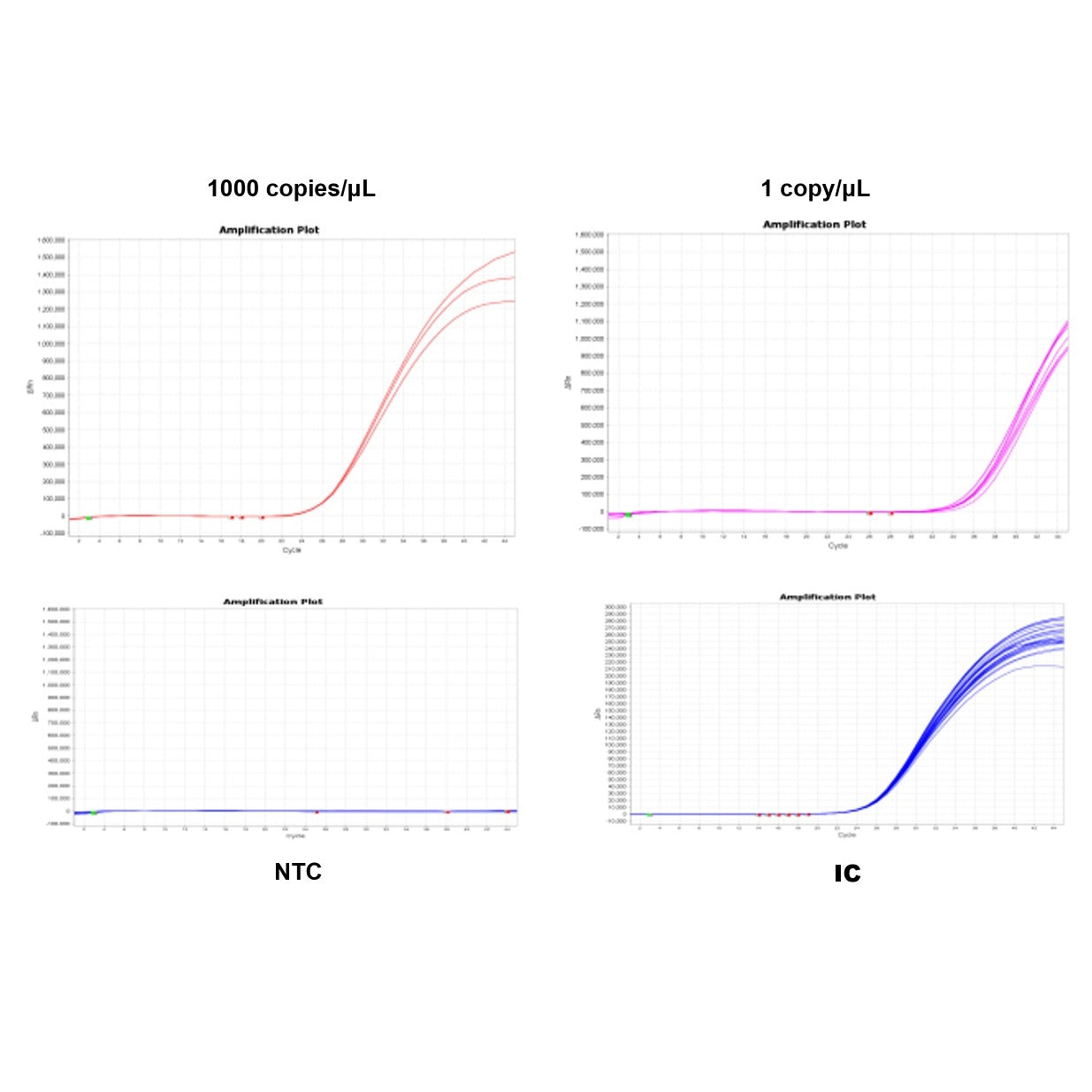
**PCS: Positive control solution,the concentration is 1,000 copies/µL.
***DNA Dilution buffer: used for IC dilution and the template of NTC and NCS.
****Ultrapure water: used for the preparation of qPCR Mix.
Application
Mycoplasma Detection;
Mycoplasma Detection for BioProduction process media, cells, raw materials.
Figures
1. Workflow

Figure 1. Workflow of mycoplasma detection using the Mycoplasma Real-time Quantitative PCR Detection Kit
2. Specificity

Figure 2. Specificity validation
Table 1. Results for 20 strains and engineered cell lines
|
No. |
Sample |
Result |
No. |
Sample |
Result |
|
1 |
Staphylococcus epidermidis |
Negative |
11 |
Candida albicans |
Negative |
|
2 |
Clostridium perfringens |
Negative |
12 |
Salmonella enterica subsp. enterica |
Negative |
|
3 |
Clostridium acetobutylicum |
Negative |
13 |
Bacillus subtilis |
Negative |
|
4 |
Acinetobacter baumannii |
Negative |
14 |
Bacillus cereus |
Negative |
|
5 |
Lactobacillus acidophilus |
Negative |
15 |
HEK293 DNA |
Negative |
|
6 |
Enterobacter aerogenes |
Negative |
16 |
Vero DNA |
Negative |
|
7 |
Micrococcus luteus |
Negative |
17 |
CHO DNA |
Negative |
|
8 |
Streptococcus mutans |
Negative |
18 |
E. coli DNA |
Negative |
|
9 |
Pseudomonas aeruginosa |
Negative |
19 |
293T DNA |
Negative |
|
10 |
Streptococcus pneumoniae |
Negative |
20 |
SF9 DNA |
Negative |
(A). Nine common sample matrices and the kit’s DNA dilution buffer showed no mycoplasma detection in the target channel (FAM, blue). Normal FAM signal was observed only when Mycoplasma fermentans was added to a sample matrix.
(B). DNA from 14 non-Mycoplasmatales strains and 6 commonly used biopharmaceutical cell lines showed no target channel amplification. In all cases, the internal control channel (Cy5, green) amplified normally.
3. Limit of Detection (LOD): >95% detection rate.

Figure 3. Limit of detection (LOD) test.
Table 2. Example detection results for Mycoplasma arginini
|
Sample |
FAM Ct |
CY5 Ct |
Interpretation |
|
Mycoplasma arginini 10 CFU/mL |
33.36 |
26.96 |
Positive |
|
33.28 |
26.96 |
Positive |
|
|
33.60 |
26.95 |
Positive |
|
|
33.57 |
27.00 |
Positive |
|
|
33.81 |
27.26 |
Positive |
|
|
33.48 |
27.12 |
Positive |
|
|
33.77 |
27.02 |
Positive |
|
|
32.20 |
26.88 |
Positive |
|
|
NCS |
/ |
27.22 |
valid |
|
NCS |
/ |
27.32 |
valid |
|
NTC |
/ |
27.26 |
valid |
|
NTC |
/ |
26.92 |
valid |
Ten mycoplasma standard strains (10 CFU/mL), sourced from German MB, were tested following kit instructions for nucleic acid extraction(Cat#18461) and detection kit(Cat#40619). Mycoplasma samples were tested three times with 8 replicates each. Each run included NCS (negative control solution) and NTC (no template control).
When controls passed, at least 23 out of 24 replicates tested positive for each strain.
4. Performance Validation Summary
Table 3. Performance Validation Content and Conclusion of the Mycoplasma qPCR Detection Kit
|
Performance |
Validation parameter |
Kit validation result |
|
Limit of detection |
LOD for mycoplasma strains |
10 pharmacopoeia-required mycoplasma strains at 10 CFU/mL, each tested 24 times; detection rate ≥ 95% |
|
Specificity |
Sample matrix interference |
9 sample matrices and DNA dilution buffer tested — no mycoplasma detected |
|
Specificity |
Cross-reactivity |
14 strains and 6 commonly used biopharmaceutical engineered cell lines tested — no mycoplasma detected |
|
Robustness |
Freeze-thaw stability |
Withstands 20 repeated freeze-thaw cycles without affecting kit performance |
|
Robustness |
Heat-accelerated stability |
14 days at 37°C and 30 days at 4°C without affecting kit performance |
|
Robustness |
Instrument compatibility |
Compatible with ABI 7500, ABI QuantStudio™ 5, Bio-Rad CFX96, Roche LightCycler 480 |
|
Coverage |
Mycoplasma DNA coverage |
Database comparison based on mycoplasma 16S rRNA sequences; covers 183 species of the class Mollicutes |
Storage
FAQ
Citations
Documents
| Brochure |
|---|
| Biopharmaceutical_Safety_Quality_Testing_Solutions.pdf |
| Validation Report |
|---|
| 40619ES-Validation_Report-Ver.EN20250812.pdf |

You may also like
Inquiry
FAQ
The product is for research purposes only and is not intended for therapeutic or diagnostic use in humans or animals. Products and content are protected by patents, trademarks, and copyrights owned by Yeasen Biotechnology. Trademark symbols indicate the country of origin, not necessarily registration in all regions.
Certain applications may require additional third-party intellectual property rights.
Yeasen is dedicated to ethical science, believing our research should address critical questions while ensuring safety and ethical standards.